Can a good walk be spoiled by a terrible journey to it?
The Falls of Clyde should be a good walk. It ticks all the boxes of things I like. Its is very scenic, it has unique sights (the village) and there are options to make it a short or long route BUT I hated driving to it.
I hated it because the roads were awful, I got lost and I spent twice as much time in my car than my Sat nav claimed it would take.
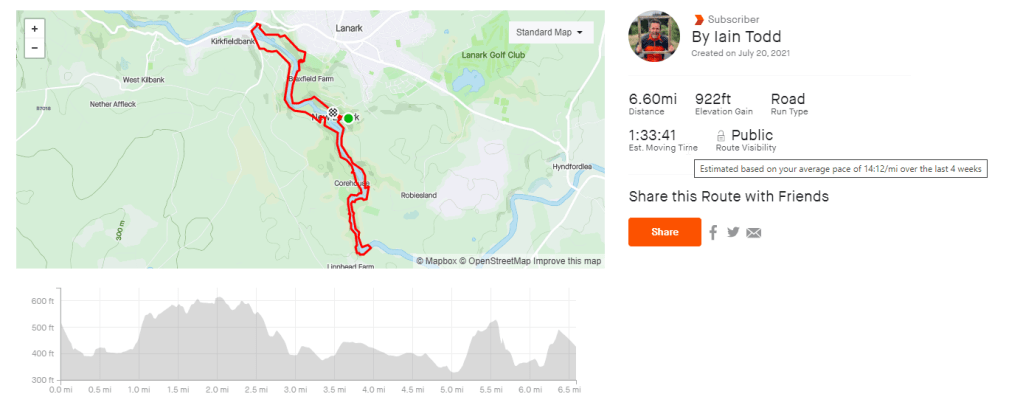
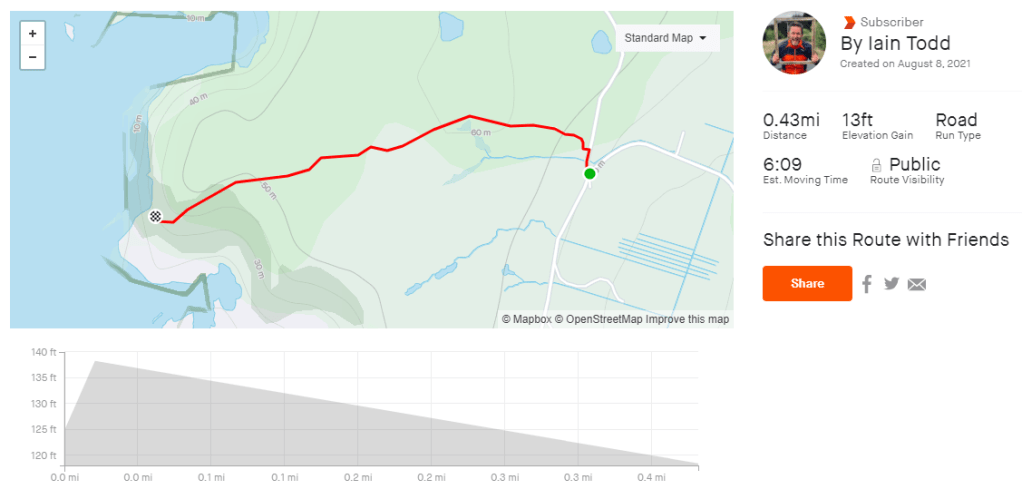
By the time I started the walk I was in a foul mood so I did a short route out and back route rather than a full loop. Check out the maps below to see the options.
I enjoyed the walk. It was long enough for me. The route is very well signposted so I won’t bother putting directions here. Just follow the signs to the falls.
Every fortnight we cover the best and worst football songs from every club in the UK from our book ‘The Sound Of Football: Every Club, Every Song’. You can buy it here
Accrington Stanley
Nickname: Stanley
Ground: Crown Ground (currently known as The Wham Stadium until 2021)
Stadium Capacity: 5,070
Song: On Stanley, On
Sir Walter Scott’s epic poem ‘Marmion’ describes one of Scotland’s heaviest military defeats, the battle of Flodden Field (1513). The English army routed the Scottish army after killing King James IV of Scotland.
Accrington Stanley’s song ‘On Stanley, On’ was inspired by a line in the poem.
“’Charge, Chester, charge! On, Stanley, on!’
Were the last words of Marmion.”
(Source: Marmion, Sir Walter Scott, public)
The “Stanley” referred to in the poem is Edward, the first Earl of Derby, and not the team. Instead, two journalists, Harry Crossley and Allan Lamber borrowed this line to write a song to inspire Accrington Stanley to victory against Torquay United after the club reached the third round of the FA Cup in 1953, the first time Stanley had got that far in almost 30 years.
The song’s lyrics were published in the Accrington Observer on 12 December 1953. A version of the song, recorded by the Accrington Male Voice Choir, was played over the loudspeaker before the game. The music helped inspire Stanley to a 2 – 2 draw, though the replay saw Flodden Field recreated, as Stanley was slaughtered 5 – 1.
‘On Stanley, On’ became a popular song for supporters in the 1950s and 1960s with new versions recorded, including one by the local band Red Dawn and the Stanley Choir. However, the club itself was not so popular. It collapsed in 1966, and its current incarnation was formed in 1968.
Stanley’s collapse and resurrection was, for many years, the most famous thing about the club. However, as it has steadily climbed the league, it has become more well-known. A fact that led to considerable angst for the band Accrington Stanley. As their lead singer, Dan O’Farrell, explained in 2013, they were counting on the club remaining obscure:
“We chose [our] name in early 1986… purely because I had this ace book called The History of Football, and there was a picture of a football crowd watching an Accrington Stanley match in the 1930s… Accrington Stanley was only ever mentioned as a sad story from going bust in the 60s. It had the ring of the underdog about it. Now, [their name is] a bit of a pain, as it renders us very hard to Google or find on YouTube.“
‘On Stanley On’s’ popularity has waned in recent decades. However, in May 2011, the Accrington Observer campaigned to resurrect it for a crunch play-off tie with Stevenage Borough. Reporters for the paper handed out song sheets to fans before the game. Sadly, the song couldn’t inspire the players to another famous result, Stanley lost its home game 2 – 0 and the return leg 1 – 0.
Before the game, Accrington Stanley chief executive Rob Heys told the Observer:
“I’ve heard the song a few times. There is a lot of history associated with it. I am sure some of the older supporters remember it fondly, and if people were to sing it again, that would be great.”
Another link between Stanley and Flodden Field made ‘On Stanley On’ a perfect line to borrow for a football song.
King James IV of Scotland was the last British King to die on a battlefield. After the battle, his body was taken to Sheen Priory in Richmond, Surrey, where it remained until the 16th century before it disappeared – though it’s believed it’s buried underneath the fairway of the Royal Mid-Surrey Golf Club.
While the body remains missing, at least until the golf club decides to check beneath the 14th green, there’s an easy way to identify King James once found – he has no head. This is because the King’s head became detached from his body before being transported to Sheen Priory. And, legend has it, the last time anyone saw the King’s head was when a group of Elizabethan workmen found it and decided they would use it to play a game… a game of football.
The route was a new improved Toddman route featuring an altered bike and swim course than the 2020 version.
Swim
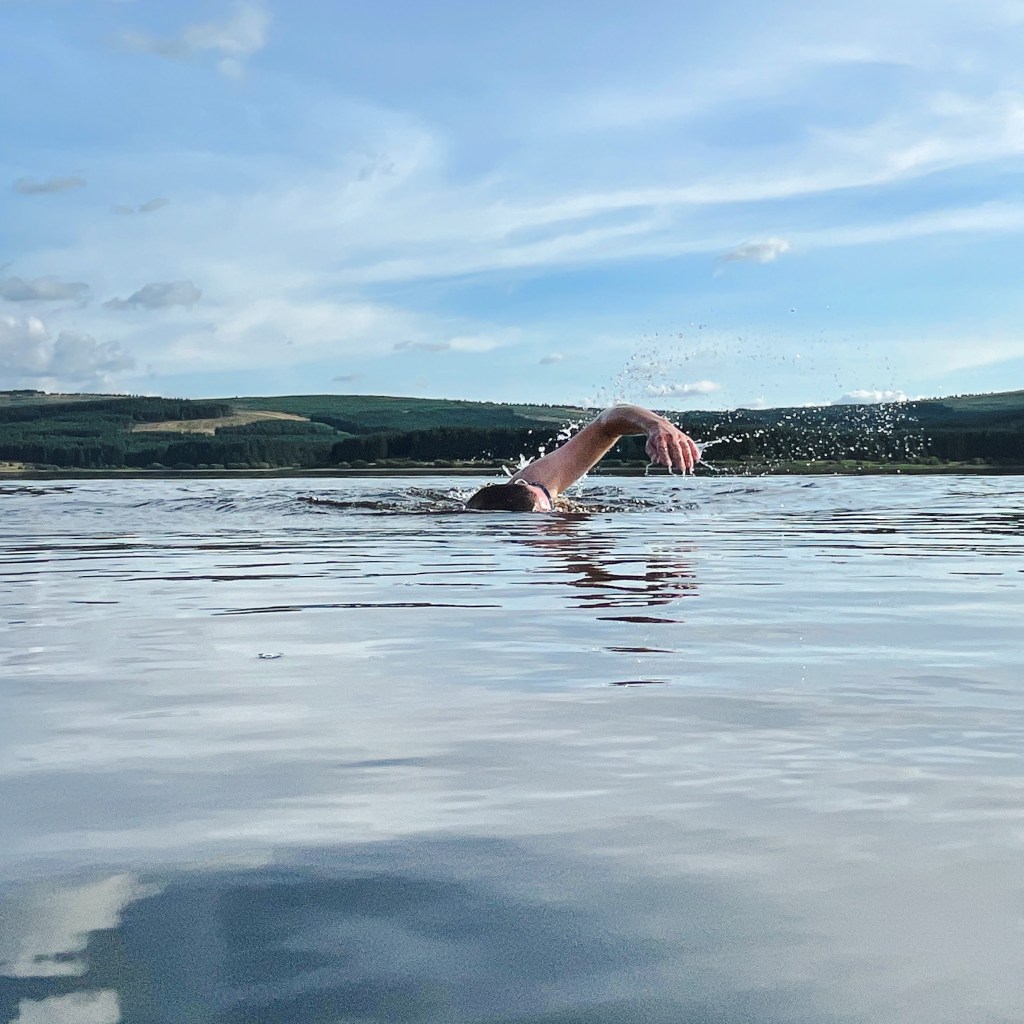
We started with a 1km swim in Carron Valley Reservoir. There is no set route so I did some 200m laps back and forth until I hit the race distance. Even though Andrew started five minutes before me, I still finished before him.
I think our GPS watches have very different ideas about how far 1Km is. I’ve noticed even if I swim, bike or run right next to him we will often have very different distances logged.
But in this instance I’m sure my watch was 100% accurate and therefore I declare myself the winner of the Swim leg. 1-0 to Iain.
Bike
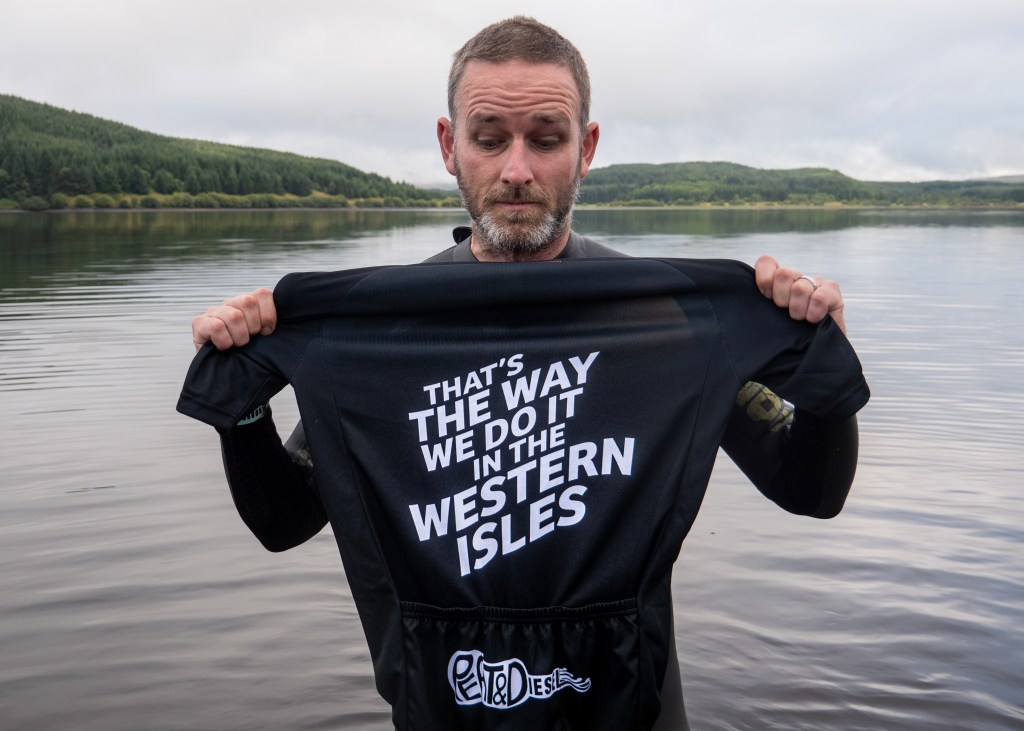
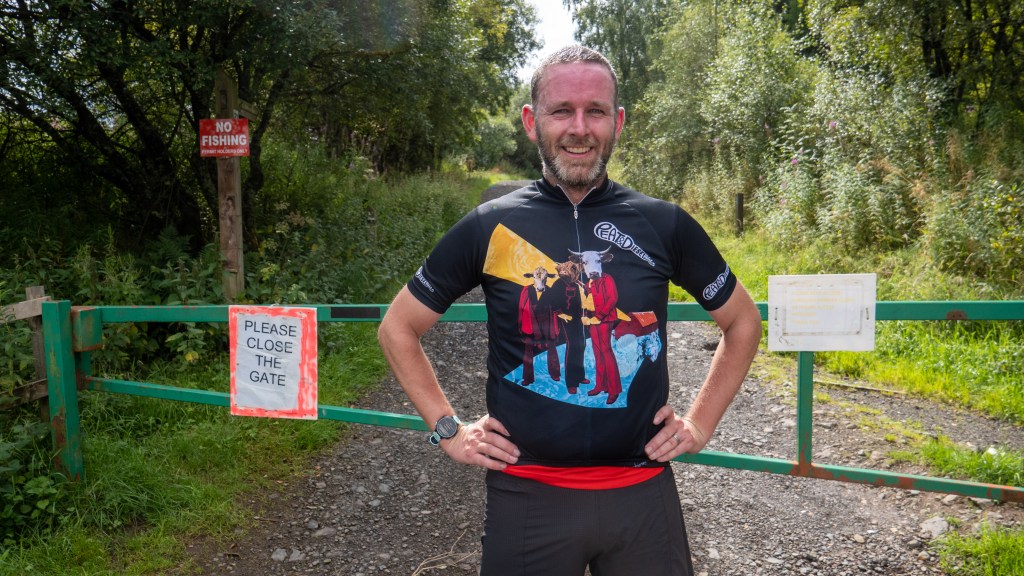
The new bike route comprises a climb of Crow Road and Tak Me Doon. Which we have renamed Todd Me Doon. The fastest to the top of both climbs would be declared Todd of the Mountains and he would be awarded the Polka Todd Jersey.
Andrew beat me to the top of both climbs.
BUT I let him win. I had a camera with me as I was filming the competition as we did it. Did Chris Froome have to film his own Tour De France wins? No! Someone did it for him. I lost all the time having to cycle slowly so that I could get Andrew in the shot. If I’d cycled at my normal pace he’d have been left behind and I wouldn’t have had any shots of him.
That’s my excuse and I’m sticking to it.
I think, even though he came first, I should be declared the winner. 2-0 to Iain.
Run
The last leg was an out and back run to the Summit of Meikle bin. I knew from the start of the run that I would win. Each time I pushed the pace a bit faster Andrew would struggle. I was feeling great so I was confident I’d outpace him at the end.
With 1KM to go. Andrew’s shoe lace came undoe. He claims he shouted at me “Hey, wait a sec, I need to tie my shoelace!”
All I heard him say was “Hey Champ, run on. You deserve the win. You truly are Toddman!”
Who knows who was correct? All I can say is “I am Toddman !”
Mangersta bothy was built into the side of the Mangersta cliffs, on the Isle of Lewis, almost 30 years ago by two locals, John and Lorna Norgrove.
John and Lorna are the parents of Linda Norgrove who was involved in a terrible accident in Afghanistan in 2010. She was killed by US soldiers. You can read the details about the case here https://en.wikipedia.org/wiki/Death_of_Linda_Norgrove
The bothy is in a very remote part of the Isle of Lewis but the walk out to it is relatively simple. Park at the end of Mangestera village and follow the fence westward. The both is tucked into the cliffs near the end of the fence line.
I would not recommend the walk to anyone with young children or anyone who is uncomfortable with heights. Their are allot of steep cliff drops in this area.
I would be scared to spend a night in the bothy in case I needed the loo during the night. I might head out, trip and then never be seen again!
“What does a day in the life of triathlon superstar Jonny Brownlee look like? Take a look at Jonny’s triathlon training, recovery, nutrition, relaxing at home and meet the dogs in this candid and unique view into his life in Yorkshire!”
What it should say is:
“Do you want to see how Jonny Brownlee hangs his wetsuit, does his washing and how he keeps his trainers in the back of his car? Take a look at Jonny’s non-glamorous triathlon training in this candid and unique view in his life in Yorkshire!”
A very good video to show what an average day looks like for a world champion who has to keep his kit in his car just like everyone else.
Just because you can do it, doesn’t mean you should do it. I can, if I want, pour myself a nice bath of baked beans and spend the day soaking in Heinz’s finest. It wouldn’t be against the law to marinade myself in toot juice. It might be unusual, but, provided I did it in my own home, then no one will ever know I did it. Yet… yet… just because I can do it doesn’t mean I will ever pop into the supermarket and buy enough beans to fill a tub.
Equally, I can walk or swim pretty much anywhere in Scotland. Right to roam laws grant everyone very wide rights to access hills and paths, lochs and rivers, regardless of who owns them.
There are exceptions. You can walk on a golf course, but you can’t walk on a green. But, in general, unless you’re trying to walk through someone’s garden then you can go where you like.
But just because you can do it, doesn’t mean you should do it. You may have a right to swim in a loch, but an angler too has a right to fish in it, a sailing club has a right to sail in it, and land owners do and should expect that people won’t damage their land or invade their privacy.
There is one farmer who owns a field near a loch north of Glasgow. He’s a nice man, I’ve spoken with him a couple of times but, the only reason I’ve spoken with him, is that he comes out in his tractor to watch parking spaces to make sure no one cuts through his field to get to the loch.
He shouldn’t have to ‘guard’ his field and protect his cattle who graze in it. He should expect that people will walk round and avoid the field.
So, this is less a review and more a plea for tolerance. You might be able to swim in a loch but that doesn’t mean you should. And the Brother Loch and Harelaw Dam have large and active angling clubs. There are plenty of lochs in Scotland, almost as many as beans in a full bathtub, so I don’t swim at either lochs. And I would suggest that you don’t either.
Every fortnight we cover the best and worst football songs from every club in the UK from our book ‘The Sound Of Football: Every Club, Every Song’. You can buy it here
Nickname: The Dons
Aberdeen
Ground: Pittodrie Stadium
Stadium Capacity: 21,421
Song: The Northern Lights of Aberdeen
In 1983, Bayern Munich had a team filled with legendary players: Breitner, Augenthaler, Hoeness, and Rummenigge. Names that were as well known then as BMW or Audi today.
Aberdeen had Mark McGhee. When he walked into a room, even his wife asked, “who are you, and why are you in my kitchen?”
When Aberdeen met Bayern Munich in the 1983 European Cup Winner’s Cup quarter-final, it should have been no contest; Bayern would win. But, after drawing the first leg in Munich 0 – 0, Pittodrie’s greatest night followed.
Bayern scored first, then Aberdeen equalised. Bayern scored again, but a well-practiced free-kick led to Alex McLeish drawing Aberdeen level. One minute later, striker John Hewitt added a third. Despite late pressure, Aberdeen held on and won the game 3 – 2.
As the referee blew the final whistle, Alex Ferguson leapt from the dugout to run onto the pitch. It was a legendary night for a legendary manager – and one followed a few months later when Aberdeen won the European Cup Winner’s Cup final 2 – 1 against Real Madrid. A victory soundtracked by the European Song – a record so popular that an initial run of 100,000 copies sold out, and more copies had to be issued to satisfy demand.
The European Song wasn’t the cup final’s only musical legacy. The final was one of the first matches where fans could be heard singing a chant that would dominate Eighties football:
“Here we, here we, here we f*****g go!“
(Source: public)
Despite his success, Sir Alex, as he would become known, is only the second most famous man to have worked at Aberdeen. We’d argue the most famous Aberdonian is former coach Donald Colman. Who, you may ask?
In the 1930s, Donald Colman had a successful career with Motherwell and Aberdeen, where he was appointed club captain and capped by Scotland three times. However, it was his post-playing career that saw him achieve football immortality
Colman loved feet, but not in a kinky way. When appointed as a coach, he persuaded the club to dig a hole at the side of the pitch. Colman would stand in it and have his head level with the player’s feet. Donald believed players needed to work constantly on their footwork, which he could see far better from his vantage point below pitch level.
When English club Everton visited Aberdeen a few years later, it saw Donald’s ‘dugout’ and created its own at Goodison. Soon every club followed until we have the airport lounge/dugout for today’s modern pampered footballer.
If standing up was Donald’s obsession, he would have been proud that fans have adopted a chant called Stand Free.
“Stand free wherever you may be, We are the famous Aberdeen, We don’t give a f**k whoever you may be, We are the famous Aberdeen.“
(Source: public)
The tune is from the Lord of the Dance and is shared with other clubs, including Hibernian (We Are Hibernian FC) and St Mirren (We’ll Go Wherever St Mirren Go). If you want a song just for Aberdeen, then you need to meet Mary Webb. But, again, you may ask, who?
Mrs. Webb was the co-songwriter behind Aberdeen’s anthem, The Northern Lights of Old Aberdeen, a song played by the club and by the city. Yet when Mrs. Webb died, nobody mentioned her passing. She was forgotten, even though her song had become the unofficial anthem of Aberdeen.
Mary and her husband William wrote the song in the 1950s to cheer up a homesick colleague. Mary worked in London and thought the song would help a friend, Winnie Forgie. It did, and it helped thousands more. Including, as Aberdeen’s Evening Express reported in March 2019, providing comfort to sailors fighting in the Falklands conflict. One letter from a sailor to Mary said:
“We are a Scottish ship, and on the evening, we were all clustered on the front end of the ship under the cold skies of San Carlos Water, waiting for the bomb to be defused, the Captain said ‘Sing!’ So we sang, and the first song that came to the lips of the most vocal member of the Ship’s company was your song, and of course everybody joined in, and it made us all feel better. “
This is the perfect song to remind us how important the sound of football is to fans. Of course, not every club wins a league or wins a cup. Not every club can be a success. But still, the fans sing, whether winning or losing, and all they can ask is for a song that makes them feel better.
Today, the Northern Lights of Aberdeen can be heard regularly at Pittodrie – along with a few other words that we have had hide with asterisks.







 Twin brothers swimming, cycling and running in Scotland