TwinBikeRun
Andrew and Iain Todd write about endurance sport, football and the everyday absurdity of life. Twin brothers, occasional triathletes, and authors of six books between them.

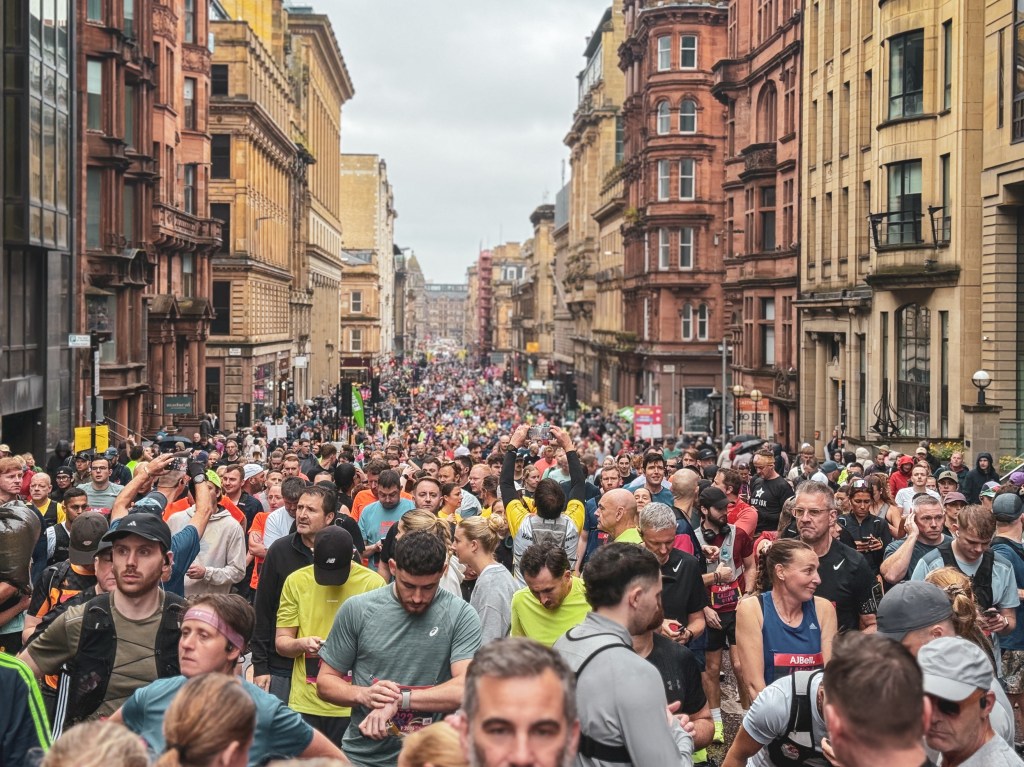
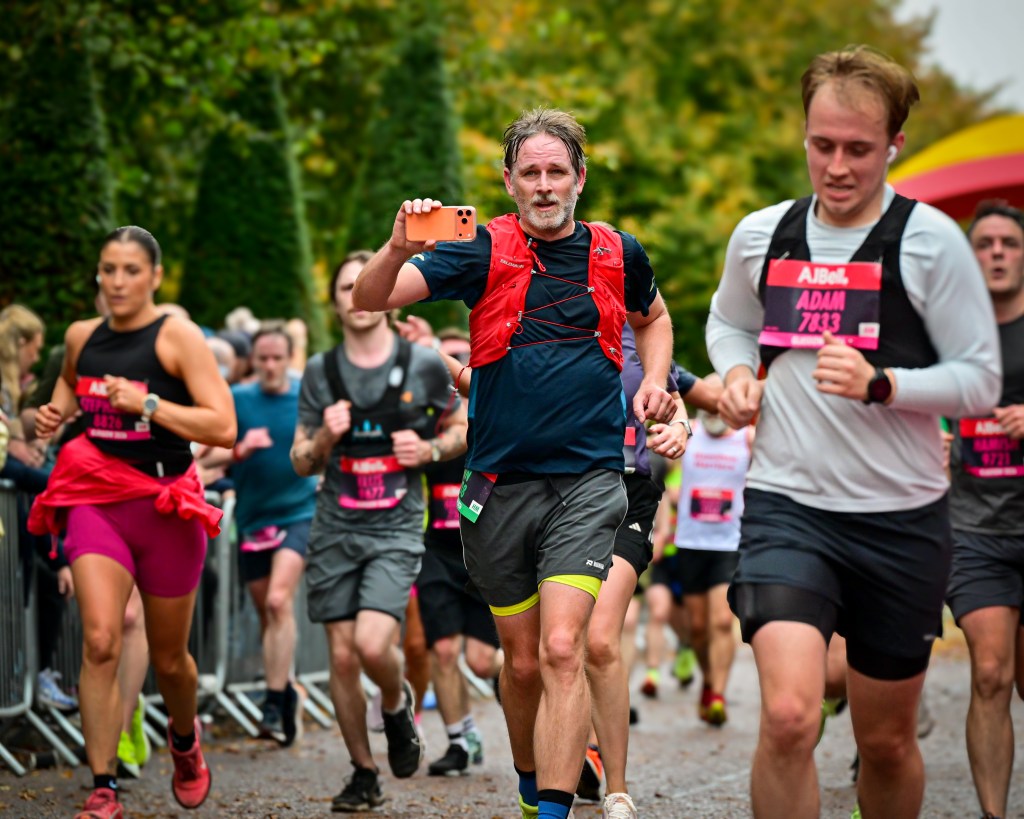
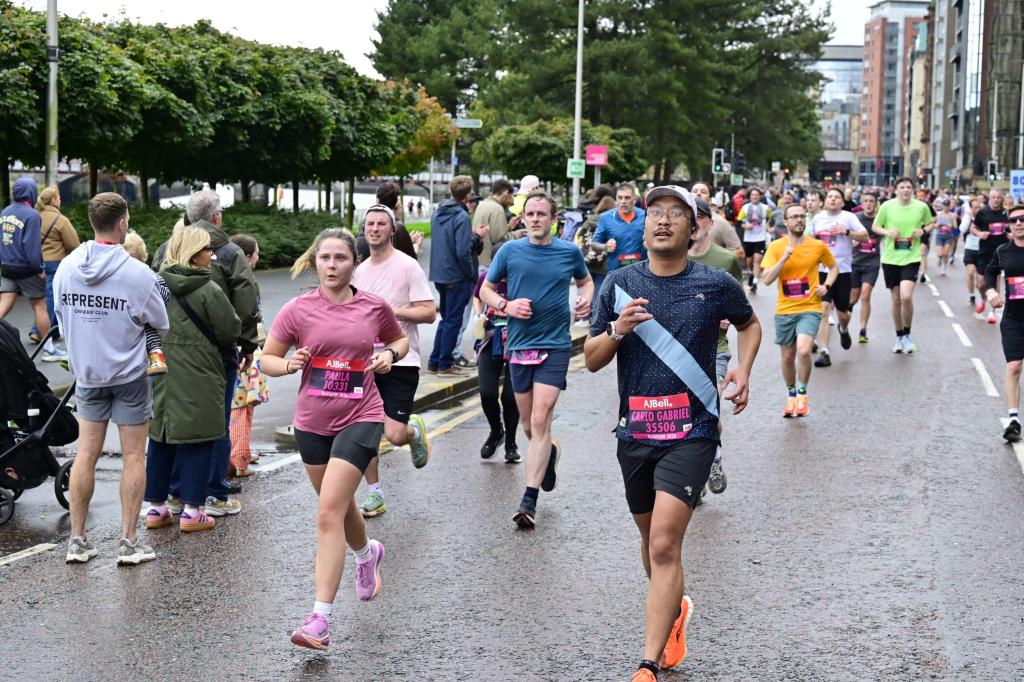
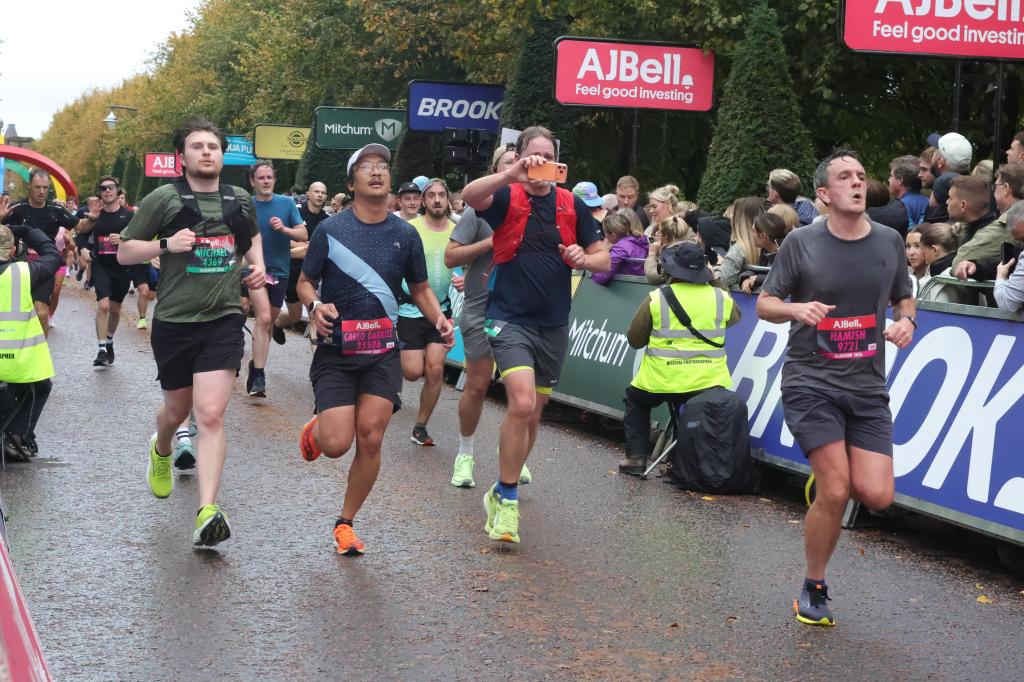
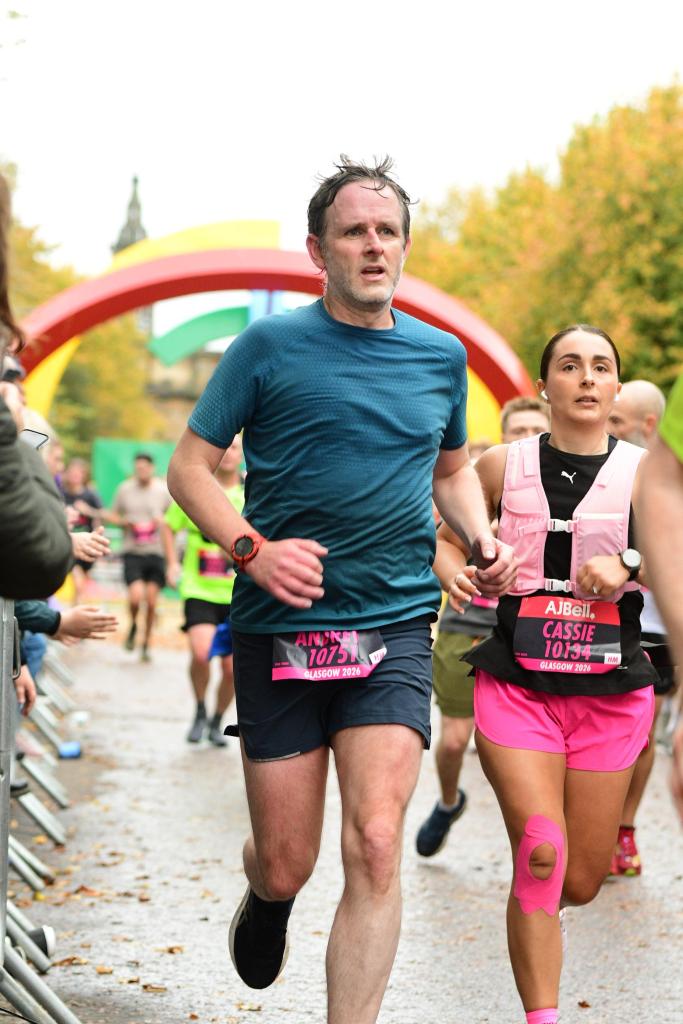
I think I first entered the Glasgow Half Marathon 25 years ago. I can’t find the exact details to make it certain but it was either 25 years ago or 24 years ago and 25 years ago seems to be about right as I’d started running and had entered my first race earlier that year. I think I went straight from a 10k in Motherwell to the start line of the Glasgow Half Marathon a few months later.
25 years ago the route was completely different. It linked three parks in the Southside of Glasgow: Bellahouston, Pollok and Richmond Park, before returning to Glasgow Green from the east. Today, the route only visits Pollok Park, the only bit of greenery on a course which favours industrial estates over parkland estates.
I’ve said it before – Glasgow 2024 – the route is not one you choose if you want to see the best of Glasgow. At least the 10K route goes to the Transport Museum.
This year, the route was less scenic than ever. The start line was moved from George Square and started further up West Regent Street. While this avoided a few hundred metres of climbing from the square, it also avoided all the Victorian buildings that towered over the initial mile. Instead the extra distance was made up of a there and back dog leg near too, but not in, Bellahouston Park. One day, the Glasgow Half will just be 13 miles around Polmadie Tip, from the cardboard compactor to the old mattress drop.
Sadly too, there was only one person in fancy dress. Maybe I was just unlucky with timing, but I only saw one Pink Panther, and no other costumes. However I did see a man with long hair, pulled back into a ponytail, running in a band t-shirt. “Listen to my band”, it said, with a QR code. The band was ‘Lost in Lilacs’ and, after I checked out their Spotify to make sure I wasn’t promoting a Neo-Nazi band AKA a Kanye West cover band, here’s a link to their song ‘Radiobed’.
Which is worth a listen, even if just for the title alone.
As we ran round, there were some good signs from supporters. I loved: “This isn’t Hyrox, don’t **** yourself” and the couple who held up a sign for “The OJ Fan Club”. I assume they were supporting an Oscar Johnson and not the other more famous OK. I didn’t see an “Epstein Fan Club” signs, but maybe Frank Epstein wasn’t running…
I ran with Iain TwinBikeRun and we kept a steady pace throughout. I was happy with our time though he claimed he could have run faster.
There are many quirks of nature that seem magical. For example, the moon is exactly the size of the sun so that a total solar eclipse occurs with the moon completely blocking the sun despite them being millions of mils apart. Proportionally, when seen from the earth, they are the same size.
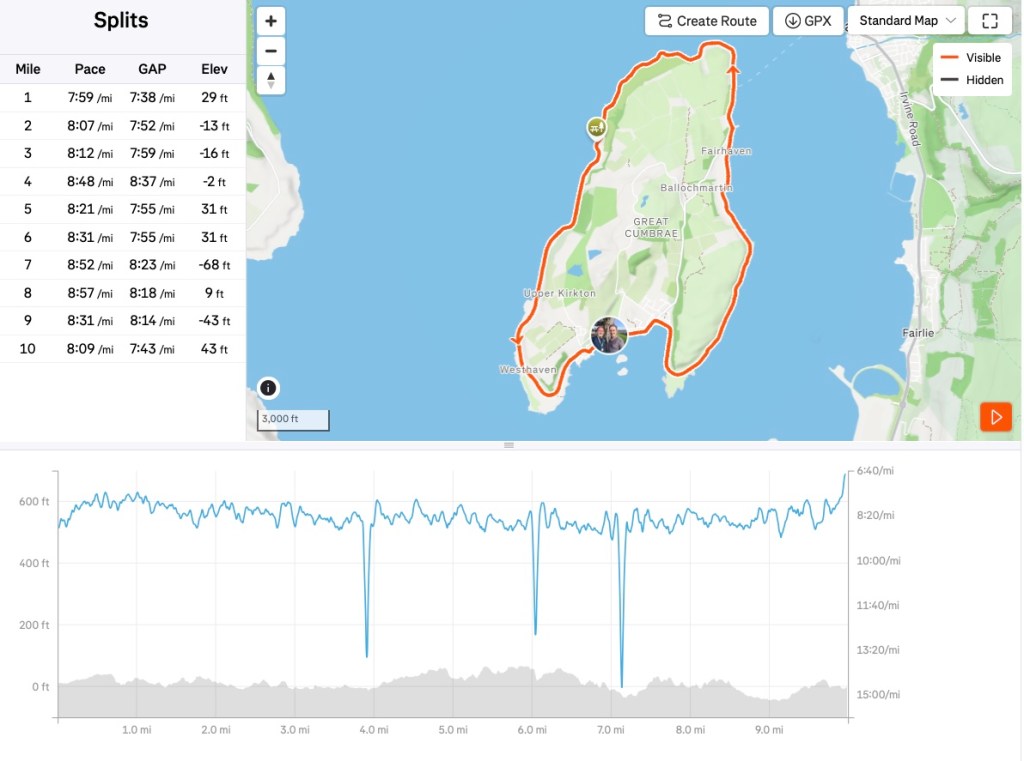
And the Isle of Cumbrae is exactly 10 miles long. It’s not 9.9 (despite my watch showing that, I just made a mistake with pressing start at the start line), it’s not 10.2 miles. It’s exactly 10 miles. That’s pretty magical – and perfect for a round the island round race. The only thing that would make it better is if it was 13.2 miles long and exactly the length of a half marathon. Has anyone ever measured the Isle of Mull?
The race starts at 2pm to allow time to get to it from Glasgow. To get there, you need to catch a ferry from Largs (every 20 minutes) and a bus from the pier on Cumbrae (whenever the bus arrives as the timetable didn’t seem to mean anything).
The only annoying thing about a 2pm start is working out when to eat in advance. I had breakfast and then a small snack at 10:30. And then, after the race, a fifteen course banquet because I was starving. But, for the race itself, I felt fine and just had a coupe of energy gels with me, just in case.
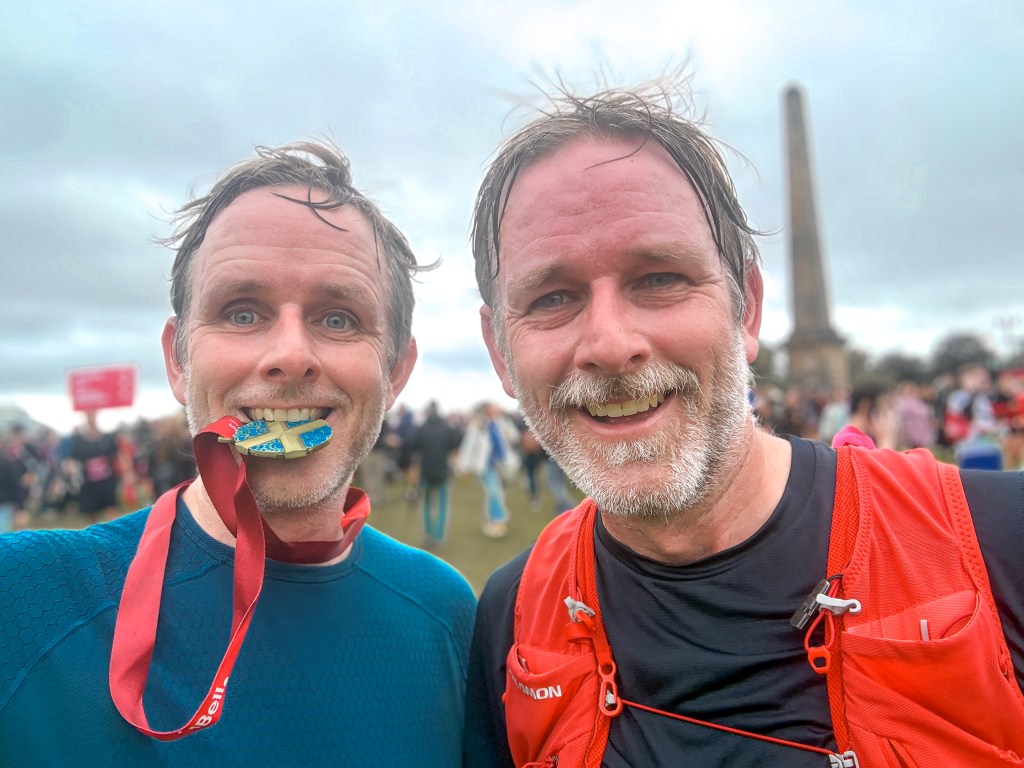
The race starts in Millport and proceeds anti-clockwise around the island. At the start, a man in a traffic cone costume limbered up. Within a minute of the race starting he was already ahead of us. By the end, he finished well before us. Iain asked for a photo. I wanted to ask if he was going to sit on a statute next.
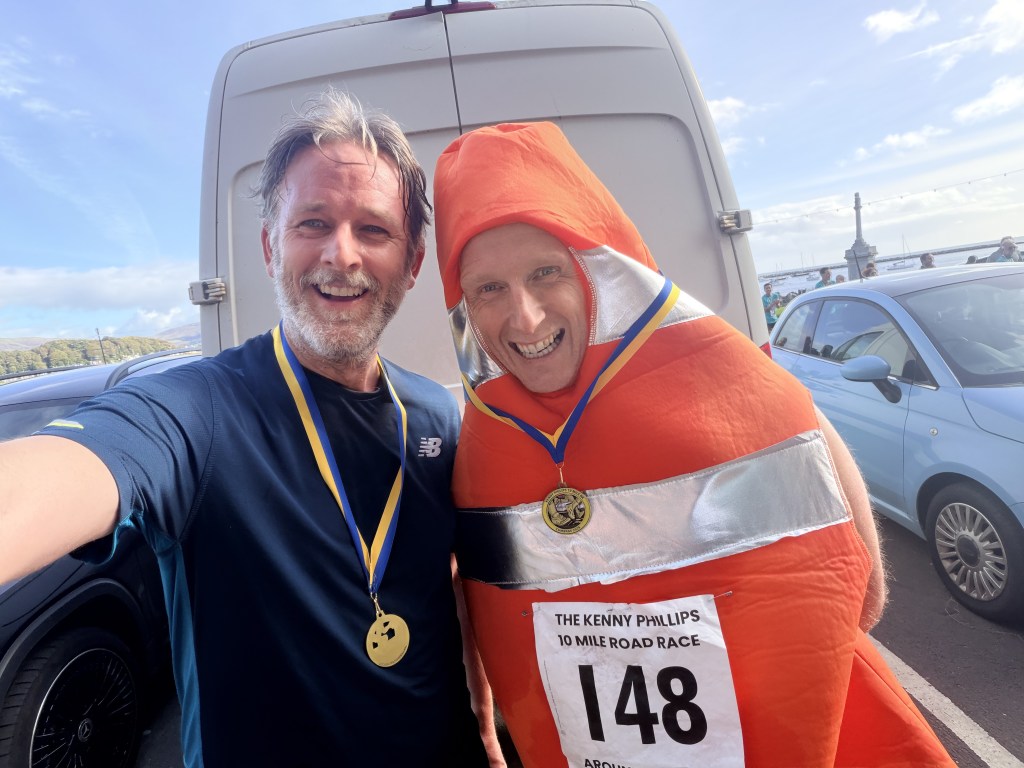
It was a cool, dry (apart from a couple of small drops of the lightest rain in the first mile) and windy day. The first half of the race had the wind behind us, the second half was more of struggle as it pushed against us. But it was decent conditions for running with good views across to Largs and Fairlie on one side, and Bute and Argyll on the other.
The only strange thing about the race was the changing facilities: the town hall. There were separate male and female facilities (as you’d expect), but the male facilities had two little old ladies service water and rich tea biscuits. Were we expected to get changed in front of them? Did they volunteer for this?
“Would you like to man a water station?”
“Why yes, dearie, that would be nice. Can Nora join me and we can have a wee natter too?”
“Of course. And how do you feel about 100 male dongs?”
The race was well organised with two water stops on the course (no nudity required) and detailed instructions in advance to help with getting to the island on time for the start.
As for Kenny Philips, he was an amateur runner and race photographer. I couldn’t find his connection to Millport, though he seemed to be active on the west coast.
When I was younger, checking my blood pressure was just a box I had to tick when entering some races. The entry requirements would ask: Do you have high blood pressure? No, I’d write down. Can you bring a GP certificate to confirm it when you register? Erm…
I don’t know why some races asked for a GP certificate, when most do not. I think I’ve only been asked for it once for a run, but several times for bike races. I guess the tight lycra makes middle aged men squeezed into it like a sausage more prone to high blood pressure and organisers keep a careful eye on lycra corseted riders before they let them start.
I always failed the blood pressure test. I would have to pay a GP to test me, because they don’t offer tests for free, and the result would always be:
“Your blood pressure is too high.”
And then they would add:
“It’s probably because you are getting a blood pressure test. That’s quite stressful. Of course, your blood pressure is going to be high. Let’s try again in 10 minutes.”
And, after an hour, and several attempts to retake it, and Yoga and stretching, and clearing my mind, I would emerge from the surgery with a certificate confirming I had normal blood pressure. Just.
Then, one year, Iain TwinBikeRun discovered you could buy a doctor’s stamp from Amazon and you didn’t need a GP letter, just an ordinary letter stamped with his make-your-own stamp from Amazon. He made a stamp from the surgery of “Dr Cupmaballs”. No one ever questioned “Dr Cupmaballs” and his expert opinion of Iain TwinBikeRun’s low blood pressure.
However even Dr Cupmaballs couldn’t help me. With a history of high blood pressure from both Mum and Dad I knew it would only be a matter of time before I would get diagnosed too. That time was 2025 and, after a routine check-up, I was prescribed some pills and I asked:
“How long do I take them?”
“The rest of your life.” Said the Doctor.
“I hope that’s a long time,” I said.
“It’ll be longer than if you didn’t take them.” He said.
That how I ended up no longer running clean. I am a ‘dirty runner’. I should enter the Enhanced Games. I take a small pill with a small dose every morning to keep my blood pressure in a normal range. I never noticed when my blood pressure was abnormal, increasing my risk of a heart attack or other health problems. And I don’t notice anything different now that’s it normal. I think that’s why they call high blood pressure a silent killer. You don’t know you have it until it’s too late, or until Dr CupMaBalls refuses to give you a clean bill of health.
This run needs to be read through the perspective of writing as a man in his late forties, not fazed by much, when you, dear reader, could be anyone. While I’d be happy to run with you, you may not be as happy to run with me, until you get to know me and find out that while I might have poor chat, I won’t run off and leave you in the middle of a neighbourhood that estate agents would only show you the homes during daytime and only with two agents and a back-up sniper in place to defend you.
For this run there are two easy ways to run with strangers: first, join a Parkrun event, of which there are hundreds across the United Kingdom. Or, join an organised group or club run.
For Parkrun, if you don’t know then it is a series of free, weekly 5k events held Saturday mornings in parks and open spaces not just in the UK, but worldwide. It is open to all ages and abilities. Except me.
I have run nearly every week since I was 18 yet I have never participated in a Parkrun events. It’s very popular, hundreds of thousands of people join Parkruns near me every week and, yet, I have never joined. I don’t know why. I keep meaning to do it but, even for the purposes of research for this post, I still didn’t do it. I think I just balk at the idea of running in a park at a set time when I could run in the same park at any time. My anti-authoritarian streak comes out, and I refuse to run when told. I’ll run when I want.
You might love it though, many do. Running with strangers for free will remind you that anyone can run and size, speed, body shape or unnecessary hydration vest will not be judged. Well, perhaps the vest, are you running Parkrun in the Sahara desert?!? Parkrun is for everyone. Except me, a man in his late forties, mansplaining Parkruns, something I don’t do. I’m parkrunsplaining.
A second option for running with strangers is to join a group or club run.
Through Autumn to Spring I take part in a monthly trail event organised by a club. They pick a trail of around 6 – 8 miles and everyone runs it at the same time, but no one is allowed to run ahead. When the group splits the furthest ahead stops and the rest catch up. While this sounds charitable in principle, it is hellish in practice. The faster runners always get a rest while they wait for the slowest. As soon as the slowest arrive, everyone starts running again. The slowest runner never gets a break. Instead of this system they should require the fastest runner to run back to the slowest, who waits for them to join. If you want to run faster than average then you get to run further than average
Running with a club is an excellent way to find new routes and to meet people of similar abilities and interests. Most clubs ensure any runs are suitable for all. Try running with a club and you may find that you too will be running back to the start as you get stronger.
Often, when I’m running on my own, I can tell I’m ill before I’m ill. My body reacts differently, easy sections become much harder, I’m sweating pulling my shorts on, before I even start running. Running alone can a great early detection system as you spot your running with an illness before…
… you run with an illness.
Some runners live for the machismo of running in any conditions. Wind, rain, hurricane, plague of locusts, it doesn’t matter what is happening in the world they will keep running. Even injury and illness don’t stop them. One leg broken? Just hop? Two legs broken? Switch to a marathon in a wheelchair. Clinically dead? Not an excuse, where’s the spark pads?
I’ve also operated under the maxim “above the neck, fine, below the neck, rest.” I do not know where I got this from or whether it has any connection to any known medical science. Given it dismisses all mental illness, I suspect it’s from TwinBikeWife’s mum’s little book of medical sayings. My mother-in-law used to be a nurse, in the same way that quackery used to be a legitimate medical science. She was a nurse in the 1960s. She quit to raise a family and has been using the same medical knowledge as The Beatles ever since. The Beatles, whose song ‘Doctor Robert’ recommended their friendly GP, Dr Bob, whose prescription for a grazed knee was LSD and whose prescription for a headache was, you guessed it, LSD.
TwinBikeMotherInLaw last saw the inside of a hospital before decimalisation was invented. I suspect I may have got this advice from her. Don’t listen to it. Don’t run when ill, below or above the neck, but do use your solo runs to check your own body. You’ll be surprised how a run can warn you that blue light is about to flash.
In 2024, I had two goals, complete a triathlon in June after running an ultramarathon in April.
I thought my training had been going well for the ultra, but then I injured my foot before getting a chest infection just as I was getting ready to start running again. Between illness and injury, I cancelled the ultra and I managed to run only six times between Easter and taking part in the triathlon in June.
I wasn’t disappointed, just realistic. Injury and illness are part of running, and they have a way of forcing you back to the simplest version of it: just getting out the door, on your own, with no plan beyond moving forward. In those six runs between Easter and June, every single one was alone. And I’d argue that every single one was better for it.
Running alone is a great way to stay healthy. Not just for the benefits of exercise and a healthy life but also because you rarely encounter anyone who is ill when you are running. It’s not like you take a route through the tropical disease ward at your local isolation unit. Or even run within coughing distance of someone with the flu. When you run on your own, you isolate yourself from other people.
If I’m running down the street and see someone ahead of me, I make sure to give them plenty of space as I pass. Like a super-tanker approaching the Panama Canal, I assume the more distance between us, the better. No one wants to hear the swish of Lycra shorts right behind them, feel a runner’s breeze brushing past their arm, or catch the warmth of someone’s breath as they sidestep around them at the last second. That’s not running; that’s practice mugging.
I will occasionally cross the road. I am conscious, as a man, that my perception of what is safe and a woman’s perception of what is safe are very different. For example, my perception of a well-lit street in December at night, occupied by several parked cars, a white van, and a woman walking alone is that this street presents no danger to me whatsoever. The woman, on the other hand, may have her keys in her hand, ready to strike like the point of a knife, and is eyeing up me, the stranger panting and running and dressed entirely in black, and my grab-van and thinking that this is how Silence of the Lambs starts. If I ask her to move a sofa, I’m getting maced.
In that circumstance, night, me being the only other person on the street, I cross the road to be polite and non-threatening. I even sheath my knife, pull up my balaclava and shout “I’m not going to hurt you” to make it as safe and comfortable for her as possible. I’m not looking for you to call me a knight of the night, or man of the year, but if those are the words you want to use then don’t let me stop you.
My regular solo run takes me four miles through the southside of Glasgow, past the same houses, the same corner shop, the same park. I know every pavement crack. I know where the footpath narrows near the school and where the dog is always behind the gate. I don’t think about any of it. That’s the point. The run thinks for me, and by the time I’m back at my front door, whatever was tangled in my head is either resolved or forgotten. I’m not sure which is more useful.
Running alone should be safe. Both for you and for others. You don’t meet, speak or interact with anyone except the occasional 40mph Deliveroo rider on a moped modded with a NASA rocket who gets a well deserved: “Oi, you should be on the road”. Other than that, you’re on your own. It is liberating, it’s just you and the world. For me, running on my own with no phone, gives me a chance to think about problems at works and to try and solve them, or to plan ahead and bounce ideas around my noggin, or just to tune our completely so that by the time I get home I’m not thinking of anything at all. My solo run is just me. Your solo run is just you. And on the right evening, on the right street, with the right amount of quiet, that is enough.
I have a ‘favourite bin’ run. It’s three miles from the house beside a roundabout and a small ornamental flower bed and black metal bench. I like to run to the bin, take out a gel, sit on the bench, finish the gel and put it in the bin. I don’t like eating an energy gel and then putting it back in my shorts pocket, where it will either leak or remain forgotten about until I find it in the washing machine later, blocking the outflow pipe. I prefer to put it straight into a bin to avoid emergency call out plumbing mishaps. Running is good for your health – and your bank balance.
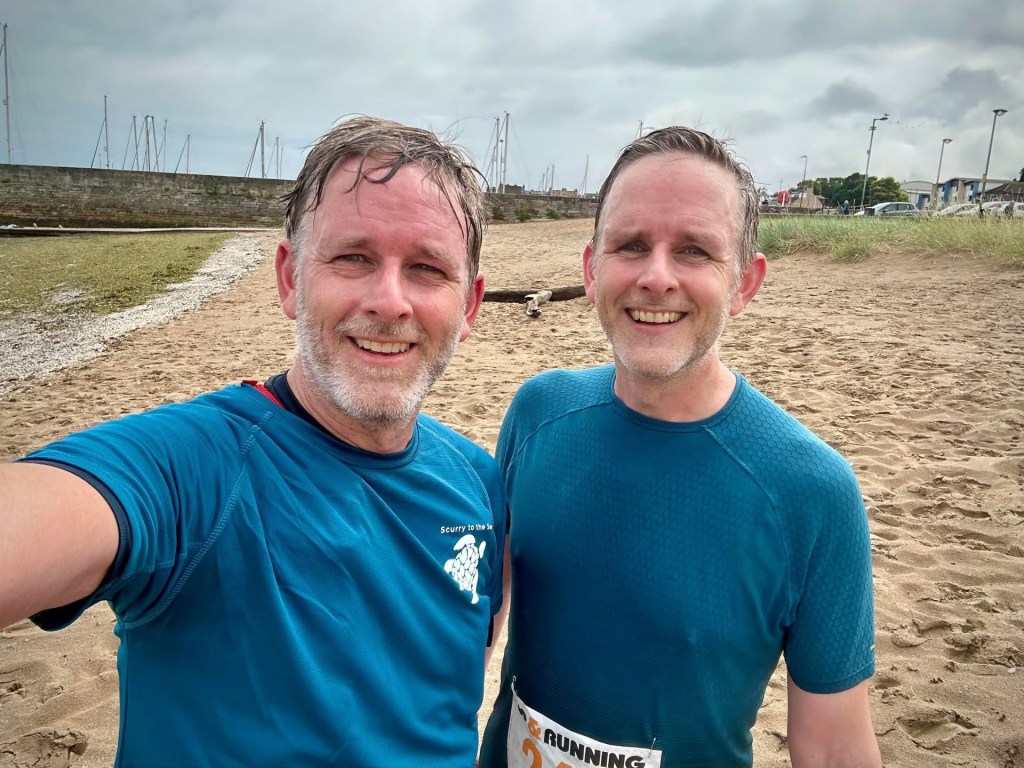
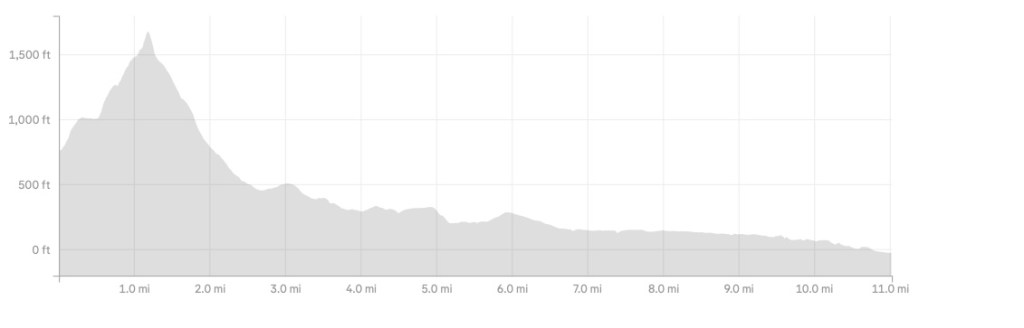
Scurry to the Sea is a 12 miles-ish race from the Pentlands to Musselborough. I think of it as a downhill race as most of it is downhill but, as this elevation shows, there’s an awful lot of climbing in the first two miles.
This is the third time I’ve entered Scurry to the Sea so for more details you can read 2024 and 2025. It was only on re-reading my 2025 report that I realised I made the same mistake this year as last year: I entered both Run The Blades and Scurry to the Sea despite them just being a week apart. My legs were heavy last year and, while I felt it again this year in the fast few miles, by mile four I felt okay and continued to feel okay until the finish. Maybe that was because we found a shortcut?
I’m not sure what we did, but we finished the race about a half a mile shorter than in 2024 and 2025. Given we were following the runners in front, I can only assume one of the leaders had worked out a new shorter route to run between start and finish while still passing all the checkpoints. If so, my legs thank you!