I have slept in a living room, a cleaner’s cupboard and what felt like a supermarket skip. Racing around the country is expensive and one of the skills all triathletes need is the ability to find the cheapest and closest accommodation to the start line as possible.
On Skye we stayed in a hotel room whose window opened into a skip. Which was handy, as the room didn’t have a bin. Or much in the way of sheets, paint, any wifi or hope of better days. Every hour someone would throw a glass in the skip. Every hour. All night.
In Dunkeld, I thought I’d found a bargain before the Etape Caledonia. £35 a night for a double room. The room was new. Recently renovated and had a smell which could only be described as Eau Du Crime Scene Clean Up Crew. My eyes started watering as soon as we opened the door. The smell of bleach was so strong, my teeth turned white. The room was so new I’m sure it was still a cleaners cupboard that morning.
As for sleeping in a living room. That doesn’t sound too harsh until you read this – Norseman – and you spend three days with the equivalent of a torch shining in your face while you try and sleep.
But not this time. This time we’re staying at the Torridon Inn, a luxury hotel only a few minutes from the finish line.
After years of slumming I want something to look forward to at the end of the race.
Not that there’s that much choice for Celtman. The Applecross penisula is isolated and there’s not a lot of accommodation. To make it harder, the penisula forms part of the North Coast 500 tourist trail so any accommodation is already hard to find with tourists booking for their own tour of the Highlands.
So, no sooner were places confirmed than Iain scoured AirBnB and hotel websites for places to stay because there’s no point having a place if you don’t actually have a place to stay too. And not, thankfully, anywhere that will involve a rubbish dump, the eternal sun or more chemicals than the Rolling Stones dressing room.
Goals for December:
Training will officially start in January. December will be about getting into a routine of doing ‘something’ most days of the week but without any pressure to do anything in particular. It’ll just be about getting used to a routine.
Work out training plan
See if I can try and be a bit more scientific and check stats like heart rate, functional training power, watts and a whole host of other words I don’t know the meaning of yet.
There are three starts to a race. The first start is when you start running. For most of us this will be a few metres before the start line as we don’t start at the start as we don’t want to mix it with the top club runners looking to win races. The second start is when you start your watch so you can keep track of how far you’ve run and how long you’ve been running. This second start will be as close as possible to the third start – the point we cross the start mat and hear the beep of timing chips.
Three starts. Three times we control exactly when we start a race as we decide when to start running, when to press start, when to cross the mat, yet still I like to hear the sound of a starting gun, klaxon or just a loud whistle. There is something ‘official’ about having a starting signal that Garmins and beeps cannot replicate. Even better, the start should be marked with an official starter, and in most years, for the Jimmy Irvine 10K it’s been Jimmy Irvine himself. You can read about it here (including more about Jimmy Irvine). This year, he wasn’t here in person, but he was here in portrait as the finisher’s t-shirt had a picture of him and his wife on the start line at Bellahouston Park in Glasgow.
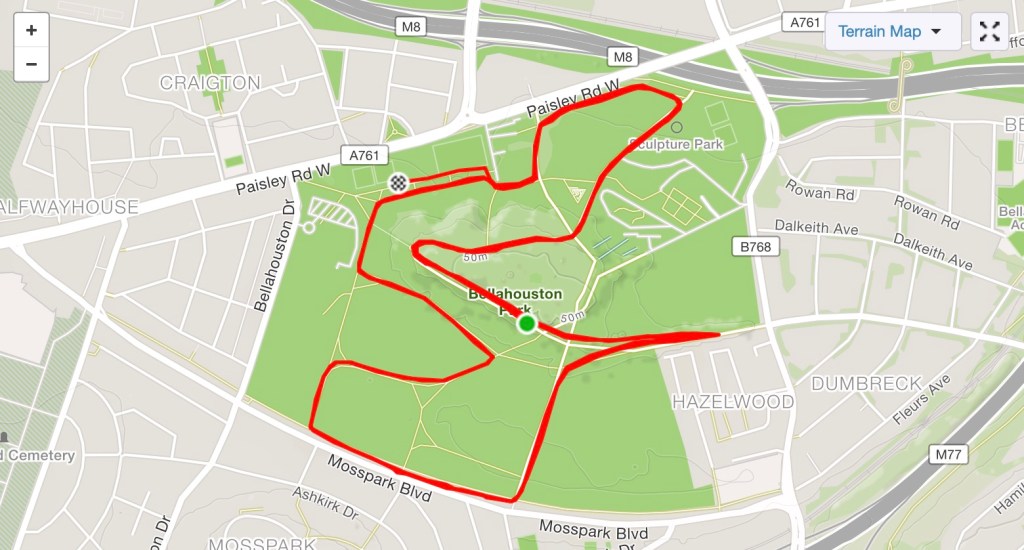
The race has taken a number of different routes around Bellahouston Park however, this year, it stayed the same as last, which I originally thought was great as it features two laps and three visits to the same downhill section. As the race starts on a hill you run downhill for most of the first kilometre. You then repeat it again at the end of the first lap and again at the end of the second. Two laps, three downhill sections.
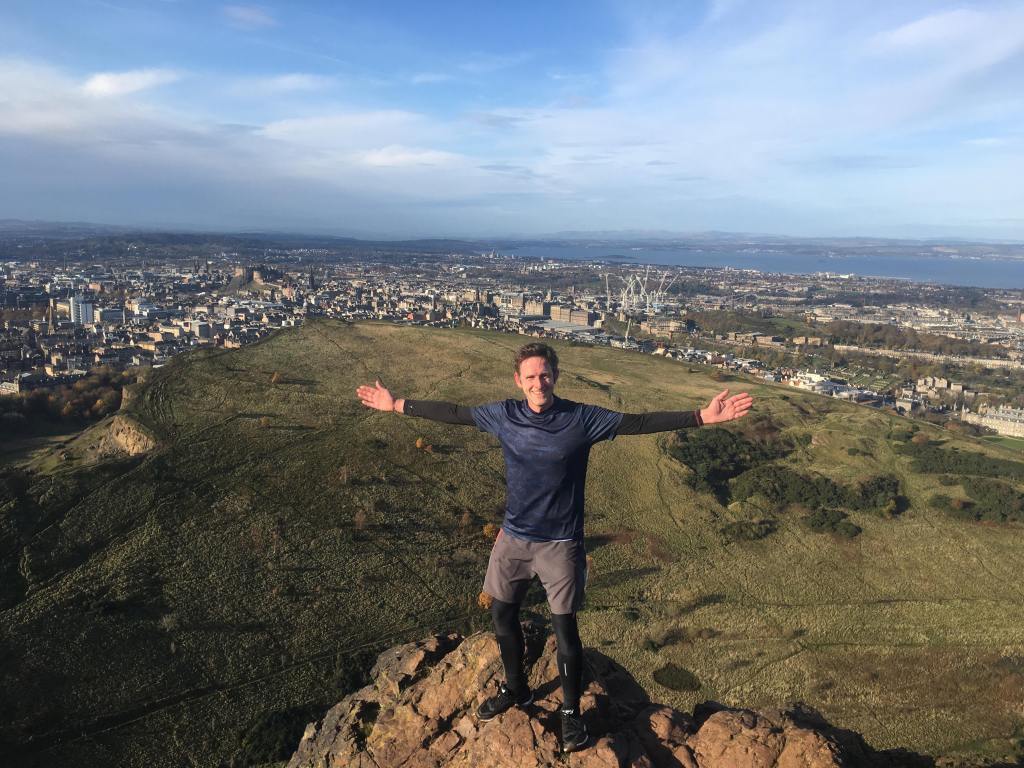
However, when I say I “originally thought it was great”, I have now changed my mind. Last week, Iain and I ran around Edinburgh, taking in a number of hills including Blackford and Arthur’s Seats. After checking Strava, I notice something curious. The highest heart rate was recorded at the bottom of hills, and not the top. With the peak rate being recorded at the bottom of Arthur’s Seat after running down from the summit.
King of Edinburgh
I’d always thought that running uphill was harder. It certainly feels like it. But, the scientific evidence – and what is more scientific than a record on Strava! – shows that running downhill was much, much harder.
So, when I originally thought I was going to write about how the Jimmy Irvine 10K is a nice route as it’s more downhill, than up. I’m now here to warn you that the Jimmy Irivine 10K is a hard race because it’s mostly downhill! Avoid, do something easier like the Ben Nevis Hill Race or the Mt Everest Marathon. Anything except run downhill!
Saying that, I might just be annoyed because I missed out on breaking 45 minutes by 8 seconds. It was still the fastest I’ve run a 10k in a few years but, still, even with three starts, I couldn’t find one that would take my time below 45 minutes…
I blame Iain. He ran off to fast and I decided not to keep up as I wanted to warm up a bit first. Then, to make matters worse, he ran the rest of the race too fast as well! What a cheat! I bet he even ran the downhill sections. I didn’t. I walked them* – you can’t be too careful you know!
So, while there was three starts, there was only one way to finish: second place to Iain again.
*This might be a lie to avoid saying I couldn’t catch up with him even when I was trying to sprint.
The only races I ever dreamed of entering were Norseman and the Marathon Des Sables. I’ve been lucky enough to have taken part and supported at Norseman but I will never do MDS. My body struggles badly exercising in hot weather. MDS would kill me!
Next year, my plan was to take part in one of the hardest middle distance races in the world https://triathlonx.co.uk/index.php/half-x and then do one of the easiest long distance races – Ironman Denmark.
I only entered Celtman because I wanted to do it in the future. Entering this year would increases my chance of getting a ballot place later. Failed entries give you more extra ballot places in future years.
And then this happened
Trust my luck to win the one ballot I didn’t want to win!
BUT…
…now that it has happened I’m excited about it. It will be great fun to go head to head with Andrew. May the best Todd win!
Although, if you are anywhere near Torridon in June 2020, expect to hear me repeatedly utter the line made famous by Dante in Kevin Smith’s Clerks “I’m not even supposed to be here today! ”
I spent the week before the race full of the cold. Not the normal cold but life threatening man flu.
My fellow men will sympathise at just how potent this horrific affliction can be. Its only known cure is watching TV, drinking beer and replying “no. I’m ill” to any enquiries about whether any housework is going to be done.
I decided I wasn’t going to do the race as it always rains when I take part. Last years event was so biblically wet I spotted Noah leading animals two by two to his boat. I didn’t fancy running whilst being at deaths door.
But for the first time in my five attempts at the race there was no rain. It was actually a very pleasant sunny morning.
I decided to run. I was still ill and I definitely wasn’t fit enough for household chores. In fact, I think it might be a few weeks before I can even think about hoovering or helping out around the house. A run though is fine to do.
The course is two laps of Bellahouston Park. It’s not a very scenic park but it’s pleasant enough. It’s mostly flat but there is one hill that is tackled twice.
I decided I was going to run as fast I could. As soon as the race started I legged it away from Andrew. Later Andrew complained I went off too fast. No – he went off too slow!
The race was pretty dull. I spotted Andrews wife a couple of times so I gave her a wave. Which turned out to be more times than Andrew spotted her. He managed to run past her without seeing her.
I kept a good pace up for the whole race and I was happy with a sub 45 time. I didn’t expect to be as fast as that. Maybe man flu isn’t as bad as I thought….
IronMan UK was my one and only long distance triathlon. Never again I said. That was it. One go. Done it. Never need to do it again.
Except for Norseman.
And possibly Challenge Roth.
But the chances of getting in were so slim that IronMan UK was, I thought, the only time I’d ever swim 3.9km again, probably the only time I’d ever cycle more than 100 miles and definitely the only time I’d run a marathon as I don’t like running long distances.
Oh, and except for Celtman too.
Apart from those three races, I was never going to voluntarily spend an entire day racing again!
But what were the chances of getting into Norseman? Challenge Roth or Celtman? People try for years and don’t get into any of them. I applied, still with no expectation of getting in, and, straight away, I’ve got a place in Norseman.
A couple of years later and I manage to get a place in Challenge Roth too.
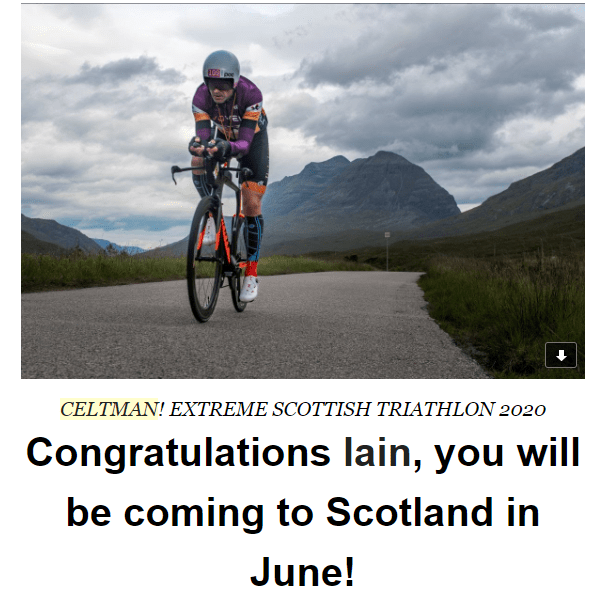
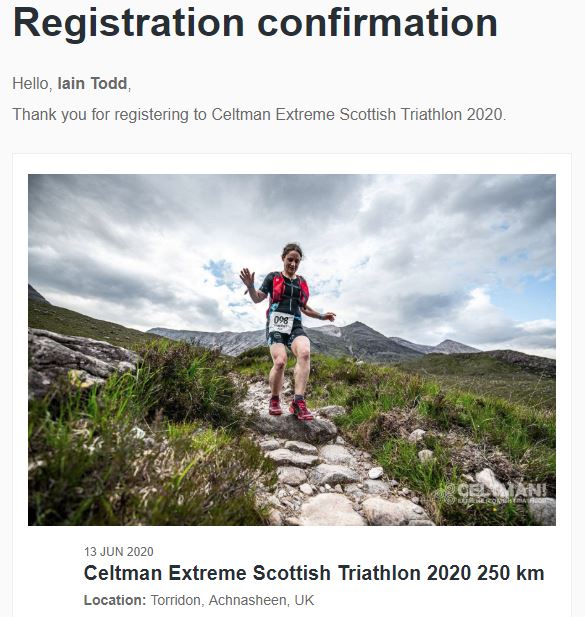
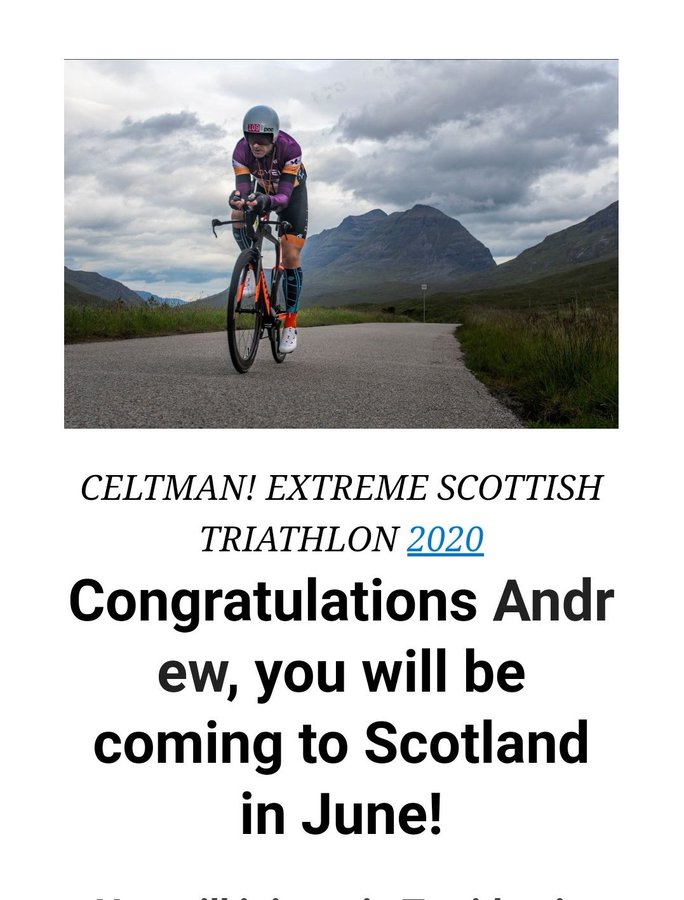
And now I have a place in Celtman.
I don’t know whether God likes a laugh, but he certainly enjoys a good ironic chuckle.
While Norseman was fantastic. I’ve written about it on the blog and you can find out all about it. Roth too. And they were both ‘special’ and they have given me some great memories (along with a deep, deep fear of losing my watch while swimming – read about it here and, four months later, I’m still mentally scarred by it!), it’s Celtman which means the most to me because it was Celtman that got me interested in triathlons.
I never watched triathlons on telly. I’d never heard of IronMan or knew anything about the World Championships in Hawaii. I knew triathlons existed, I’d even tried to the New Year’s Triathlon in Edinburgh but I was like a dog playing football. It might know to chase a ball but that’s all it has in common with a footballer. I knew you needed to swim, bike and run but I didn’t know it was better to swim freestyle, that a mountain bike is not the professional triathlete’s first choice or that the run is something you race, not walk in to finish.
Celtman changed that. I was watching the Adventure Show on BBC Scotland. Every month it reports from different events across Scotland. In 2011, it reported back from the first Celtman extreme triathlon. 3.4km swim on the west coast of Scotland, a 120 mile cycle round the Applecross penisula and then a marathon up a Munro and finish in Torridon.
“That’s impossible,” I said, “how do they do that?”
Every year since I’ve watched the Adventure Show and thought I would love to take part but secretly I knew that I wasn’t good enough. I don’t want to swim through jellyfish in freezing cold water. I’ve never cycled 120 miles. I’ve never run a marathon up a mountain. That’s what other people do.
But as I started to train for races in middle distance, then long distance, then Norseman and Roth, I started to think this year that maybe, with a bit more effort, I could be ready for Celtman. Because I don’t want to just complete it. I want to stand at the top of the mountain and be one of the few competitors who complete the whole course. In order to do that you need to be halfway through the run eleven hours after starting. Which means I’ll have around 8 hours to complete 120 miles on the bike, knowing that my swim time is the one thing I won’t be able to change no matter how hard I train.
And, to make this Celtman, even better, unlike Norseman and Roth, Iain will be racing too, which will be a good incentive for both training and on the day itself. Though it has spoiled my support runner plans as he was going to run the final half with me!
Now that I’ve secured a spot I keep thinking of the first edition. I think how impossible it seemed and I think how possible it now is. I can’t wait to take part!
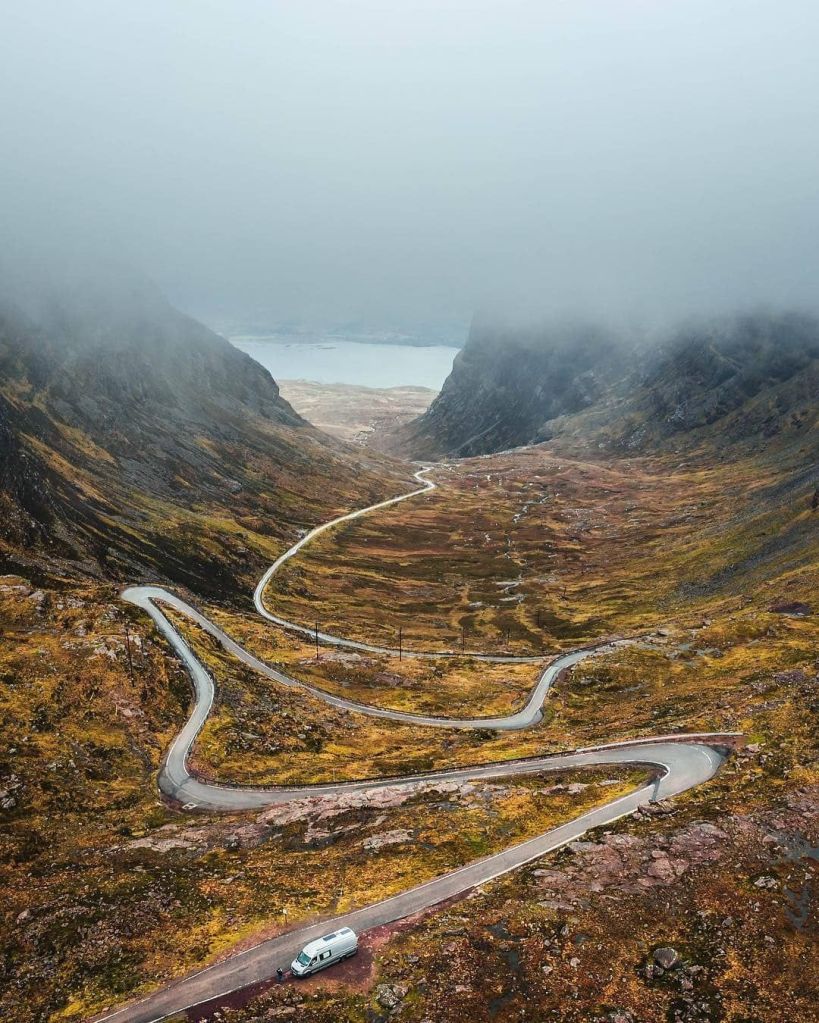
The Bealach na Ba, in the North West of Scotland, boasts the greatest ascent of any road in the UK. It begins at sea level and rises to a height of 626m. It takes six miles to get from sea-level to the top.
The name means ‘pass of the cattle.’ It was originally a gravel track used by crofters to move cattle between two parts of the Applecross peninsula. It’s now mostly used by tourists. The route is part of the famous North Coast 500 which has been named one of the top coastal road trips in the world.
It is 2012 and I am at the start line of my first ever bike sportive. I look at the other riders.
They are all using road bikes. I am on a mountain bike. I am the only one on a mountain bike. Why are they not on Mountain bikes? We are going to ride up a mountain. Surely a mountain bike is the most effective way to do that?
They are all wearing skin tight lycra. I have wearing a thick winter jacket and a pair of baggy shorts.
They are all clipped into their bike using proper bike shoes. I am wearing trainers.
They all have a bottle on their bike. I do not have a bottle on my bike. I have a backpack containing a sandwich, a two-litre bottle of water, and a map in case I get lost.
It is fair to say I do not know what I am doing.
Andrew is here but he is not on the start line. He has the flu. He has offered to drive a van around the course in case I need him. I spot my friend Malcolm who is also doing the race. I say to him “Good luck.” He says “You’ll need it more than me” and he then rides off. All the other bikes whizz past me.
I now realise why they are on road bikes. Honestly, up until this point, I thought there was no difference between a road bike and a mountain bike. I had assumed road bikes did not go up hills.
I honestly do not know what I am doing.
After two hours of cycling I have cycled further than I ever have. I realise it is two hours back to where I started so I will need to the do the same again to get home.
I stop and eat a sandwich. I wonder how the other cyclists are getting on. They must be starving. They don’t have any sandwiches.
I try phoning Andrew but I don’t get a signal. The race is too remote for mobiles to work correctly.
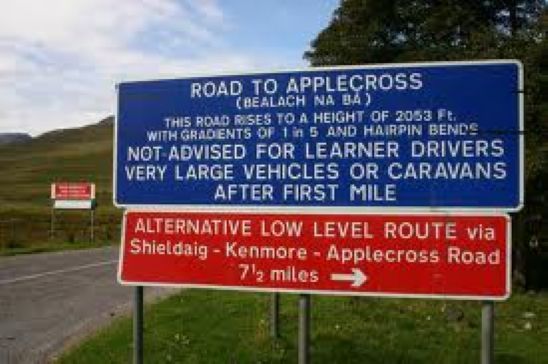
After another hour I reach the climb. The sign at the bottom says
Road to Applecross (Bealach Na BA) This rod rises to a height of 2053 ft with gradients of 1 in 5 and hairpin bends. NOT ADVISED FOR LEARNER DRIVERS, VERY LARGE VEHICLES OR CARAVANS AFTER FIRST MILE
It does not mention bikes. That means I’ll have to do it.
I start the climb. Within 100m I have started to heat up. I start to sweat. I decide to take off my jacket. I put it in my backpack. I restart the climb. It doesn’t feel too tough yet.
The road gets steeper. I try to switch to a lower gear. I am already in my lowest gear. No wonder the start was easy.
The road climbs higher. I struggle to turn my pedals. I haven’t even done one mile of the climb. I’m still at the part safe for learner drivers, very large vehicles and caravans.
Maybe a bit of food will help. I stop and eat the rest of my sandwich.
I restart the climb. I feel heavy. The sandwich has not helped. I struggle onwards. I stand up on the pedals to make them turn. I stop and admire the view. I consider quitting. I don’t have to think twice. I decided to quit.
I wish I could say I have the stomach to battle it out when things get hard but I don’t. I try phoning Andrew again. He can come and rescue me. There is still no reception. Feck. I’ll have to keep going. Mainly because I assume I’ll get a phone reception at the top of the hill.
I push my bike all the way to the top of the hill. A film crew is waiting for me. Probably not me specifically but anyone doing the race. They are filming for BBC Two Scotland’s The Adventure Show. The reporter approaches me:
– I can’t believe you’re using a mountain bike!
– It’s my only bike
I take out my water bottle to have a swig.
– You carried that all the way up the mountain?
– Yes. I thought I’d get thirsty.
– You do know the organisers supply water and food at regular stops?
I thought I had to supply everything myself! DOH!! I try my mobile. It has a signal. I try Andrew but there is no answer. I send him a text saying. “I quit! Come and get me at the bottom of the hill in Applecross”
The descent of the other side is great fun. Six miles of fast downhill with treacherous corners. At one corner an ambulance is tending to a rider. I think to myself how glad I am that it is not me.
At the bottom of the hill I reach Andrew. There’s 40 miles to go but I’m not doing any more.
I’ve achieved my race by cycling further and higher than ever before.
We head to the finish to wait for Malcolm…and we wait…and we wait…and we….
As it gets dark there’s no sign of Malcolm. I approach the race organisers and ask if they have seen him. They go to check their list of riders. When they come back they have bad news – Malcolm was the man I passed on the mountain who was getting tended to by the ambulance.
The news got worse. He was taken to hospital. Great. He must be in Inverness as that was the closest one to us. We need to go that way to get home. We’ll pick him up on the way but the news got even worse. The hospital was not Inverness, which is close by and on our way home. He was sent to Broadfoot on the Isle of Skye which is miles away and nowhere near our route home.
We head to Skye to collect him. He is sitting on a chair with his arm in a sling. His brakes failed whilst taking a corner on the descent. The bad news was that he had broken his collarbone and will be off work for six weeks. The good news was that it coincided with the Edinburgh fringe. He spends the next six weeks partying.
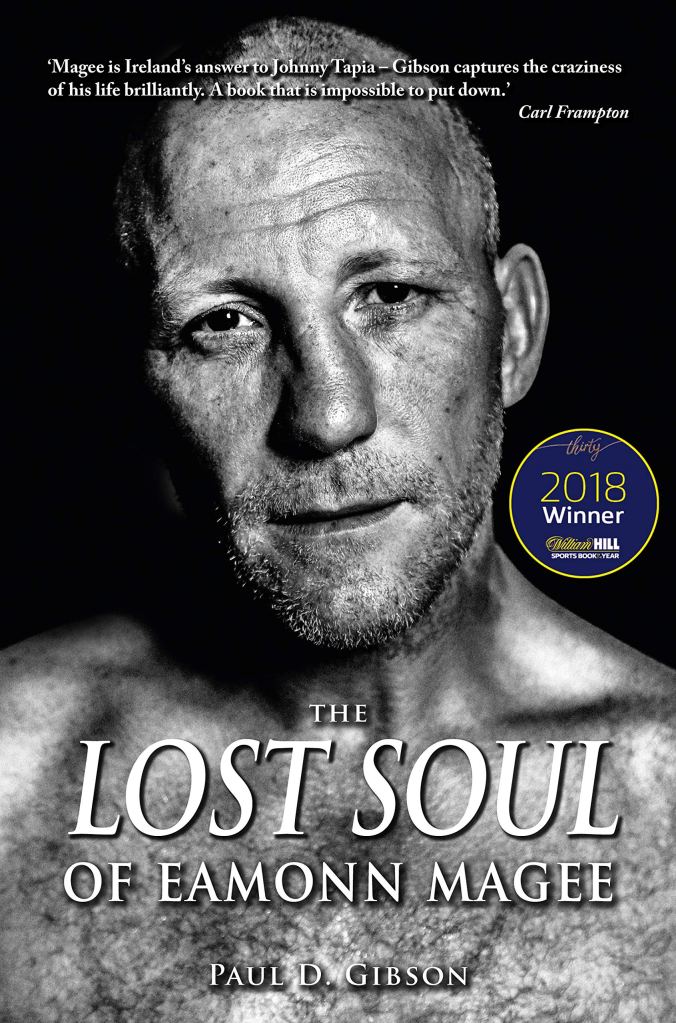
When is a sports book not a sports book? There is a pattern to sporting biographies. A couple of chapters on childhood. A spark or twist that sets the athlete on their sporting journey. Then a forensic minute by minute breakdown of their greatest achievement before either a hopeful look to the future for more medals/trophies (current athletes) or a final “what a career I had!” for those who’ve retired.
Most sports books are predictable and only really of interest to people who really love the sport that’s been written about. No one will pick up Geraint Thomas’s tour diary who doesn’t already know they want to read about how he decided on his gear selection for every stage of the Tour De France.
The Lost Soul of Eamonn Magee is different, at least for most of it. Eamonn Magee was a Northern Irish boxer who was brought up in one of the harshest areas of Belfast during the Troubles. His biography is as much a story of what it was like to live beside nationalists and unionists and see a community defined by both. It’s also a story of a man who started drinking at nine years old and made a life of alcohol, drugs, violence, prison and chasing women – and, when his trainers could control him, boxing too.
The first half of the book is gripping. It explores what it was like for an angry alcoholic petty criminal to grow up in Belfast in the 80s and 90s. It shows the impact that the IRA could have and how one word from one well connected member could mean fleeing your home that night to live in London for a year. It sets Eamon’s life in context and it tries to explain how one boxer came to represent Northern Ireland for a brief few years as someone who could wear the Irish tricolour but still be loved by unionist fans.
And then, in the last third of the book, it begins a detailed round by round summary of Eamonn’s career. Which if boxing is your thing then I’m sure it’s great. But, as I don’t know my uppercut from a supercut, and couldn’t tell you if the author was describing a boxing match or a barbers, this section was a bit of a slog.
However, the rest of the book is recommended and provides a glimpse defined by trouble and Troubles.
If you are familiar with UK politics then you might have heard of the West Lothian Question.
It is a phrase coined by the West Lothian MP Tam Dalyell asking why Scottish MPs can vote on laws that will only impact England.
There is also a East Lothian question. One which is less political but equally contentious. How should you pronounce Gullane? Should it be Gillan, Gullan, Goolan or Gull-ane?
A former Gullane minister took the trouble to write to the Scotsman newspaper’s letters page to explain how it should be pronounced.
“A good many years ago now the BBC wrote to me to ask how the name ought to be pronounced.
“I told them that, though most of the old folk pronounced it Goolan, the other version Gillane had prevailed and that it would be now impossible to re-establish Goolan.
“The one thing to avoid was the tripper vulgarisation of Gullane. It had nothing to do with seagulls.”
Darn! I pronounce it like sea gull. Sorry Rev.
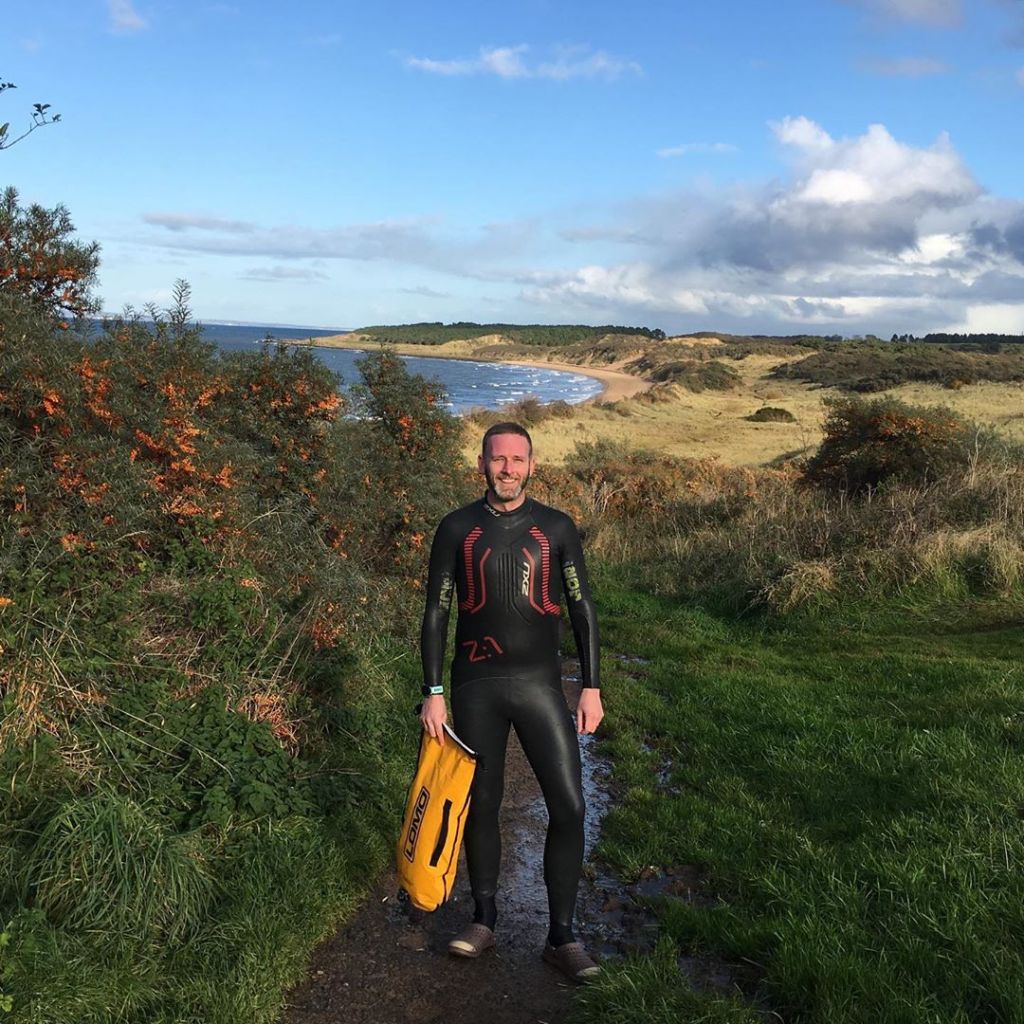
It was a very windy day when I visited. It was actually warmer in the sea than on the beach as the wind was baltic!
My photographs showing sunshine and blue skies but don’t assume that means it was warm. There was a strong cold wind! It was actually warmer in the sea than on the beach.
REVIEW
Ease of Access: Gullane is close to Edinburgh. There is a paid car park near the beach. Beach access is a short walk from the car park. It can be very busy in summer especially at weekends.
Water quality: The water quality is tested and it always ranks highly.
Swim Quality: Cold. Water temperature was 9.3C. I managed 15 minutes of wetsuit swimming. There wasn’t anywhere to swim to so I just swam aimlessly and admired the view.
Other People: Even on a cold, grey, dreich day the beach was busy with walkers and dogs.
Would I go back: Yes. I love East lothian. The beaches here are great. Just avoid high season.





 Twin brothers swimming, cycling and running in Scotland