I’d planned to swim on Findhorn Beach, but six foot high rollers and a dozen birdwatchers changed my mind. While the fierce waves gave me second thoughts about venturing out into the water, the thought that risking swimming in those conditions would be captured by a dozen twitchers with foot-long zoom lenses ready to take a photo of my imminent demise was more than I could take.
Not that the birdwatchers were that interested in being there. When I saw them gather, I asked one of them. “Are you here to see anything in particular?”
He just shrugged and said “just some boring migrating birds.”
I wasn’t sure whether to be impressed by his disdain for his own hobby or to be saddened by the fact he was standing on a beach in November and didn’t even want to be there.
I did want to be there though having spent the day driving north from Glasgow and looking forward to a quick swim at the end of my journey. After going to the beach, I decided to drive to the south bank of Findhorn instead and swim in the sheltered bay beside the town. I wondered if it would be too public a spot for swimming. I was parking on the ‘Main Street’ and would be changing in front of people’s homes.
I shouldn’t have worried. While I was parking two others arrived to swim too and, when I went down to the water, another was already swimming. I shouldn’t have been worried about whether to swim. Instead I should have been worried about finding a space to swim.
Every fortnight we cover the best and worst football songs from every club in the UK from our book ‘The Sound Of Football: Every Club, Every Song’. You can buy it here
Alloa Athletic
Nickname: The Wasps
Ground: Recreation Park
Stadium Capacity: 3,100
Song: The Boys In Black & Gold by The Utopians
Just like Albion Rovers, Alloa has used The A-Team theme song when walking onto the pitch – though we think it has missed a trick by not renaming it – just like the French, who renamed The A-Team as the All Risks Agency (L’agence Tous Risque). However, the French didn’t stop there. They also added new lyrics to the music and turned it into a full-blown soft rock song. A-Team leader Colonel ‘Hannibal’ Smith may have loved it “when a plan comes together,” but when the plan involves an iconic 80s TV show and a cheap rip-off Charles Aznavour singing, even he will baulk at the result. So, maybe Alloa is right to just call on the A-Team even if we all know that they should have renamed the song as the AA-Team.
Our favourite song for Alloa’s is ‘The Boys In Black & Gold’ (the team colours) by The Utopians. The band was founded in Leicester in 2007 by frontman Jason Westall and guitarist James Shaw. They didn’t last long, and their Facebook page consists of only a handful of entries. The second last one from 2010 promises “that work has begun on a record which is arguably ‘more important than the New Testament,'” which shows while they may have lacked success, they didn’t lack ambition.
The band toured in January 2008 to support the release of its debut single ‘There’s a Train,’ which gained good reviews and Radio One airplay. ‘The Boys In Black & Gold’ was released as a B-side, and the band was invited to Recreation Park. The club’s website confirms that the song was played before kick-off, halftime, and after the final whistle.
It’s appropriate that the song was a B-Side as, while many clubs are known as perennial runners-up, Alloa Athletic has made a career out of coming second. It holds the record for finishing runners-up in the third tier of Scottish football a record eight times, most recently in 2012/2013 when Alloa clinched promotion to the First Division via a play-off.
Many clubs hate playing Alloa Athletic, not because of a fearsome reputation, but rather because its pitch is artificial turf. However, this had one benefit – in 2010, Alloa was the only club in the country to play football after a cold snap meant every other Scottish game was postponed due to freezing weather conditions.
One of its greatest players was Willie Crilley, affectionately known as “wee Willie Crilley,” “Electric Spark,” and also “The Mighty Atom,” a free scoring striker who played for Alloa in the 1920s and was considered to be one of the best strikers in the league. He still holds the record for the most goals scored by an Alloa player in a single season.
Willie’s nickname was not ironic. At best, he measured 5 foot 3 inches, but some records say he was smaller. He was so small that even the club’s official history recounts an apocryphal story that during one game, he ran with the ball between an opponents’ legs before scoring. He subsequently joined Celtic, but his heart was with Alloa, and he only lasted a few months before returning.
Injury meant his career was, ahem, cut short, and he emigrated to the United States to start a new life. He played for several US clubs but, after marrying a US girl and taking American citizenship, a dream return to Alloa was foiled by immigration. In 1929, Willie had returned to Scotland to re-joining Alloa, but as he was a US citizen, he was deported back to America before playing for the club.
In 1934 he returned to Scotland for a final time to try and re-join his beloved Alloa but time and injuries meant he was not the player he once was, and the club’s directors turned down his offer to play.
If Willie had played today every time, he scored he would have heard ‘Live is Life’, the 1985 hit by Austrian pop group Opus.
‘Live is Life,’ often misconstrued as ‘Life is Life,’ was recorded live at Opus’s 11th-anniversary gig at Oberwart Stadium in Austria. This live version of the tune immediately shot to number one in the Austrian charts, and as 1985 dawned, the hit went global. While Opus is often considered one-hit wonders, they’d started in 1973, and, in Austria, they continued to release hits, including a tune for the Austrian national team for the 1998 World Cup. ‘Viva Austria’ sold thirty thousand copies, although sadly, the Austrian team didn’t fare quite so well after being knocked out in the first round.
‘Live Is Life’ has been adopted by several sports as an anthem, particularly in Europe, and in 1994 Opus released a new version for the World Cup that year, held in Willie’s adopted homeland, the United States.
Does Sir Chris Hoy have to pay to work out in the Sir Chris Hoy Velodrome? Does Olympic swimming champion Adam Peaty have to find 20p for a locker when he pops into Uttoxeter Leisure Centre’s Adam Peaty Swimming Pool? Because otherwise what’s the point of having a sport centre named after you if you can’t get in for free?
Whether Sir Chris has to pay or not, he might first ask himself if he really wants to ride the cycling track in the velodrome? I assume after five gold medals and 15 year career racing in velodromes that the answer will probably be “yes, I, Sir Chris Hoy, gold medal winning track cyclist and one of Britain’s greatest Olympians will ride the track!” but, as he now spends more time racing cars, maybe he’s scunnered and doesn’t want to go anywhere near a 45 degree sloping wall?
I know how he feels.
The fear of a 45 degree sloping wall, not the whole being one of the greatest athletes in the world.
I thought it would be great to learn how to ride in the velodrome. It would give an opportunity to ride indoors during winter months and to learn a new skill: dangerous balancing. See also tight rope walking for more examples of dangerous balancing.
In order to start at the velodrome I had to complete four induction courses. You can find more details of them here: Velodrome
However I quickly realised that I didn’t have what it takes to ride in a circle again and again and again.
It wasn’t the steep walls. After the first couple of circuits it felt natural to ride the steep banks. It wasn’t other riders, though having seen one accident – Iain TwinBikeRun describe it here Welcome to the Velodrome (Iain) – I wasn’t keen to see another. It was actually a single thought that stopped me going back. That thought was this: “What if I get a puncture?”
You can’t ride a bike without getting a puncture. It’s as much a part of riding as wobbling and pretending to fall off is a part of tight rope walking.
And there’s nothing you could do if you get a puncture while riding 10 foot up a track.
Now you could say that all life is a risk and that at any moment a bolt of lightning could shatter a peaceful blue sky and strike you dead, which is true. Life is filled with randomness. But that doesn’t mean I need to be standing in the middle of a field waving a long metal stick while shouting “Everyone knows the Good Lord smells!”
Which, in my mind, is the same thing as riding a bike on a velodrome track waiting for the inevitable puncture.
It wasn’t for me.
Maybe it’s for you.
The induction is well run, felt safe and was fun. I’d definitely recommend trying it – but it just wasn’t for me.
This book was bought as a Secret Santa present for a colleague at work. He was moving to Elgin from Glasgow. It definitely 100% should not have been in Stornoway two years ago on Christmas Day. It should not have been opened by Iain TwinBikeRun as his Christmas present.
It was meant to be a thoughtful gift to a colleague. Instead, I mixed up the presents and my colleague received Iain’s gift and had no idea why ‘Santa’ had sent him a book called “So You Want to be a Gold Digger?”.
As I said, whoops!
But the book was only part of the gift, I’d actually bought Iain a one day gold panning course at the Leadhill Goldmining Museum.
Unfortunately, COVID and lockdown meant that all courses were cancelled in 2020 and they only resumed in August 2021. Luckily, we were able to book one of the few dates this year and popped down to Wanlockhead last month to find… GOLD!!!!!
But how do you find gold?
Well, first of all you need to dig out some earth and soil and gravel from a river. Then you have to sift it using either a large plastic ridged sieve or a plastic pan, just like the prospectors of the Eighteenth century. Once sifted you have to carefully swirl the lightest soil and gravel around the pan to separate it from any gold. Gold is a heavy element so it won’t move as easily as other rocks and stones. If you swirl water around the pan then the gold should sty in place, as it’s heavier than the water, and the soil can be washed away.
While the theory is fairly simple, it takes a lot of skill to move the soil and not the gold and to keep the gold in the pan while removing larger rocks.
“How much would you make in a good day,” I ask our instructor.
“About £200” he says, which is more than I thought, but to put that into context, there were 15 people on the course and over 4 hours they made around £50, which just shows how hard it is to find gold.
Unless you’re me!
And you have the gold touch!
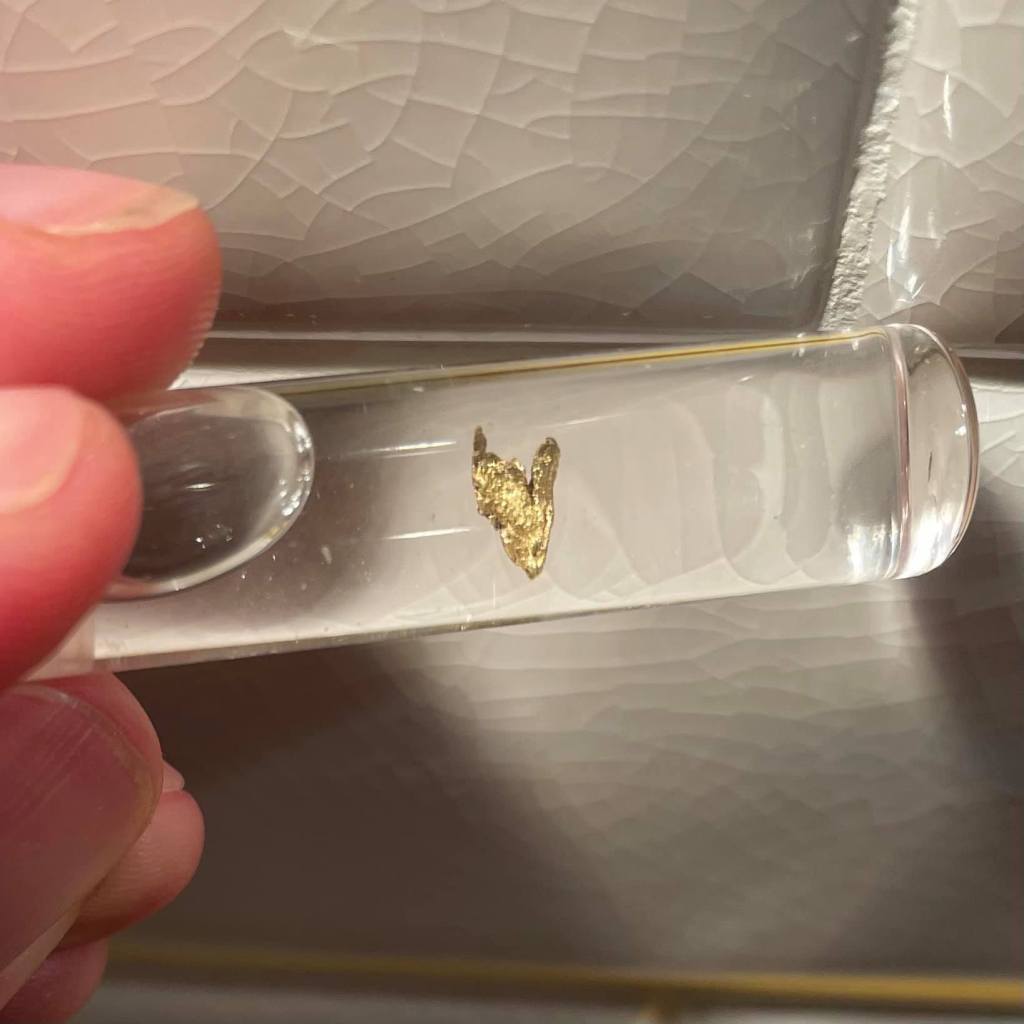
As I found £50 in just one pan – woo hoo! I’m going to be a trillionaire and fly into space like Jeff Bezos and Elon Musk! Looks at this beauty:
Every fortnight we cover the best and worst football songs from every club in the UK from our book ‘The Sound Of Football: Every Club, Every Song’. You can buy it here
Albion Rovers
Nickname: The Wee Rovers
Ground: Cliftonhill Stadium
Stadium Capacity: 1,238
Song: The A-Team theme song
Everyone knows a Mike Post song. He started as a session musician in the early 60s playing on songs by Dean Martin and Sammy Davis, Jr. By the end of the decade he was in a band with Kenny Rogers and playing guitar for Sonny and Cher on their biggest hit ‘I Got You Babe’. But it wasn’t his session songs that made him famous. After moving to television he composed theme songs for the biggest shows of the 70s and 80s. He wrote themes for classics like Doogie Howser, M.D., Hill Street Blues, Law & Order, Magnum P.I., Quantum Leap, Remington Steele, The Rockford Files and The A-Team, which is how
Albion Rovers can hear the following famous voiceover as it’s unofficial anthem.
“In 1972 a crack commando unit was sent to prison by a military court for a crime they didn’t commit. These men promptly escaped from a maximum security stockade to the Los Angeles underground. Today, still wanted by the government, they survive as soldiers of fortune. If you have a problem, if no one else can help, and if you can find them, maybe you can hire the A-Team.“
Post has made it known several times that the theme is very close in rhythm to ‘Zip-A-Dee-Doo-Dah’ a song from the 1946 Walt Disney film Song of the South.
The 80s provide another interesting addition to Rover’s history. In 1983, as part of a sponsorship agreement, the Wee Rovers agreed to change the appearance of its shirt to mimic the gold wrapper with red diagonal stripes of a Tunnock’s Caramel Wafer. The link between Tunnock’s and Albion Rovers was inspired as one of Hannibal Smith’s cunning plans.
Tunnock’s is a company that’s changed very little. It knows its strengths and it has kept to them, selling wafers, teacakes and snowballs in the same way established by Thomas Tunnock over 100 years ago. The company hasn’t changed the size or packaging one bit. Tunnocks is a company that believes in its product and actually heeds the common sense advice ‘if it ain’t broke, don’t fix it’.
Albion Rovers also believe in the principle that ‘if it ain’t broke, don’t fix it’, especially if fixing it might involve spending cash.
Albion has spent most of its existence, since it was formed in Coatbridge in 1892 from the merger of Albion FC and Rovers FC, in the bottom league of Scottish football. Coatbridge lies close to Glasgow and the pull of the Old Firm has always meant that the Wee Rovers has always struggled to build a support, and with few fans, and little cash, it’s finished bottom of the league more times than they care to remember.
Recent seasons have seen an improvement, winning promotion though a play-off in 2010-11, the first time Albion has left the bottom tier of Scottish football in 22 seasons. After managing to avoid relegation the following season, the first time they avoided going straight back down in almost 80 years, the club couldn’t deny football gravity in 2012-13 and was relegated.
It is cheating. It doesn’t just feel like cheating. It is cheating pure and simple. I stop pedalling, I look down, the speedometer says 15mph and I’m still going up hill. This isn’t a bike, it’s an escalator.
I recently moved office from Larbert to Glasgow. With the world opening up and people returning to offices, I didn’t want to return to commuting by car five days a week. Instead I moved office so I could work most of the week in Glasgow city centre and commute from Glasgow Southside, roughly three miles away.
It’s been seven years since I worked in Glasgow. When I did, I would always cycle into work. Not only was it good to get out on my bike, it was normally faster too as I could get to the office in the same time it would take to walk to a train station or bus stop and catch a lift into town.
However, I had one problem when it came to commuting by bike again. There was no shower in my new office! And I would be sharing a room with one other person, who I assumed, because I’d seen it and because most people have one, has a nose. And a sense of smell.
So, I thought an ebike would be ideal. It would mean I could still commute back and forth but with no effort and no chance of turning up to the office drenched in sweat.
I looked at a number of different bikes and settled on the Eovolt as:
We have limited room so a folding bike was ideal as it wouldn’t block any corridor
A folding bike could also fit in the car or be taken on a train if I wanted to go to Larbert while in Glasgow
It has chunky moped like wheels which made it very stable and comfy to ride.
It was cheaper then a Brompton, which I know is the traditional folding bike but with slimmer wheels, it didn’t feel as good to ride on pothole ridden streets.
It has a range of around 40 miles before it needs recharged. I’d looked at cheaper bikes but they all had shorter ranges and would have needed charging more than once a week. I was wanting to buy a bike, not spend all my time plugging and unplugging it.
It has a removable battery. The battery is in the seat post, which can be removed by unclasping one clasp. The seat post can then be charged in the house and the bike kept in my shed.
It was bright orange (though other colours are available). I used to have black bikes for commuting but, with winter approaching, I’d much rather have one that stands out in a garish colour to help with it being seen at night. Bike colours can be cool, but. do you know what’s cooler? Not getting run over by a bus.
It is relatively light (for an bike). I looked at full frame bikes but they were all closer to 30kg, this one is 17kg. While I couldn’t recommend it if you need to carry it up three flights of stairs, I’d definitely say it’s okay for one flight.
Overall
This is a cracking wee bike that has transformed my commute. I have 2.5 miles of flat and then half a mile uphill to get to the office. The flat now feels like a down ride and the uphill feels like a flat. And my roommate hasn’t complained about any smell so I’m counting this as a success.
I’m lying on my side staring into my stomach. I’m getting a nasal endoscopy – a video camera at the end of tube inserted via my nostrils – and I think I’ve been conned.
Before coming to the operating room, I had a chat with a nurse who checked my medical history and then gave me a spray to numb my nostrils and throat.
“We’ve just started carrying out these procedures at this hospital, but don’t worry, you’ve got Dr Sinclair and he carries out lots of them. There may be some other doctors though as they want to know what to do.”
Great, I thought. I’ve got good ol’ Steady Hands Sinclair. Nothing to worry about.
Except, I’m now on my side, a cable down my nose and throat and stomach and the doctor pushing the cable down my gullet is shouting “Whoa ahh! I always perform best under pressure!” like he’s Tom Cruise in Top Gun. This can’t be Steady Hands Sinclair?!?!
I’m not nervous, I don’t know enough about what’s going on to be nervous. I just trust that everyone knows what they’re doing. But now the Doctor is saying “I’m running out of scope!” and I’m not sure if I’ve got a surgeon or a submarine captain.
It’s a strange experience to see your insides on a screen in front of you. I don’t even know why they do so. Who thought: “I know what a patient wants to see when we carry out an endoscopy, they want to see it live on screen, so lets get a second telly so they can watch it themselves.”
So, I watch the camera approach my nostil, which I assume will be the easiest entry the Doctor will have all day as my nose is so big you could thread the Flying Scotsman down it. Then I watch it pass the back of the throat, through my vocal cords and then into a pink ribbed stomach and gut.
I stop watching.
“Are you okay,” asks a nurse.
I can still talk, the cable doesn’t block my mouth but it’s uncomfortable with my throat numb and the plastic snake sliding through my belly so I just nod. But what I want to say is “Switch the channel! I don’t want to watch this! Put on Homes Under the Hammer!”
While the Doctor is pushing the tube and saying “C’mon, c’mon” like he’s a ten pin bowler trying to direct a strike.
This only takes four minutes. It feels longer. Maybe it was longer, but it feels like it won’t end until it does and I’m handed some wipes for my face and the doctor says “everything looks normal.”
That’s good to know but I didn’t need to see it. I would have just believed him.
Every fortnight we cover the best and worst football songs from every club in the UK from our book ‘The Sound Of Football: Every Club, Every Song’. You can buy it here
Airdrieonians (formerly Airdrie United)
Nickname: The Diamonds
Ground: Excelsior Stadium
Stadium Capacity: 10,170
Song: Can’t Help Falling In Love
‘Can’t Help Falling in Love’ has an unusual background. The melody reworks an 18th century love song by Jean-Paul-Égide Martini (1741-1816). What little is known about Martini presents him as a rather odd character: by birth he was Bavarian and was baptized Johann Paul Aegidius Schwarzendorf. He later moved to France and, for some unknown reason, adopted the French version of his first name and changed his surname to the very Italian sounding name of Martini. That’s why ‘Can’t Help Falling In Love’ is a perfect song for Airdrie, a club that moved and changed its name, and is both one of the oldest and newest clubs in the Scottish football league.
It’s one of the newest clubs because it was formed in 2002.
It’s among the oldest because it was formed out of the ashes of two other clubs. It succeeded Airdrieonians, a club based in Airdrie, in Lanarkshire, and Clydebank, a club based in the suburbs of Glasgow.
Airdrieonians had a proud 124-year history. This included a three-year period between 1922 and 1925 when the club remained unbeaten at home, a factor which helped it win the Scottish Cup in 1924. But, eighty years later, in 2002, the club was bankrupt after debts spiralled to over £3 million. Airdrieonians was liquidated and the Scottish Football League invited applicants to join the league and replace them.
One of the applicants was Airdrie United, a new club set up to continue Airdrieonians legacy. Despite its link to the town, its bid was unsuccessful, and Gretna in the Scottish Borders was appointed instead. Gretna was the wrong choice. Despite a meteoric rise from the third division to the SPL in successive seasons, at the end of the 2008 SPL season, Gretna’s owner withdrew his financial support, and with fewer than 500 fans, the club could no longer afford to pay its players or its bills. All the club’s staff were made redundant, and the club was relegated to the Third Division before it resigned its place in the SFL in June 2008 and was formally liquidated on 8 August 2008.
While Airdrieonians was liquidated in 2002, another Scottish club had severe financial problems. Clydebank was in administration and Airdrie United spotted an opportunity to buy the club, its membership of the Scottish football league and transfer it to Airdrie to start again. With the blessing of the football league, the transfer was a success and Airdrie United (nee Clydebank) started 2002/2003 in the Second Division.
So, while Airdrie United have started to build a new history for themselves, it also continues the history of Airdrieonians and, in its uninterrupted link to the past, Clydebank too – which give it’s a unique musical legacy. While many players would be proud to have the name of a band emblazoned across their chest, Clydebank’s squad did not. In 1992 the club became the first in the UK to be sponsored by musicians when local band and ‘Love Is All Around’ chart toppers Wet Wet Wet became its official sponsor. That meant ever week players had to run out with Wet Wet Wet emblazoned across their chests. The players were not happy.
With a new Clydebank playing non-league football, Airdrie United has sought to distance itself from Clydebank and reclaim more of Airdrieonians history. In 2013, to reflect the club’s links to the past Airdrie United officially changed its name back to Airdrieonians.
One of the many traditions that has continued from Airdrieonians to Airdrie United and back again is for the fans to sing ‘Can’t Help Falling In Love With You’, a tradition which started in the pubs around Airdrieonians’ previous ground, Broomfield, in the early 80s.
The lyrics are apt. The words portray a tragic and almost cynical view of love, claiming that happiness is temporary and heartache permanent, which in Airdrieonians case almost turned out to be prophetic after facing extinction.
Watch the video and watch the three presenters from website BikeRadar smile their way through the Dirty Reiver 2021 gravel race. Now read my report on the exact same race with almost the exact same bike: Dirty Reiver.
I hate them and their happy faces. I couldn’t sit down for a week!
When we used to work in offices it was easy to buy swim/bike/run gear without anyone knowing. A parcel would arrive, it could be opened before you got home, and no one would know that you’ve just bought another pair of trainers.
However, during the pandemic, we no longer get deliveries at work.
Or, to be more accurate, I still get deliveries from work but work has now become my home. And, instead of reception wondering why I get so many round boxes shaped like a tyre, I have my wife asking if I’m getting another delivery instead?
But she’s not complaining about the number of deliveries. She’s desperate for more. That’s because she’s discovered that when the online retailer, Wiggle, sends a parcel, it also includes a wee bag of Haribo sweets.
No sooner do I start to open a parcel before she’s ripping it out of my hands and tearing it open like a lion and a bag of Hula Hoops (assuming lions like Hoops).
“Where it is?” She says.
“What,” I ask.
“You know what,” she says, “the good stuff!”
I think she’s addicted and I think Wiggle know this and that’s why they send a bag of Haribo with each order. They might as well send crack cocaine, it would get the same reaction.
“Where’s my baggy?!”
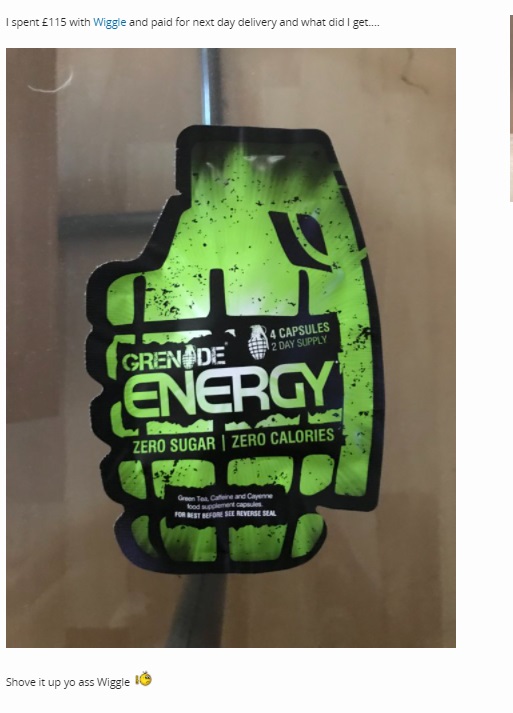
I tried to search online to see if there was an official reason for why Wiggle includes a bag of sweets but all I could find were complaints.
I’ve never had any problems with missing Haribo, however, having read the comments, I have bought a spare packet, just in case. I would hate to think what would happen if my wife didn’t find a Haribo the next time a parcel arrives.








 Twin brothers swimming, cycling and running in Scotland