All posts by Andy Todd

The Sound of Football: Cardiff City (Andrew)

Every fortnight we cover the best and worst football songs from every club in the UK from our book ‘The Sound Of Football: Every Club, Every Song’. You can buy it here

Cardiff City

Nickname: The Bluebirds

Ground: Cardiff City Stadium

Stadium Capacity: 26,828

Song: Do The Ayatollah/Men of Harlech

What links the Nobel Prize for Literature; the Ayatollah Humani, spiritual leader of Iran; and porn baron and former West Ham chairman David Sullivan?

A. A special edition of Asian Babes dedicated to contemporary theology; or

B. Cardiff City?

If you picked A, shame on you. If you picked B, you must know that David Sullivan was born near Cardiff; the club’s nickname was based on a Nobel Prize winner’s play, and the club’s fans sing a song inspired by Iran called ‘Do the Ayatollah’.

First, the play: Cardiff City was originally called Riverside A.F.C. It played in a chocolate coloured strip. The club changed its name to Cardiff City and its strip to all blue after the town was granted city status in 1905. After changing colours, a play called ‘The Blue Bird’ was performed to sell-out audiences in Cardiff. It was written by a Belgian playwright and winner of the Nobel Prize for Literature. After watching the play, some Cardiff City fans nicknamed the team ‘The Bluebirds’ and the nickname was so successful that it became a symbol of the club and was used on the club crest.

But why the song  ‘Do The Ayatollah’? It was first performed in 1990 by the singer of a Welsh-language punk group called U Thant.  The singer had been inspired by footage of funeral attendants of Ayatollah Khomeini raising their arms together, clasping their hands, and repeatedly pressing their locked hands up and down on their head  After he performed the dance on stage at a gig in Cardiff, fans borrowed the ‘dance’ and adopted it for the terrace while chanting ‘Do The Ayatollah’ repeatedly.

The song is now sung at players in the team, opposition managers, and anybody the fans want to have a go at. The person being sung at has to respond by… performing the Ayatollah.

An official version of the song was released when Cardiff City reached the FA Cup final in 2008.

It may be surprising that a club from Wales reached the final of an English competition, but when the club formed in 1899, there was no Welsh league to enter.

The club is proud to be Welsh, but the date of its greatest triumph is a very English day – St George’s Day. The Welsh side became the first non-English side to win the FA Cup on St George’s Day, 23 April, in 1927.

Many owners have tried to use Cardiff’s unique status in English football. One of the most controversial owners was ex-Wimbledon boss Sam Hammam  Sam bought the club in 2000 with the aim of converting Cardiff into a focal point for Wales by renaming the club The Cardiff Celts and changing its colours to mirror the flag of Wales with red, white and green.

Fans boycotted the change, and he was persuaded not to go ahead with it. But money talks and, under new management from Malaysia, the fans have seen the team’s colours change from blue to red and black and the bluebird replaced by a dragon.

The fans would like a Welshman to own the club. And while local boy, David Sullivan, born in nearby Penarth, has repeatedly said he wants to own the team he supported as a child; instead, he bought Birmingham and then West Ham, proving that porn barons don’t become millionaires by listening to their hearts.

Before every Cardiff home game, the club plays the song ‘Men of Harlech’  The song describe events during the seven-year siege of Harlech Castle. The garrison held out in what is the longest known siege in the history of the British Isles.

From the hills rebounding, *clap clap*

Let this war cry sounding, *clap clap*

Summon all at Cambria’s call

The mighty force surrounding, *clap clap*

(Source: trad.)

Men of Harlech was first published without words during 1794 as Gorhoffedd Gwŷr Harlech – March of the Men of Harlech  There have been many different versions, including one for Michael Caine’s 1964 film Zulu and, more recently, a fan-produced version referring to Gareth Bale for the Welsh national team’s 2016 European Championship campaign. 

As a traditional song, we’ve not included it among the oldest football songs but, with its origins in the eighteen century, it, along with Newcastle United’s ‘Blaydon Races’, are among the oldest songs you’ll hear in British stadiums.

Buy the Sound of Football from Amazon.
Outdoor Swim Review – Loch Tay (Andrew)

This is less a review and more a plea for help. I only know one spot to swim at Loch Tay. There is a small lay-by just outside Taymouth, less than a mile along from the marina, with a path from the road to the lochside. But Loch Tay is a big loch. It must have plenty of better spots to swim. So, if you know one, I’d love to know it as I’ve never had the time to properly explore around the loch.

From this spot, you get a good view of the Ben Lawers range and crystal clear water to swim in. You also get a rocky entrance and, for the three times I’ve swum here, a quite choppy swim. Whether that’s location or just bad timing with weather, I don’t know. But be prepared for less than calm conditions.

Ease of Access: The shore is easy to access from the road.

Swim Quality: Good though watch out for the fish farm to the west. Swim east to avoid it.

Water quality: Clear and colder than other lochs for the same time of year.

Would I go back: Yes. If only to find other spots to swim.

Other People: There are boats using the loch so make sure to use a swim float so that you can be easily seen.

Outdoor Swim Review – Loch an Eilein, near Aviemore (Andrew)

San Francisco has Alcatraz island. Aviemore has Loch an Eilan castle. While Alcatraz may have the world famous prison and is infamous for the murderers, gangsters and scoundrels who have stayed there, Loch an Eilein, was once voted Britain’s Favourite Picnic Spot in a poll organised by Warburtons to commemorate National Bread Week. So, while both places might have islands with buildings on them, there’s only one place you want to have a flask of tea and a sandwich.

And I have to agree with Warburton’s. This is a cracking spot for a picnic. It’s also a cracking spot for a swim.

There’s a large car park (which you need to pay for, when manned), a short walk to a small ‘beach’ a the top of the loch, and then a gentle slope into the loch with just smooth stones underneath. For that alone, it’s a great spot for a swim. But what makes it a swim spot you won’t want to miss is the ruined castle on an island in the middle of the loch. It’s around 500m from shore but you can follow the shoreline until you get closer to the island to avoid swimming in the colder, deeper parts of the loch. You can then swim across and around the island to see the ruins.

You might be tempted to go ashore to explore the castle when you first cross but I would recommend swimming to the eastern side of the island where it’s easier to walk ashore. You can then have a picnic, if you haven’t drowned your sandwiches on the way.

REVIEW

Ease of Access:

Rating: 4 out of 5.

It can be busy as it’s a popular spot but I was there on a Sunday evening at 6pm and there were only half a dozen car in the car park.

Water quality:

Rating: 5 out of 5.

Very clear.

Swim Quality:

Rating: 5 out of 5.

Very shallow around the foreshore so plenty of good places to swim if you don’t want to venture too far from shore. For those that do, it’s got a castle! A castle!!!.

Other People:

Rating: 2 out of 5.

It can be busy.

Would I go back: 

Absolutely. You’re surrounded by the Cairngorms. It’s nice and sheltered. And did I mention the castle?

The Sound of Football: Cambridge United (Andrew)

Every fortnight we cover the best and worst football songs from every club in the UK from our book ‘The Sound Of Football: Every Club, Every Song’. You can buy it here

Cambridge United

Nickname: The U’s

Ground: Abbey Stadium

Stadium Capacity: 8,100

Song: I’ve Got A Lovely Bunch of Coconuts

Although Cambridge United was formed in 1912, the town has an even longer football pedigree. It all started with the Roman game of harpastum, an early kind of ball game that involved two teams trying to keep the ball on their half of the field for as long as possible, and which was played in Cambridge when the Romans conquered the town.  

During the middle ages, a form of the game continued as a team from the university – the gowns – competed against a team from the town. This town vs gown match was fierce and, to try and impose some order to it, in 1848, the teams met to establish one uniform set of rules.  These rules were written on papers fixed to the trees in Cambridge and, later, when the Football Association was founded in 1863, they used the Cambridge rules. 

However, helping write the rules did not provide Cambridge United with an easy pass into the football league. It was nearly 40 years before the club became professional in 1949, and, even then, it didn’t enter the football league until 1970.

When it did, you would hear ‘I’ve Got A Lovely Bunch of Coconuts’ after they won their first league game against Oldham Athletic on 29 August 1970, just as it has been played after almost every home victory. You may wonder what connection coconuts have with Cambridge. The answer is… none. As BBC News reported in 2015, one fan, Robin Mansfield, remembered how the song was chosen:

It’s quite simple.  Our neighbour, Jack Morgan, did the announcements in those days. He said: ‘I had a pile of records in front of me, and that was the one on the top’.”

Buy the Sound of Football from Amazon.

Outdoor Swim Review – Findhorn Bay (Andrew)

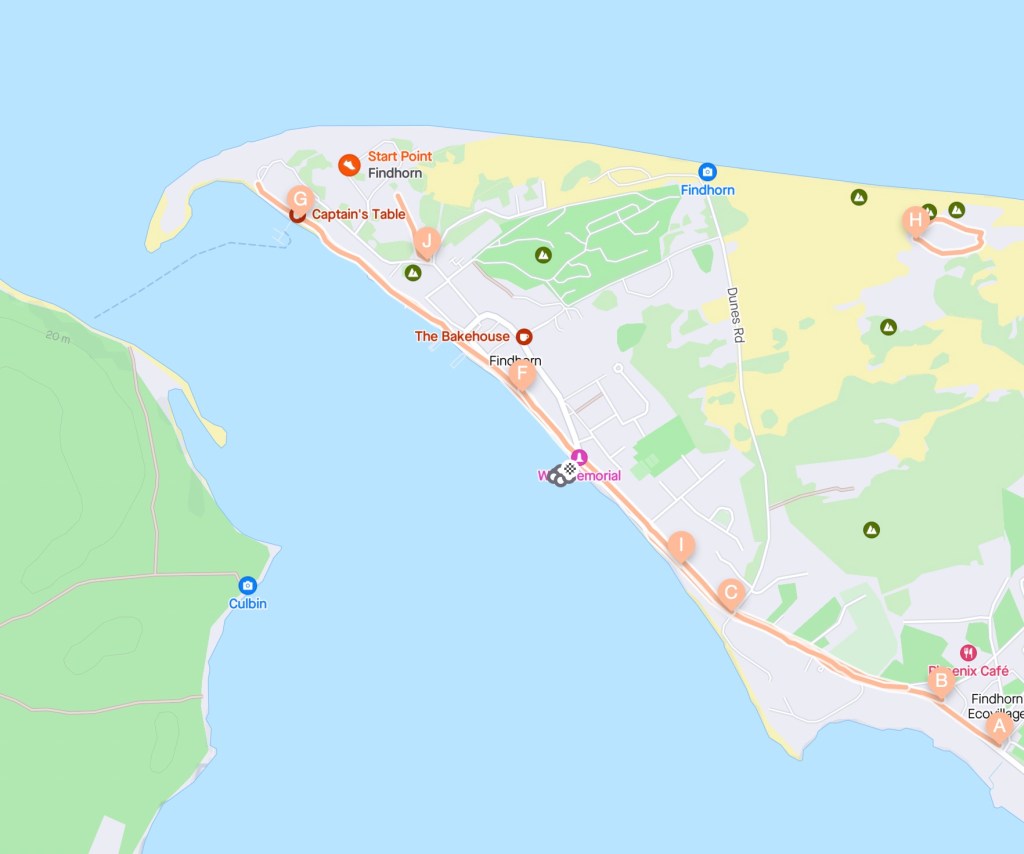
Findhorn is a small village on the Moray coast which is famous for being the site of the Findhorn Foundation, a charity dedicated to spiritual learning to, as the foundation website proclaims:  explore kinder, more joyful ways of living, and co-creating a transformed world.

Given we’re currently on the brink of World War 3, I’m not sure their ambition has resulted in any meaningful changes but, as mission statements go, it’s better than “live, laugh, love”.

I was in Elgin in June and decided to pop along to Findhorn after I saw that it would be high tide at 7:30. I’d swam in Findhorn before and I knew that the tide would have to be reasonably high for the water to fill the bay.

I timed my arrival right and was able to access a small rocky beach from a slipway at the front of the village. While easily accessible I do have one warning. The slipway is right beside a short road that has two pubs on it. Both are popular and the road provides parking. On a hot summer night you may struggle to get parked. And, if you do, remember you’ll need to get changed publicly too.You may want to bring a few towels to provide some privacy.

For swimming, the bay is nice and sheltered with few waves, even when the beach on the other side of Findhorn is being battered by waves whipped up by a north wind.

I’d definitely recommend a swim here, particularly if you want the protection of knowing you are going to swim in calm conditions.

Ease of Access: The slipway is easily accesible. But be warned. The town (and parking) can be very busy on a nice day. 

Water quality: I prefer it when it’s a high tide.

Swim Quality: Good though watch out for tethering ropes from the boats in the harbour. They are easily avoided.

Other People: It can be busy in Summer.  

Would I go back: Yes.

I Have A Confession (Andrew)

Tri-suits are not flattering. Every lump and bump is highlighted when it’s covered by lycra. That’s why, when I go to a race, I always admire anyone who would wear one because it requires a level of body confidence I don’t possess. I’d much rather have a tri-burlap sack.

But, at races, among the ‘normal’ athletes you will also find the men and women who couldn’t crease a suit even if they breathed out after eating a dozen Krispy Kreme donuts. The Kreme de la Kreme of triathletes. The ones you can’t help buy admire if you end up running, cycling or swimming behind them.

I don’t notice these physical gods at any other time. I don’t think “oh my, what broad shoulders he has” or “what a slim waist she has” at any other time. They only catch my eye at races and only with a tri-suit. That’s why I think I might be… ahem… tri-sexual.

The Sound of Football: Bury (Andrew)

Every fortnight we cover the best and worst football songs from every club in the UK from our book ‘The Sound Of Football: Every Club, Every Song’. You can buy it here

Bury

Nickname: The Shakers

Ground: Gigg Lane

Stadium Capacity: 11,313

Song: Bury Aces

The summer of 2013 saw Bury become the busiest team for transfers in/out of the club. The club had been relegated to League Two the previous season and had released a statement saying it needed £1 million to survive. To cut costs, it let 16 players leave the club. The financial situation was so bad that the club couldn’t afford a lawyer to transfer the deeds from the old regime to the new one when it was taken over.

The move out of administration was led by supporters, spearheaded by Neville Neville, the father of former England internationals Gary and Phil.

This financial boost gave the club a fresh start, but Bury had no squad. The manager Kevin Blackwell had to sign over twenty players, and with so many new signings, he struggled to remember all of their names. Kevin is quoted as saying:

One of the players had a word with me because I’d forgotten his name, and I said, ‘listen son, I don’t know anybody’s name – never mind yours‘.”

However, soon everyone would know one player’s name: striker Lenell John-Lewis. Sadly, not for his goal-scoring exploits but for the chant the fans would sing to remind them who he was.

His name is a shop!

His name is a shoooooopppppp!

Lenell John-Lewis!

His name is a shop!

While most players go through their careers without winning a medal, most clubs go through their existence without winning a significant trophy. Lower league Bury has the distinction of not just one major win but two.

In 1900 it won the FA Cup by beating Southampton 4 – 0. The Shakers returned in 1903 and did even better – it didn’t concede a single goal in any round and then beat Derby County 6 – 0, still the biggest win in the FA Cup final. It inspired Bury Aces:

Oh, the lads, should have seen us coming,

Fastest team in all the land, you should have seen us coming,

All the lads and lasses, with the smiles on their faces,

Walking down the Manny Road to see the Bury Aces!

(Source: unknown)

Nowadays clubs complain about a congested fixture list, but at least it doesn’t have multiple FA Cup replays to contend with. In the 1954/55 season, the FA Cup match between Stoke City and Bury was replayed four times.

The teams first met in Bury and played out a 1 – 1 draw. The replay also finished 1 – 1 (after extra time). The next match was a 3 – 3 draw (after extra time). Bury then played out a 2 – 2 draw just days later. Finally, Stoke won the last match 3 – 2, scoring the winning goal in the last minute of extra time just as everybody was preparing for a sixth game. The tie lasted 9 hours and 22 minutes.

Since 1903, Bury’s FA Cup success has been limited. However, in 2006/7, Bury managed to go through the whole tournament unbeaten, well, kind of… It became the first professional side to be thrown out of the FA Cup after the club had fielded an illegible player. And, sadly, it’s not just the FA Cup that has expelled Bury. In 2019, after falling into financial difficulties, the club was removed from the football league too.

Buy the Sound of Football from Amazon.
Film Friday – Jumping Off The Eiger (Andrew)

Film Friday is a weekly recommendation of one video to watch this weekend.

Don’t watch this video if you hate heights. I hate heights and now I’m a nervous wreck after watching one man narrowly miss every rocky outcrop on the Eiger while flying around it in a wingsuit. Avoid!

Loch Leven Half Marathon 2022 Race Report (Andrew)

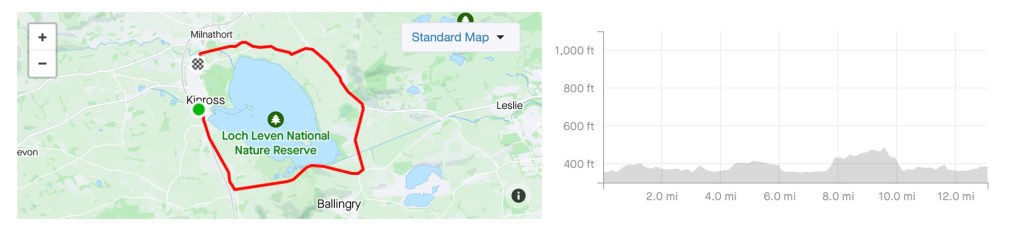
The Loch Leven Half Marathon must have one of the worst starting locations in Scotland.

Kinross is a beautiful victorian town in Fife with large mansions, open fields and plenty of trees and hedges. It is the kind of town that people want to retire in. Rich people. Homes are not cheap here!

However, for the start of the race, you have to take a right at the bottom of the High Street and start beside an industrial unit and a large metal fence. No trees. No hedges. No homes thinking of applying for Scotland’s Home of the Year. Instead, you start beside a crane and a log splitter. It’s bizarre as the rest of the route is one of Scotland’s best half marathon routes as you run around Loch Leven with views stretching miles in each direction. It’s one of my favourites.

Perhaps to make up for the start line, the Loch Leven Half Marathon must also be one of the easiest half marathon loops in Scotland. You start beside metal sheds. You immediately turn right and then you only have to turn left three times after that before you’re back at the start. That’s one turn every four miles. You can’t get easier than that without running along the M8 to Edinburgh.

I was looking forward to the race but was conscious that my preparation had been poor. I’d ran 17 miles the previous week and I’d ran some longer runs during the week than I would have normally run in the week before a race. My legs felt heavy before I’d even left the industrial estate.

However, even with heavy legs, I still managed to run faster than Iain TwinBikeRun, which is all that counts because, unless you’re running for a record, than you’re running to beat your competitors and I ran faster than mine! 🙂

Race profile

  • 100% tarmac.
  • Open roads but with the number of people running, cars will crawl along to offer you a safe run. The second half of the route is much quieter.
  • Three miles of a steady climb, three miles of downhill and undulating, one mile straight down a hill, a few hundred metres straight back up one; undulating until a flat finish (except for one very short climb).