Lucy Charles-Barclay and Reece Barclay are both professional triathletes and husband and wife. Both were swimmers before converting to triathlon in 2014 having no background in running or cycling. They are now both successful professionals and Lucy has become one of the best triathletes in the world.
Their YouTube channel is worth a follow and this video in particular is worth a watch to see what a typical day of training if like for them as they get close to a race. I say “typical” but as the video was shot in lockdown it also shows how they are training and having to comply with COVID regulations.
The Bob Graham Round ultra running challenge is a challenge to run up and down 42 mountains (aka Fells) in the Lake District within 24 hours. The challenge is named after the first person to complete it back in June 1932, Bob Graham, a guest house owner. For the next 90 years he would have be pleased that other people have followed in his footsteps as his challenge inspires people to travel to the Lake District to complete it – and he can rent them a room when they arrived. It should be called the Bob Graham Advert.
This documentary about the Bob Graham Round follows Danish runner Kristina Madsen as she attempted the round in 2019. I’ve read a number of books about the challenge and they all say the same thing: if you’re attempting the challenge there will be a big community of runners willing to help you. Previous racers, local runners who know the fells, everyone will go out of their way to help anyone trying the challenge. And this documentary is no different, it shows the problems she had when some of her support pulled out, the people who stepped into help her, and it shows how grateful she is for everyone’s support. It’s nice. Very nice. But…
… wouldn’t it be great to see just one film where someone turns round and says “why are you talking about my support crew, they didn’t run it/cycle it or swim the Atlantic – I did! It was all me! I am the greatest!”
Humble is nice but it would make a change to see Kanye West or Donald Trump complete the Bob Graham.
But I must admit to some nerves. Swimming pools don’t reopen until the end of April and the lochs have only just started to warm up and reach 5 degrees. Yet, just a few weeks later, we will need to swim 3K in the sea. That’s a big ask and one that I do worry about as a lack of training will certainly mean a slower swim, at best. There will be an increased risk of hypothermia and I’ll certainly be more tired on the bike after swimming without adequate training.
To help prepare, Iain TwinBikeRun spotted that Pinkston Watersports was starting open water swimming in it’s canal lock again in April. We were able to book a weekly session through to the end of May so at least we’d have one swim a week. I’ve also applied for the Arlington Baths for membership so I can use their pool once they reopen, which I thought was an expensive but safer option than trying to get in the Glasgow Life swimming pools. And, finally, I hope it’s sunny for the next two months so that the water can heat up and I can get back to wild swimming. Five degree is my cut off for swimming as the effort to swim is not matched by the time in the water. If I’m going to spend at least an hour trying to get to a loch then I want more than just a few minutes in the water.
Hopefully, all this effort, will help bring back some swimming ability before June, assuming it does go ahead. Because although the organisers have announced that it will I think it may be too ambitious to hold it so soon after lockdown eases because athletes may say that a lack of swim practice is just part of the “extreme” nature of an “extreme triathlon”, sometimes athletes need protected from themselves.
I am reminded of sitting in a boat waiting for a swim to start when the organisers announced it was cancelled due to high winds. The safety boats couldn’t sail and there would be no one to protect the competitors. “It’s okay,” shouted one man, “I don’t need a boat!”. However, some decisions need to be taken out competitors hands, especially when those hands haven’t been in water since lockdown 3 started in December.
What do you do if you are a racer who has no races to race? If you are rising star of trail running, Italian runner Davide Magnini, then you continue to race the one thing you can still race: time itself. He challenged himself to try and beat the current records for running three iconic Italian courses: Ortles, Stelvio Pass, and Presanella.
If you like watching someone running up a hill faster than most of us can run down it, and if you like watching someone run down a hill faster than we could sky dive down it, then each of these short films are well worth a watch:
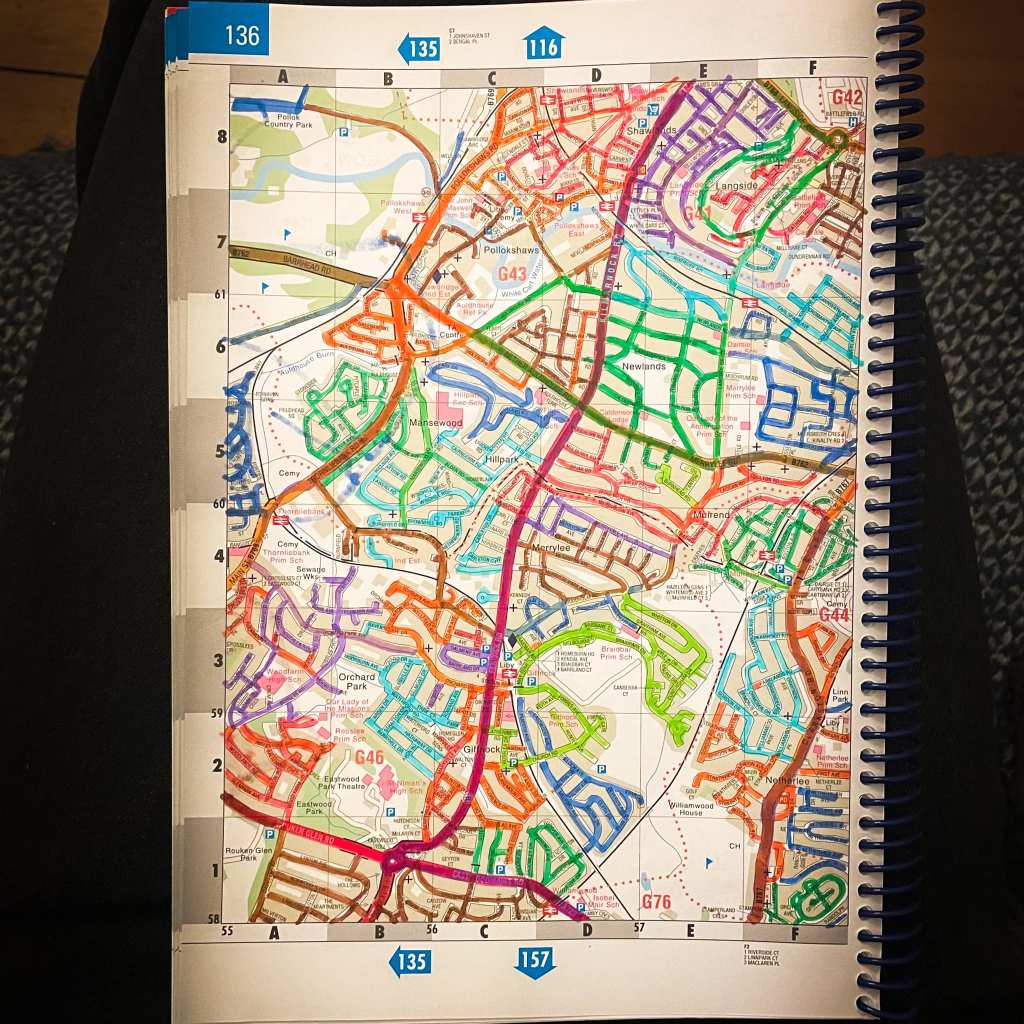
After 50 runs averaging six miles each time, I have finally completed a single page of my Glasgow Street map. To put this in context: there are nearly 200 pages in my street map (though it does cover half of Ayrshire, the Central Belt and as far north as Kincardine) so I have completed 0.5% of central Scotland!
Aside – I really should have got a street map with a smaller area, my progress would seem much more impressive, just like an advert for a sofa always makes the cushions seem bigger by hiring very small models to sit on them. Oh well, I’ll know better next time.
With one page complete, I thought I’d share some tips in case you think of trying to run the streets around your own home:
Tip One – There is a purity in running every street from your own home. It’s what the Pope would do, as he’s very pure, though I have to point out that he’d have it easy as the Vatican state is very small and he’d be able to run every street just by crossing St Peter’s Square to give a speech. However, if you’re not the Pope, and I’m fairly confident the Pontiff will not be reading this so it’s unlikely your name if Francis and you’re going to appear on Strava next week with the Vatican’s local hero tag, then you’ll probably have quite a few streets to run. And while the first ten or so runs will spiral out from your home, the next runs will involve you having to run along the streets you’ve previously claimed to get to your new world of virgin streets. After a few more runs, you’ll find you’re running 1 – 2 miles to get to the new streets and suddenly your average run has risen from 4 – 6 miles to 6 – 9 miles because you feel that you at least need to make a good effort to claim the streets after you get there.
So, just like the Pope, I feel I need to absolve you of your sins. Once you get to that stage, it’s okay to drive a bit or cycle over before starting. I didn’t. But I am pretending to be the Pope in this example so must be whiter than white. However, in future, now that I’ve finished my page, I will have no hesitation in driving from my house to get to a ‘start line’.
Tip Two – You may feel tempted to look at your phone to check where you are or what streets you need to cover. And for this, I must confess, that I have sinned! For yea, didst I look upon the Google Maps whilst trying to find a street in Orchard Park that I’d missed the first time and didn’t want to miss a second time as I’d already ran two miles to get there. But, if you can, try not to use your phone. There is nothing more satisfying than working out the layout of a new housing estate just by looking at the road and checking whether it’s covered in tarmac like a public road (which is likely to have roads branching from it) or is made of bricks like a private drive (and likely a dead end). And, you know what else? Orienteers use maps. And you don’t want to be an orienteer. Orienteering is nothing but advanced geography with trainers. Who knows what an ox-bow lake is? Orienteers, that’s who! The dweebs! Avoid!
Tip Three: After running all of these streets I have found a new love of the area I live – because these are no longer Glasgow’s streets, these are my streets. I am the Snake from the old Nokia mobile game. I have conquered these streets and turned them red, blue, green, brown, orange, yellow, blue and purple in my name. Now, to add the other 199 pages to complete my atlas.
One year ago, I left my office not knowing whether I’d ever be back. So I stole as much as I could. I made off with a laptop, a desktop, two monitors, a keyboard and a mouse.
I thought I’d be away for a long time but I returned two days later to pinch my chair.
Working at home for a year has been strange but not as strange as this analysts dress sense when he revelated a pandemic had been declared.
It was hard to take news seriously when it was delivered by a man who took style tips from Cruella Deville.
This was the first person I saw wear a mask. I found it quite unnerving. Not the mask. The fact he was wearing a t-shirt for The Rise of Skywalker . It is the worst film ever!
I think it is important even in the worst possible circumstance to keep a sense of humor about it. Otherwise it would be unrelentingly depressing.
I will celebrate my coranaversary in the same way, over the last year, that I have celebrated two mothers days, one Christmas, an Easter, three missed weddings and multiple birthday party’s. I’ll be in the house thinking of all the money I’ve saved!
It sounds simple: run three miles and then run one mile every hour for 24 hours until you run a marathon. It sounds so simple that maybe you should make it more complicated. How about running one mile every hour and also build a table, some oars, clear all the rubbish along the way you run and maybe 30 odd other household tasks. Why not try and do as much as you can in 24 hours? And run a marathon?
If you like the sound of simple ideas that clearly collapse when you get to around hour 20, mile 20 and you’re utterly knackered then this is the video for you. Optimism, idealism and a healthy dose of stupidity. But such a simple idea that you think: “maybe I should give it a go too?”
I watched ‘The Dig’ last week, the Netflix film about the Sutton Hoo archaeological dig in 1939 – and possibly the finest film about an archaeologist not featuring the words “Indiana Jones” in the title. Also the only film about an archaeologist not featuring the words “Indiana Jones” in the title. Films about archaeology is not a big genre.
I enjoyed ‘The Dig’, however, a week later, I read a spoiler that ruined the film for me. In one scene a character offers another a piece of lemon drizzle cake. An innocuous offer in an innocuous scene that has no bearing on the larger plot until I subsequently found out that lemon drizzle cake wasn’t invented until the 1960s. 30 years after the events of the film had taken place. This wasn’t a film abut archaeology, it was a film about time travel!
For a film that had already played fast and loose with the past by inventing a character played by Johnny Flynn who didn’t exist in real life, this was a step too far. If they couldn’t get the cake right could they be trusted to get anything right? Did the Sutton Hoo dig actually happen? Are the famous helmet and sword found there as real as the holy grail? Is Indiana Jones meeting Hitler more historically accurate?!
I mention this because the same day I watched ‘The Dig’ I also watched ‘Black & Whyte: A Norseman film’.
‘Black & Whyte: A Norseman film’ is the story of Prof Greg Whyte’s attempt to race Norseman in 2019. Prof Whyte is a former Olympian, a long distance triathlete and a celebrity coach who helped David Williams swim the English Channel and Greg James race a triathlon around Britain. This film shows his attempt to win the Norseman black t-shirt – and I hated it for similar reasons I questioned the Dig. It didn’t seem real.
Which is a strange thing to say. It was real. He did race Norseman, the film is testament to that. But his narration made it sound like a complete different race. He talks about the cold of the water – yet was swimming in 16 degrees in one of the warmest ever swims. He talked about the unrelenting climbing for 100 miles of the bike course, when the bike course has long descents throughout the whole course, and it showed him running to the finish on roads that I know are banned for support vehicles to stop. That annoyed me. I could see other competitors having to run around his car because it had stopped in their path and blocked the road.
Norseman is a tough, tough race and it doesn’t need to be oversold.
“First, you jump off a ferry and then…
“What, jump off a ferry? Tell me more!”
“Sharks. Sharks with figgin’ laser beams on their head. Hundreds of them.”
“That sound’s awful.”
“Not as bad as the bike ride through landmines, an active volcano and, worst of all, a head wind.”
I suspect my criticism of this film is one that’s not matched by anyone who’s not been to Norseman. He’s telling a story, he has to show how hard it is. And for the average viewer they’re not going to care whether a car was parked on the right place of the road or not. He told a story – but not one I recognised as Norseman. And, for me, it spoiled what was an otherwise well filmed and cinematic video of the Norseman experience. He tarted it up like a lemon drizzle cake. It didn’t need to be there. Adding it, added nothing. But once you know it’s there you can’t believe the rest is real too.
After last month’s brush with COVID, this month was just about getting back into a routine and getting close to the schedule I should have been following.
My original idea was to follow a Celtman training plan on TraingPeaks. For c£50 I bought a plan showing day by day the sessions I should be doing in order to give me the best chance to meet the cut off for running Ben Eighe. However, with the COVID lurgy I managed four days before I had to stop to become part of a global pandemic and then another three weeks where I had one week for it to pass, one week of a slight cough and then a third week of rest and only very light exercise before starting back again. this meant I’ve had three proper weeks of following the programme and so far I’ve done… not too bad. I’ve completed all sessions except for a couple of switches when I cycled instead of ran because the weather was too bad to go out and shortened a couple of the long cycles because I was doing them indoors and I don’t have the fitness yet to do more than two hours indoors. I work though on the principle that every minute indoors is worth two outdoors because you don’t pedal all the time outdoors and for every metre you climb when cycling from home then you also have a metre to descend….
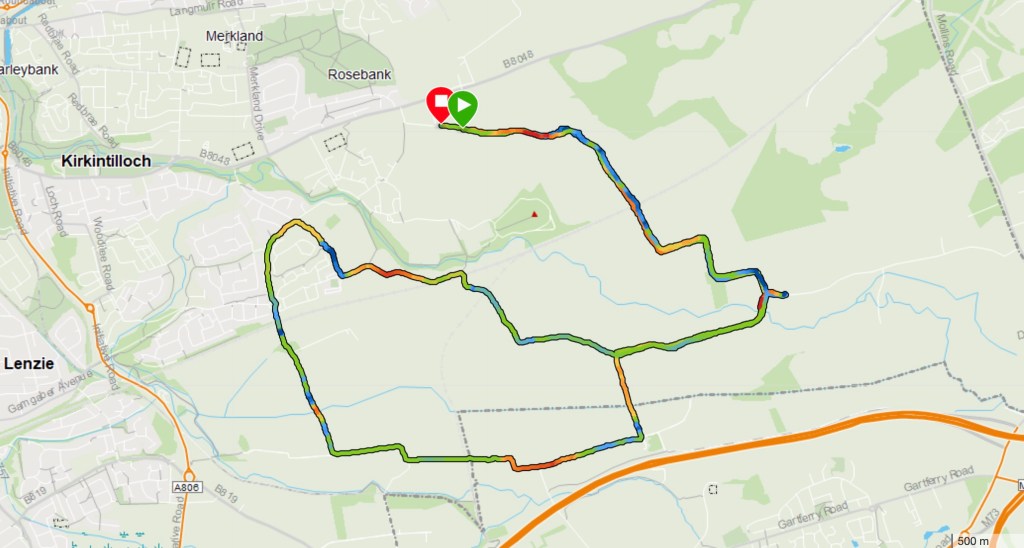
To finish the month, we raced the Kirkintilloch 12.5k and managed to get the race bike out for its first outdoor ride this year. All in all, a good month considered. Now onto the crunch month: March and the impending announcement about whether Celtman will go ahead. Given Scotland is not due to start opening up un the end of April I’m giving it 50/50. It will be hard to have the race postponed again but given it’s due to take place less than two months after lockdown could end it’s a big step to get from opening up to hundreds of people in a remote part of the Highlands so shortly after that. We’ll find out next month though.
In 2017, ultrarunner Nick Butter began a challenge to run a marathon in every country in the world. 196 countries to be precise. Or 195 if you want to be really precise. Or 194. Or possibly 201. It all depends on who you ask as there are a number of countries that are heavilly disputed such as Macedonia or Palestine. But what annoyed me was that I didn’t know that there is one country which is also disputed and I had no idea it was not a country at all.
As Nick recounts each leg of his journey, starting first in the Americas and then flying to Africa, Europe, Africa, the Middle East, Asia, the Pacific and finally finishing with countries such as Yemen and Syria where conflict makes travel almost impossible, I kept thinking: “When’s he getting to Greenland?”
And then he finishes in Athens with a final marathon back at the home of the marathon and I still think: “He’s missed a country. He’s not run the world at all! He didn’t go to Greenland!”
However it turns out that Greenland is not a country at all. It’s part of Denmark and Denmark, far from being one of the smallest countries in Europe, is actually one of the largest countries in the world because Denmark is Greenland and Greenland is Denmark.
So, sorry, Nick, I thought you’d cheated but it turned out that you had ran every country in the world, which at least saves you a plane ticket and a purchase of some thermal underwear to complete your challenge!
As for the book, while the challenge was for a good cause, he was raising money for the charity, Prostate Cancer UK, the format of the book becomes tiring. 196 countries and 196 marathons with most entries being:
“Arrive in country. Delay at customs. I wonder if I’ll get in? (He gets in). I wonder if my support will be here to collect me? (They collect him). Let’s run this marathon! (He runs marathon). I met some brilliant people, they were all great. Let’s go to the next country (he goes to the next country).”
The fact that Nick just about manages to make this format work is a testament to the uncynical and enthusiastic way he talks about the challenge. You get a real sense of what it meant to him to raise money and awareness of Prostrate Cancer and his optimistic outlook to try and find the good in every country he visited.
But 196 countries is a lot of countries… and by the end I was glad he didn’t have to go to Greenland as I’m not sure I could have handled another country.