All posts by Andy Todd

Cheat Runs (Andrew)

Every runner has a ‘cheat run’.

For South African Sergio Motsoeneng it was the Comrades Marathon in 1999.

Sergio finished eighth however another runner complained to organisers that he hadn’t seen Sergio pass him during the race. An investigation checked photos of the race at various stages which showed not just a scar mysteriously appearing and disappearing from Sergio’s shin but also his watch jumping back and forth between his left and right wrist. Further investigation discovered the Sergio had a twin and that twin, Fika, had a scar on his shin. Under questioning, Sergio admitted that he’d swapped places with his twin throughout the race when one would run into a toilet and hide while the other would run out and join the race.

Sergio was banned from races for five years and when he was released he swore that he would never cheat again. But he must have swapped places with Fika when making this promise as, no sooner was Sergio free to race, when he failed a drugs test. He didn’t race again.

While I have never swapped places with Iain during a run, except in an official relay in primary school, I too have a cheat run. Just not on the scale of Sergio and Fika.

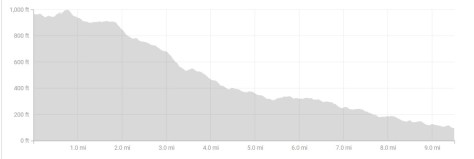
My cheat run is when I want to run 10 miles but want to do so in the easiest way possible. All I do is start beside the Whitelee Windfarm, near Eaglesham, and then run to Shawlands. A route which, apart from the first 100 metres, is entirely downhill.

Windfarm

It’s a cheat run.

I can run this even when I can’t run 10 miles on the flat. Yet, it still makes me think “wow, I can run 10 miles in training!” Of course it would be easier if I could just pop into the toilet after five miles and for Iain to take over but, in the absence of genetic based cheating, I’ll settle for running downhill all the way home.

Or a skateboard. Now that would be the easy way home!


Escape (Non-attempt) From Alcatraz 2018 (Andrew)

Only amateur athletes will ever say “I’ll just turn up and give it a go.”

You don’t see bin men turning up at the local hospital asking if they can pop down to surgery as they once watched an episode of Casualty. Yet anyone with a pair of trainers will at some point have turned up on a start line with no idea what they’re about to do or why they are there but, what the heck, let’s give it a go anyway!

However this attitude forgets that there are there are two types of fear in the world: the fear of the unknown and the fear of the known.

The unknown fear is the fear that keeps you awake at night in case aliens sneak into your bedroom and steal your socks. You’re pretty sure that if aliens did visit the earth they’d have better things to do than raid your sock drawer – but, as you can’t be 100% sure that E.T. is not phoning home and boasting about it, you worry about it anyway.

That’s why the unknown fear is a stupid fear. It’s based on misinformation – aliens steal the last bag of crisps from the cupboard, not socks – and it usually means you end up scared of something that you shouldn’t be scared of at all.

In triathlon, we have a lot of unknown fears. The big one is swimming in open water. Until you’ve swum in the sea or in a river or loch you don’t know what to expect. There could be monsters! Or, worse, it could be cold!

The first time I swam outdoors was at Bardowie Loch, north of Glasgow. I swam with an instructor who ran a regular open session on a Sunday morning. There were about 20 of us there. Most in wetsuits, one in budgie smugglers (put it away, Iain!) and one man with a loud voice who set out the rules and offered some tips for swimming in cold water for the first time.

“Go in backwards,” he said. “Let the water hit the small of your back first, then, when you’re used to it, roll over and repeatedly dip your face in the water. It’ll help you adjust.”

I don’t know why the base of your spine controls your response to cold water, but, it seeped up my wetsuit, and then through the zip at the back, all I could say was:

“AAAAAAAAaaaaaaaaaEEEEEEEKKKKKKKKKKrrrrrrrrrrrrGGGGGGGGhhhhhhhHHHHH!”

I’d hate to think what I’d have said if I hadn’t ‘reversed in’.

I found out. I dipped my face in too.

“AAAAAAAAFFFFFFFUUUUUUUU************************* GGGGGGGGGhhhhHHHH!”

However, as I started to paddle, then swim, then dipped my face again and again, the water became more tolerable. My feet were cold, my hands were cold, but my body felt fine, and, after a few minutes, I could keep my head below water and start to swim using the front crawl.

What was an unknown fear, a fear of swimming in cold water, was no longer an unknown fear. It was a quite justifiable, perfectly reasonable known fear!

Now known fears are fears of things you know are scary. Like cold water swimming. But, having practiced, and trained, and adjusted to the cold water, you can justify it to yourself: “I know this will be cold but, after a few minutes, it will be fine.”

And that’s one of the good things about training. It teaches you not just how to run, swim or cycle but it also teaches you to convert your unknown fears in known fears or, perhaps, something which isn’t ever a fear at all.

I’m not scared of swimming in lochs anymore. I know what they’re like. I know how cold they can get when it’s early Spring or Autumn. I’m happy to turn up and give it a go as it’s no longer a fear.

Swimming in the sea however…

I’m scared of swimming in the sea. There’s currents and undercurrents and waves and salt and sharks and I hear aliens nick your socks when you leave your clothes at the beach.

When I entered Norseman in 2016, it was the sea swim that scared me. It was three miles in a Norwegian Fjord, in icy water after jumping from the back of ferry.

I was scared of that jump. In the weeks before the race, I kept thinking of that jump. It was something I’d never done, something I could never prepare for – unless I wanted to start a search and rescue mission after jumping off the back of a CalMac ferry.

Without the training, my fears got the best of me. “You’ll die in those waters”. “you’ll have a heart attack, jumping from a warm boat in freezing water”. “You’ll get hypothermia.”

I ignored the voices though, got on the boat, got to the drop off point and jumped off the side.

And nothing happened. The water was warmer than expected. There were few waves. I swam round and my fear was just a fear of nothing.

I say all this because I had those same thoughts before Escape From Alcatraz 2018 triathlon and this time the fear won – but I’m okay with that.

This time my fear was based on what I knew – the swim was 2.5 miles across San Franscico bay and I hadn’t trained enough for it. A busy period at work had meant I hadn’t had time to go to the pool. My running and cycling was fine but I hadn’t swum enough for a challenging swim.

On the Saturday morning before the race I tried to swim in the bay. I swam in a sheltered spot and tried 1km to see how it felt.

It was tough. Even in the sheltered spot I didn’t feel strong in the water and it was a struggle to swim quickly against the tide.

I knew then that I couldn’t take part. The bay was going to be harder and longer. The leap from the boat was not going to be a leap to overcome an unknown fear, instead it was going to be a leap of hope that a lack of training wouldn’t matter.

And looking at the bay I thought it would be stupid of me to start. To ignore the warning in the practice and to hope that somehow swimming further and in harder conditions would somehow be easier. That wouldn’t be a smart move. Instead, I didn’t race, and I don’t regret not racing. Sometimes you have to recognise that fears are justified and that you have them for good reasons – to race again, so that with preparation and training you never need to think “I’ll just turn up and give it a go.”

The Almost True Story of Maurice Wilson (Andrew)

wilson-plane_29370

Before Edmund Hillary and Sherpa Tensing climbed Mt Everest, the world’s highest mountain, a cross-dressing shoe salesman from Bradford reached the top before them. This is the little known* story of that salesman – Maurice Wilson – and how he swapped high heels for hiking boots and back again.

In the 1930’s, Maurice Wilson had a dream. In a world bruised and battered by the Great Depression Maurice believed a single man, with faith in the Lord, could achieve anything.

That meant, despite working in a woman’s shoe shop in Bradford, despite never visiting the Himalayas, Tibet, Nepal or even Asia, Maurice believed he could reach for the stars. Literally. He would climb the unclimbable – he would climb Mt Everest – and touch the sky itself.

But first, as a warm up, he went hill walking in Wales, which, like Mt Everest, is cold and inhospitable (especially Cardiff) but nothing to match the conditions of Everest itself.

To put his training into perspective, climbing Mt Snowden to prepare for Everest was a bit like jumping in a paddling pool to swim the Atlantic. Or closing the curtains and jumping up and down in a darkened room to walk on the moon. It was simply not enough – and Maurice knew that… so he went hiking in the Lake District too.

Nothing prepares you for sub-zero conditions like an ice cream cone on the banks of Lake Windermere.

In short, to prepare for a climb that many thought impossible, Maurice did two of the three peaks in the ‘Three Peaks Challenge’. But he didn’t do them in 24 hours. Nor did he climb Ben Nevis, presumably because it was too big and far away.

But, despite being outclimbed by Dave from IT and Maureen from Accounting in your office’s annual fundraising challenge, Maurice could not be stopped. He would climb Mt Everest!

Because Maurice had a plan. A cunning plan. He would climb Mt Everest by… NOT climbing Mt Everest!

Instead he’d fly a plane and crash into the top of Everest,  pop out of the wreck, jog to the summit and claim the mountain for Blighty!

Genius.

Except for one small problem: he didn’t know how to fly.

Undeterred, he took flying lessons. Big mistake. His instructors refused to pass Maurice as they thought his flying was so bad he would kill himself during take off.

But that didn’t stop Maurice. Maurice had a dream, and he believed that dreams were there to be followed.

So, in 1933 he took off for Everest. And the take off was a success, if success is judged by escaping with his life after he immediately crashed. It was not a success. However, a second attempt followed…

Three weeks later, Maurice took off again. And this time, he travelled across Europe and the Middle East in a tiny Tiger Moth plane he christened ‘Ever Wrest’.

Despite the British Government’s efforts to either hinder him (by contacting airports to ask them to refuse to give Maurice fuel) or save him from himself, Maurice made it to Nepal, who immediately hailed our intrepid hero, wished him all the best, and, while his back was turned, confiscated his plane to stop him crashing into their holy mountain.

But Maurice could not be stopped. Despite guards barring his way, and despite not having a plane, he and two Sherpas sneaked into Nepal disguised as Buddhist monks.

According to his diary, Maurice, reached Everest one month later. Also, according to his diary, he would have got there faster, but he kept getting lost on the way.

History does not record whether Maurice had ever learnt to use a compass.

On May 15 1934, Maurice arrived at Everest. It was, as he suspected, remarkably like Snowden. Except 10 times bigger, 10 times colder, and without a steam train that takes pensioners all the way to the top.

But without a plane it was time for Plan B. Maurice would climb Everest singlehandedly.

This was not a success.

With no experience of climbing, no equipment, no clue what he was letting himself into, Maurice lasted five days before he had to turn back to base camp. In his diary Maurice wrote:

It’s the weather that’s beaten me – what damned bad luck!

But that didn’t stop Maurice. He tried a second time, and this time he made his way through faith, prayer and fasting almost all the way to the top until he was stopped by an ice wall that he couldn’t climb because, despite all his preparation, he had never learnt to use a rope.

And there he died. In a lonely tent at the foot of the wall, overcome by the cold, having failed to conquer Everest.

Or that’s what most folk think.

Here’s the thing.

A couple of years ago, a Chinese expedition reported finding, just below the summit of Everest, a single high heeled women’s shoe. No-one could explain it. Chris Bonnington’s not known for his fondness for a patent leather pump, unless that pump inflated a belay bed at 30,000 feet.

Maurice on the other hand (or other foot) was different. It turned out that some nights former shoe salesman Maurice liked to be known as Maureen. And Maureen liked ladies shoes. And in his/her bag, in his/her tent at the base of the wall, Maureen nee Maurice had packed a floral dress.

So, how did the shoe get to the top of Everest? Could Maurice have reached the tip of the world in his high heels and floral dress? Did he use his stilettos as make shift ice axes to climb the Hilary step? Could he have reached the summit twenty years before any other man and have died on the way back down, and not on the way up, as many believe?

I’d like to think so.

One day, when temperatures rise and the top melts, we’ll find that shoe’s twin. A single high heel planted on the summit confirming that the first man on Everest with a woman’s name was not Hilary but… Maureen.

*And possibly, almost, nearly true. Kind of.

Etape Caledonia 2018 (Andrew)

Recovery

It’s not often you see someone carrying a spare tyre when they’re out riding. A tube, yes. A tyre, not so much.

What are the chances you’ll need a spare tyre in the middle of a race? Or worse, in the middle of a race that you ‘d be planning to race for six months? Or worse, 10 miles into that race, you need a tyre and you don’t even get the sense you’d even started it.

What are the chances? Pretty high actually, if you’re me. I had a tyre explode 10 miles into the Etape Du Tour – a race which follows a stage of the Tour De France.

A rip in the tyre wall meant a wait at the side of the road for a motorbike support.  And then another wait as the support checked if they had any spare wheels they could give me before I was finally told “the only wheels you’ll see are the four on the bus that’s coming to pick you up!”.

I remembered this horrible memory on Sunday as I waited at the side of the road, this time just after the five mile point, for motorbike support. I was taking part in the Etape Caledonia and had selected the wrong gear before climbing a short sharp hill. I tried to change gear. My chain slipped. It became caught in the crank and it became so twisted and knotted even Alexander The great would have said “I may have conquered the world – but, fek’s sake, even that knot’s beyond me!”

But, as I waited for the inevitable conversation with the mechanic that would lead to the sweep up truck, he said:

“Wait, is that a quick release link?”

Before he pressed the chain, split it in half, threaded it through and released the knot in 30 seconds. He then threaded the chain back, linked it together and said: “You’re good to go!”

And I had a second flashback. I remembered in January I’d tried to change the chain, failed miserably at removing the pins, destroying the chain tool in the process, before I’d replaced the chain again with quick release links.

Thank you, January Andrew! You’re a star! (Even if you didn’t know what you were doing and was just following the first YouTube mechanic video you could find).

So, despite starting again near the back of field, as every one had passed as the bike was fixed, at least I was starting again this time

As for the race, a new three mile loop adds an interesting challenge to the first half and some cracking views of Schiehallion. A rebrand gives some cracking looking jerseys. And, despite a heatwave on Saturday and forecast of a dry day with more to come, there was still a couple of spots of rain as we passed Loch Tummell. The Caledonian Etape – never knowingly dry no matter what the forecast!

The highlight of the race however came as I reached the 70 mile point. I saw a man with a spare tyre tied onto the panniers on the back of his bike, I didn’t think “Ha! He won’t need that!”. Instead,  I thought: “Well played, sir, well played indeed!”

(Oh, and Iain claims he won – but the official time shows a dead heat, so I’m still the undisputed heavy weight champion of the Etape Caledonia!)

It’s a game of two sick parrots (Andrew)

“Does anyone want to play football? Eleven a-side. You don’t need to play, you just need to be able to run.”

My first thought was “No!” and my second thought was “Hell NO!!!” because full fat football, the eleven a-side version, is horrible.

First, you have to have a position. A position that says where you should be, who you should mark, when you should run and when you should defend. Which sound easy. If you’re a left side defender you should be on the left side of pitch. However, you might think that’s where you should be, everyone else in your team will shout “FFS! You’re out of position again!” To everyone else, you couldn’t be more out of position if you were a dyslexic reading the Karma Sutra.

Because here’s the thing. In every eleven a-side game there’s at least one, if not half a dozen players, who think they have the motivational skills of Sir Alex Ferguson. Not in the inspire you to victory and to give your all until the very last minute type way. More in a “I will *****ing kill you, you *****ing **** if you ******ing don’t get *****ing back in *****ing position” type motivational speech way.

Playing eleven a-side football turns some people into tyrants. Usually Dave from IT, the one you least suspect of Hulking out as he never says a word to anyone, just sends emails that you delete without reading because you know he’ll be talking about the server again.

It could be worse though. You could volunteer to play and you hear language that no one should ever hear. Words that would terrify Rambo and make The Rock cower in fear. Those words: “Barry’s not turned up, can you go in goals?”

NOOOOOOOOOOOO!!!!!!!

New Pool Rules (Andrew)

I don’t know an awful lot about torture but I do know that water torture must be the worst kind of torture –  because what can be worse than swimming behind someone in the fast land as they only go and swim the bloody breast stroke… grrr! Now, that’s torture!

And, with all that water torture that goes on at Guantanamo Bay, I can only imagine it’s like an evil Butlins. I bet they don’t even water the slides and make the prisoners slide down on the hard plastic giving them all friction burns. The monsters! Damn you, George W Bush and your slow lane hogging legacy war on terror!

However, for those like me, who hate water torture but also hate asking people to move lane, I have an answer that fixes both the torture and the akward conversation. We need to rethink how we divide swimming pools. Slow, medium and fast lanes are too subjective. What is fast?  Is it someone swimming the crawl slowly or someone swimming doggy style quickly? And who even knows what medium is? Is that when you try and swim with one arm only? It’s too difficult to work out!

Instead, we need to come up with an entirely objective approach. One where we can quite happily approach strangers and tell them that there in the wrong lane without any risk of an argument.

So, howabout:

·     The little old lady lane for little old ladies who don’t like to get there hair wet.

Now, before you say I’m sexist and ageist by picking on (a) ladies; and (b) pensioners, please read on to the next lane before you make judgement. I’m also picking on men too.

So, who would be in this land. That’s an easy one. I’m picking woman who are over 60 and below 5 foot 6 inches but, crucially, always swim with their head at least 10 feet out of the water. You know the type. Gets in gingerely. Makes sure they don’t splash and then tries to slowly, slowly swim no more than two laps by not creating a single ripple.

Ladies, I salute you, and, to you, I give you your own lane.

·     The big dick, dick lane for men who not only think they’re big dicks they’re also big dicks.

This lane is for the dick who swim back and forth no matter who is in front of them. You know who they are. They’re the ones who always swim around you and into other people because it’s more important that they keep swimming and everyone else stops than it is not to be a dick.

You can usually tell the big dick in the pool because they’re also the only ones who wear Speedos in a way which cause maximum exposure of their… big gut.

·     The lane for those who like to swim, not just paddle.

This is the lane for most of us. You can tell it because it’s the lane with the swimmers in goggles, even though they don’t really need them, and the constant question of “Is it okay if I go?” when they get to the end of the lane and someone is waiting at the wall. It’s the anti-dick lane. The ‘no, you go first’ lane.

·     The ‘kids shouldn’t be here’ lane.

This is a lane for all the parents who bring their kids into the adults only time and then take a whole lane to themselves even though little Timmy is only paddling beside the wall. You’ll find this lane in the changing room beside a clock with a timetable reminding them when they can go in!

Etape Caledonia 2018 – New Route (Andrew)

A few weeks ago it was reported that the UK Government was going to scrap 1p and 2p coins because no one used them anymore and they just clogged up space in your purse or wallet.

Within a day, after front page stories attacked the idea, the Government u-turned as it announced it had no plans to scrap them at all, proving once and for all that everyone both loves and hates change.

Runners love change because change represents variety. I usually try and run different routes each time I go out so that while I might follow streets or paths I’ve run before I try and not have too much of a fixed route in my mind. That way I can change direction, pick a side road I’ve not in in a while or, my new favourite hobby, run along a back alley and find the secret routes through Glasgow hidden behind houses, offices and shops.

Running’s all about the route, not the destination.

Cyclists on the other hand hate change. When you’re on a bike, while it’s nice to explore new routes, it’s also reassuring (and safe!) to ride the roads you know well. The ones where traffic is light, where you’re not likely to meet an unexpected pothole, and you can concentrate more on the destination than the route. You have somewhere to get to, and you want to get there in the fastest possible time.

That’s why I’m disappointed to read that this year Etape Caledonia will have a new route. Not much of a change, an extra three miles to incorporate a short climb before Loch Rannoch, but a change nonetheless.

After several years of trying to get faster and aiming to beat four hours, an extra three miles means that history is lost. I can’t compare this year with previous years as we’re now riding a new route.

And while the new route will be good – any ride in Perthshire is good – it’s also bad as it means the history is lost.

So, just like the penny, change is both bad and good!

Balfron 10K (Andrew)

DbUdMtfX0AA-Ve_

I left my legs in Wanlockhead.

On Saturday, it was a beautiful day and we went to Wanlockhead – the highest village in Scotland – for a 40 mile cycle down through the Menock pass and back via Drumlanrig Castle and Elvenfoot before climbing to the top of the radar station.

Before we started, we parked in the centre of the village. A smiling man with an old large rucksack approached.

“Are you here to open the shop?”

We explained we were cycling.

“Oh, my bus leaves in 10 minutes and I need to buy my licence.”

“You need a licence for the bus?”

“No, I need a licence from the land owner as I’m here to find GOLD!”

Which was not what I was expecting to hear at 9am on a Saturday morning when (a) we’re not in California; and (b) it’s not the nineteenth century!

“How do you find gold?”

He opened his rucksack and then showed me a tube that was used to collect gravel from the bottom of riverbeds. He showed me a large plastic tray with grooves where the lighter soil would be washed away but the heavier gold would be caught in the grooves. Then he showed me his pan where he gently washed the last of the gravel leaving behind the millions and millions of pounds of GOLD!

“Do you find much?”

“I usually find a few specks the size of a grain of salt.”

Really?!? I looked round to see his Rolls Royce.

“And how much is that worth?”

“Nothing really, not even a pound, but it’s FUN!”

I didn’t want to hear about fun. I wanted to hear about making millions just washing gravel. But despite, as I found out later, Wanlockhead being known as ‘God’s Treasure House in Scotland’ due to the abundance of minerals found in the area, there’s not a lot of gold in them there hills.

In fact, the licence was £5 (I checked) and if it was possible to make more money panning for gold than selling licences for £5 then you can bet the land owner wouldn’t be selling licences for £5.

Despite the small chance of striking riches, as we cycled round I began to see that all the people I’d previously thought were  fishing were actually panning for gold instead. It seems that gold fever is alive and well and can be found in Wanlockhead.

Gold though was the last thing on my mind on Sunday at the Balfron 10k. Iain’s already described the race (see here). I can only add that it was the first time that I’d taken part and I can confirm that it was hilly and that every down hill seemed to lead to an ever longer uphill.

It was either that or my legs were still tired from cycling round Wanlockhead and every kilometre felt like a struggle today.

The race though is very well organised and has a good turnout of runners. And if you’re chasing a fastest 1K time on Strava then I can recommend the first 1K. A downhill so steep it can only be described with one word: “Geronimo!”

DbY7h40W4AA3swu