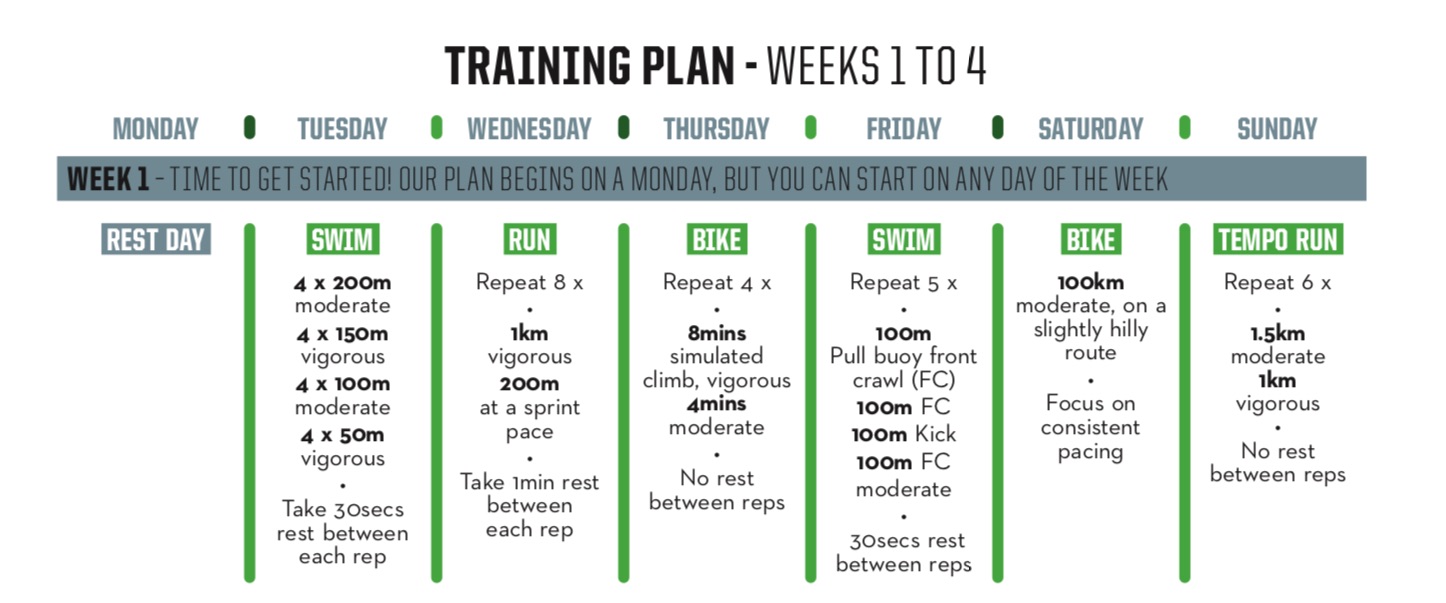
With 12 weeks to go until Challenge Roth I’ve switched my training to a 12 week training plan from 220 Triathlon. Or, I will, tomorrow. Because Monday is a rest day.
Now to find a training plan where Tuesday is a rest day and switch to that by tomorrow. Then, find a plan where Wednesday is a rest day and then…
People always say they’d like to be more fit – but what does that mean?
If you watch the Olympics you’ll see the finest athletes in the world (and shotputters). Fast athletes, strong athletes, one who can run for hours and other who get tired after sprinting 100 metres. They’re athletes. They must be fit. Yet, what is fit? Can they all be fit when they all excel in different areas?
That’s why I think there’s no right way to define fitness. One person’s idea of fitness can be completely different from someone else’s ideas. Instead, I’m sure we can all agree that there are instead many wrong ways to describe fitness and these include:
Mirror fit
This is the type of fitness that means you looks good in a mirror selfie (which isn’t a selfie – it’s a photo of a mirror!). You’re someone who doesn’t like t-shirts with sleeves. And never runs, because, if you did, you would know that the sleeve is the perfect thing to use to wipe the sweat off your face. Or a dribbly nose, when you have a cold. Compare this with…
Frit fit
You can run, you can cycle, but no matter what, you will never ever take your top off especially when standing in front of a mirror. …
Coffee fit
This is the type of fitness that only requires you to own a hoodie, a takeaway skinny latte and to stand beside the free weights while someone else lifts them. You do your drinking in the gym but compare this with…
Cake fit
You can run, you can cycle, but not matter what you do, you eat an entire chocolate cake when you get home because that 5 minutes on the treadmill meant “you can!”
But most of us are, I suspect, are just normal. We’re not mirror fit, coffee fit or any type of fitness but “bit fit”. As in we like to do a bit and we’re… well.. a bit fit!
James Brown had the funk. In fact he had over 37 songs with the words funk or funky in them. Which is a lot of songs to talk about what it feels like to get stuck in a rut while training and not feel like going out.
For the last couple of weeks I’ve been struggling a bit with running. I’ve managed to keep to my long run at the weekend but my weekday runs have lagged. I don’t have my normal rush to get changed when I get home and to head out.
I’m in the funk.
I think it stems from trying to do too much in February. I had two half marathons in four weeks, the Glentress Trail and Balloch to Clydebank. In between I managed two weeks of training with no breaks for a rest, including three days of running more than an hour each night. It was too much. And I knew that at the time but, I was away for work, and one of my colleagues kept asking if I wanted to go out and I couldn’t say: “I feel a bit tired tonight”.
I’m a guy. We don’t get tired. 🙂
But, it was a bit much and has led to a couple of weeks where my motivation has put it’s feet up.
Not me, I could run for miles!
That’s the guy talking again. 🙂
So, having identified that I’m in a funk, I’ve diagnosed the only known cure. Just like James Brown, we just need to “Get Up!” when we feel the funk.
Sitting down doesn’t help anyone. Sometimes you just need to get out and try and change things. A new route. A new distance. A new time to go out. Shake things up a bit and see what happens.
In my case, I’ve tried a few flatter routes to counteract the hills I was trying to run in preparation for Glentress. Some simple routes that make me think how easy it is to go out.
My clothes are neatly folded and I’m lying face-down wearing nothing but my pants. There is an awkward silence as a pretty young girl in immaculate make-up considers the word “groin”.
It’s at this point I regret my choice of Bugs Bunny boxers. Her eyes flick down and I feel less than magnificent.
It’s not uncomfortable. This is not my first massage, but it is my first with a woman.
Normally, it’s Steve the Physio. Steve the Physio is practical. Steve the Physio doesn’t do small talk. “Groin?” he asks. And when I nod, he roughly pulls my legs apart and, before going to work, sternly tells me to “Cup the balls, and pull them back”.
Which is not a phrase I’ve ever had to use, not that it would fit any other social situation.
“Andrew, can you pass the English mustard?”
“First, cup the balls, and pull them back!”
“Andrew, do you have any spare change for the bus?”
“FIRST, cup the BALLS! And pull them back!”
“Andrew, is this extended flight of fantasy becoming increasingly laboured”
“CUP THE BALLS AND PULL THEM BACK!”
But Steve the Physio is on holiday, and last week I was presented with the slim and attractive Muriel, and the thought of asking her to work the groin is making me feel ever so uncomfortable. Not that it should. She’s a professional; I’m a customer; and this is NHS approved physiotherapy clinic not a cat-house (which is second only to a duck-house in dodgy MP expense claims).
I think of saying nothing. Saying nothing is okay during a massage. No one expects a running commentary or political discussion. Small talk is fine. In fact, anything is fine, except for “ooooooh!”, “aaaaaahhhh!” and “just a lit bit”.
But my inner thigh has tightened and, if I am to resume running, I need her fingers to work their magic. So, when she approaches, when she lays her gentle hands upon my back, and asks “According to Steve’s it’s normally your groin that’s the problem, is that right?”
I don’t say: “Yes, if by problem you mean it’s too big!”.
Instead I nod, glad that she has gotten the G word out of the way and I can relax safe in the knowledge that I’m not going to embarrass myself by making some well intended but sexually sounding overtone to this young girl. Everything is going to be okay.
Until she says “So, where should we start?”
And I say, without thinking: “Cup the balls and pull them back!”
It wasn’t a good start. I was in the back of a taxi and having to point out to the driver that he was driving away from where we need to go. “Are you sure Clydebank is not back this way”, I pointed. He took one look at the sign saying “Clydebank” behind us and said: “I don’t know that way”. I asked if he was following his satnav and he added “Never use it – it gets things wrong all the time!”.
Given I had been tracking him on an app as he approached the house and I could see he’d missed the road, done a u-turn, missed the road again, got caught in a one way system and had parked for 5 minutes in a laybay (I assume to try and work out where he was going), he maybe wasn’t one to judge others on directions. Never mind criticise the location prowess of multiple geo-stationary satellites and the software calculations of Google.
“Can you just turn round and I’ll tell you where to go?”
“We’re going the fastest way,” he said.
We weren’t.
“You won’t get there any faster,” he claimed.
We would.
“But if you insist…”
I did.
And 10 minutes later we were in Clydebank for the start of the race and not in Hamilton, which is where we would have gone because ‘that’s the way he knew!’.
On the way over, between giving directions, I could see the weather was turning. Grey clouds were turning black. A few spots of rain became a shower became a powerwash from heaven.
By the time I left the taxi, I was soaked through just spending 30 seconds looking round for Iain.
He wasn’t there.
Hardly, anyone was there.
I phoned him.
“Are you in the car park?”
“Yes!”
“No, you’re not. I’m here and I can’t see you.”
Then he asked if I was in the right car park as the race start had moved from the old sports centre to the new one.
“Errr…”
Turns out my taxi driver wasn’t the only one with no idea of where he was going…
The Balloch to Clydebank half marathon should be called the Clydebank to Balloch to Clydebank half marathon as you start in Clydebank, the finish line, by jumping on a bus which takes you to the start at Loch Lomond shores in Balloch.
This year it might also have taken you back to the start because, as we drove up, the rain turned to snow, and you could see it start to cover the pavements. When we arrived, the driver was told to wait, in case the race was cancelled.
I thought it would be cancelled. The snow was heavy and I couldn’t imagine either runners racing on it or volunteers standing outside. I didn’t think it was safe. I was wrong. And right.
I was wrong that it would be cancelled. The race went ahead but with the option for people to jump on the bus and return to the start. But I’m not sure it was safe. There’s was a lot of snow and slush on the pavements and runners moved onto the road at points to run through Bowling and Clydebank.
While the roads were quiet, there were cars and buses driving behind them and I heard a few frustrated honks from the drivers.
The race itself was a challenge to remain warm and comfortable as the weather changed from snow to rain to dry spells to rain again.
Knowing that it might rain I’d just worn shorts and not leggings. My theory is that leggings don’t help in the rain. They just get wet, then your legs get cold as leggings cool you down. You’re better off with just your hairy legs – nature’s leggings! – when it rains.
I don’t know if this is true though but for half the race I congratulated myself on my choice as the water dried from my legs during the dry spells, and the other half of the race cursing my choice as everyone else looked like they were running as a happy as runner with toasters strapped to their thighs.
You can’t call the race scenic. There’s a few nice spots, mostly at the start as we run along the canal from Balloch, but most of the race is through housing or industrial estates. It does though have the advantage of feeling like you’re running downhill as there’s very few climbs, or even gentle inclines, and there’s a few long stretches when you run downhill.
But at least the finish line is scenic. If you like skips and bins. 🙂
I found my race report for IronMan UK that I’d posted on the Glasgow Triathlon Club forum and you can tell that I wrote it within a couple of days of racing because the first line is far too emphatic. And I then broke it by entering Norseman and now, this year, Challenge Roth. Oh, if only I’d listened to Wise 2015 Andrew!
Here’s the report:
Swam a bit. Rode a bit. Ran a bit. Walked a lot. Happy to finish. Will never do it again.
I just wanted to share six AMAZING tips I learnt from the race that you won’t find in Don Fink’s training guide*.
Tip 1: Crash at least once when it’s totally not your fault. I did and I promise that you’ll forget about your legs as you spend the next 20 miles daydreaming about a bike pump, the rider who crashed into you and the elaborate torture porn of the Saw films.
Tip 2: Your nose will run. It will never stop. Why not devise your own word for wiping your nose on your sleeve, arm, shoulder, any dry patch of jersey really. Snotting anyone?
Tip 3: You can leave a special needs bag to pick up during the bike course. You could leave spare gels and energy bars or, you could do what I did, and leave a cheese & ham sandwich and a packet of crisps. It may take a couple of minutes to stop and eat it but, after a constant diet of gels, bars and electrolyte drinks those few minutes were the highlight of my day. Mmmm…. Cheesy Wotsits!
Tip 4: We all run our own races. That’s true. But, secretly, in our heart of hearts, we all get a boost when we see a fat bloke struggle. (This is an equal opportunities tip – remember, for the people ahead of you, you will be their ‘fat bloke’ ).
Tip 5: Spectators will cheer you. They’ll shout “You’re doing great”, “Keep going”, “You’re running really well” etc, etc. However, sometimes, you know you’re not doing great. You’re walking. You’re crawling. You’ve given up and had a cry at the side of the road. At those times, the spectators should shout “You’re crap”, “You’ll never make it”, “The fat bloke’s beating you”. Sometimes we need a bit of humiliation and tough love from strangers. For your next Ironman, to run faster, why not wear a gimp mask?
Tip 6: Finally, a tip I’ve never read before. This must be a special tip reserved only for the most dedicated Ironmen and women. I call it “Recycling”. It works like this: at some point during the race, you’ll need to go to the toilet. When you do – why not eat a banana? You’re hands are free. You’ve got time. You’re not going anywhere. So why not put in what you’re… erm… putting out?
I’ve no other explanation for the amount of food found in the portaloos: folk are chewing and pooing – and they’re heading to Kouna! This could be you (but, please God, wash your hands, you’re an athlete, not an animal!).
*tips not found in Don Fink’s book for good reason!
Last year, about a week after the Glentress Half Marathon, the Beast from the East arrived and covered Scotland in snow. There were some signs of the Beast when we ran Glentress: some small snow banks at the side of trails, in the shadows of sheltered hollows and in the patches of ice where the snow had melted and the run off and frozen over across the paths.
This year, Glentress was completely different. It was 15 degrees and my first mistake was to wear a running jacket (though it’s obligatory to carry one). I was boiling. Yet, despite that, I kept mine own even when others had discarded there’s – and their t-shirt. Around mile seven a topless man ran passed. ‘Taps aff’ in February, that’s how warm it was. But, since he was still carrying a rucksack I can only imagine it was ‘nips aff’ too as no t-shirt meant no protection from rubbing and chafing across your chest. Ouch!
He wasn’t the only one wanting people to focus on their chest. A number of runners wore t-shirts with ‘Vegan Runner’ written across it. To change an old joke, how do you know if a runner is a vegan? Just wait and they’ll show you on their chest!
For my next race, I’m going to get a t-shirt which says ‘Sausage Runner’ but, to change the same joke again. How you know if a runner loves a sausage? Just wait and look at their stomach!
I tried to be a vegetarian once. It lasted four years. Until, one day, someone told me that pepperoni was a meat and not a pepper and I realised that I’d been a vegetarian for maybe one or two weeks at a time at most. D’oh!
The Glentress Trail half marathon also doesn’t love up to it’s billing. Just as I wasn’t a vegetarian, so the Glentress Trail is not a half marathon despite it being called a half marathon. It’s just over 12.5 miles long. But, if you include vertical distance then it makes up the numbers easily because this is a long, long climb.
The first 100 metres are downhill (which is a horrible kick up on the return to the finish line) then it’s a constant climb for nearly nine miles before an undulating descent for 2 miles and a sheer arm twirling-just-let-go and run final mile.
The race is varied. With sections on the wide fire roads, others on trails sneaking through the forest, bars of light slanting from the low lying early Spring sun like lunar finish lines across the path, to mossy moorland with fantastic views across the tweed valley.
It’s a cracking race, though you do need to prepare to run nine miles uphill – and for all weather conditions, even, some times, if you’re lucky, sunshine and a warm breeze.
Most folk know the story of why a marathon is 26.2 miles. In 1908, the organisers of the London Olympics had planned a 26 mile race but, at the last minute, Queen Alexandra asked them to move the start to the gardens of Windsor Castle so the royals could see the race begin and the end to right in front of the royal box so they could see the winner cross the line. That added an extra point two to the race.
Not that 26 miles was the right distance to begin with. The marathon was first run in the 1896 Olympic Games in Greece in honour of the myth of Pheidippides, who ran from Marathon to Athens to deliver the good news of an improbable Greek victory over the Persian army.
Pheidippides ran the entire 25 miles from Marathon to Athens. After he announced ‘Victory!’ to the awaiting Greeks, he collapsed from exhaustion and died. Probably because he forgot to wear any clothes. Or trainers.
So, the 1896 race became the Marathon in honour of the town and the distance was set at 25 miles to replicate his achievement. Before it then became 26 miles – presumably because no one died the next time they ran it and they wanted to keep making it longer until someone did. Sadists! Thank the lord for Queen Alexandra putting a stop to it all!
(This explanation may not be true but, as I can’t find any other reason, it’s as good as any!)
Last week we ran the Kirkintilloch 12k, which isn’t a 10k and presumably has an equally inspiring story of why they’ve added an extra point two to the race. Except… I can’t find one. So, I’m just going to make it up.
The Kirkintilloch 12k used to be 10k after Shug McGlinty ran between Cumbernauld and Kirkintilloch to celebrate Clyde FC finally winning a match against East Stirling. Just like Pheidippides he was stark naked and, just like him again, he died when he reached the end because, well, Scotland in February. I don’t go out without at least a scarf, gloves, woolly jumper, bobble hat and a three bar heater.
The original route was 10k but, when they ran the race for the first time, Queen Elizabeth lived in a semi detached beside the finish line and she wanted to see the winner while she prepared toast for Prince Philip in the morning.
Hence, the Kirkintilloch 10k became the Kirkintilloch 12k and we have a unique race on the Scottish running scene.
Or, if you don’t believe that story, here’s another one: just try running it. The Kirkintilloch 12k has 12 hills in 12 kilometres, which is clearly 11 too many. However, it is well named, with its extra point two, because it does make you feel like you’ve run a marathon as, just like Pheidippides, you’ll want to keel over at the end! 🙂
Since November I’ve tried to join a weekly swim session with Glasgow Triathlon Club at 7am on a Wednesday morning. I say “tried to join” because there’s only eight places and the on-line booking system is more popular than David Attenborough and places fill up within minutes of opening. It’s got to the stage where you need to camp out overnight if you want a spot.
Who knew a 7am spot would be so popular? But, despite the early start to get there, it’s a great session as, for the first time, I’m swimming to a coached session rather than swimming back and forth until I get bored.
Swimming is my least favourite sport. I enjoy it but, given the choice between running or cycling or smelling of chlorine, I choose with my nose every time.
During an average session, we swim between 1.5km to 2km, which is more than I would swim on my own. So, as a good way of swimming longer, it’s good to join a coached session. On the downside, I also found out that everything I was doing was wrong. Wrong hands, wrong arms, wrong legs. Even my hips weren’t in the right place, and, as anyone who’s seen me dance know, they don’t move.
For the first few weeks I’ve had to relearn how to swim. I need to pat the water not karate chop the water with my hands. I need stretch my arms out like I’m celebrating not bring them in like I’m about to fall asleep on them. Legs need to kick more. Hips need to turn. I need to ‘push’ the water back, not flail my arms like a helicopter. And I have to get up at 6am to get there.
Which is why I ask again – why is it so popular?! It’s torture. But maybe, because it’s torture, it’s popular because you then have the rest of the day to recover – as long as you can book a place!