This book was bought as a Secret Santa gift for a colleague moving to Elgin. As normal for Secret Santa, the draw was random and every gift was meant to be sent anonymously. It 100% should not be in Stornoway. And it 200% should not have been opened by my brother. It was 1010% meant to be a thoughtful gift to a colleague moving to a new town. Instead, my colleague must have Iain’s gift and I made a mistake when wrapping presents: bringing this book home to be opened by Iain and sending Iain’s gift via Secret Santa marked only with the message: “From Santa, you’ll need this in the new year!”
And now, for the past few days he must have been wondering why on earth an anonymous stranger has sent him a book called “So you want to be a gold digger?”.
(Iain was getting a gold prospecting lesson from the Wanlockhead Lead Mining Museum, but without context, my colleague is probably going to think someone’s rumpled why he married a rich widow).
I may have some apologising to do when I get back to work…
After that mistake on Christmas morning there was only one thing to do. After the traditional Christmas Day run, I had to drown myself in the North Atlantic. Unluckily the water was so cold I didn’t fancy putting my head under the waves and will still need to apologise in the new year.
The Christmas number one is the most coveted chart position every year. Everyone wants to know who will be number one on Christmas Day. This year, in America, the Christmas number one battle saw Mariah Carey’s All I Want for Christmas is You finally reach the summit 25 years after it was first released. (It had previously stalled at number two).
But, over on this side of the Atlantic, the UK celebrated as another person reached the summit in first place many years after first trying to get there.
Yes, forget about the pop charts, and check out the Strava charts as I finally, finally, finally conquered the War Memorial segment on Strava to become the fastest person in the world to climb Stornoway’s highest spot. You can read about my challenge here.
It almost didn’t happen. First, when Iain checked the Top 10 it turned out that another competitor had secretly conquered the top spot just three weeks before. No longer was Florent Schaal my nemesis – read about our imagined rivalry here – nor was Iain – read about his cheating ways here – instead a new man, Michael, had sneaked in under the radar and stolen the top spot. I needed to not only run faster than Florent, but also Iain and now, Michael.
I was planning to attempt a run on Boxing Day but, when we went out yesterday morning, Iain wanted to give it a go. I wasn’t up for it. I felt tired and was only wanting an easy run around the Castle Grounds. But, after he said to give it a go, I thought it would be good practice for the ‘real’ attempt later in the week.
There was no wind, so I thought this run would be slower. How was I meant to run fast if I didn’t have a helping push? So, I tried running fast, but not necessarily as fast as I could. This was just a practice anyway.
I didn’t even check the time when I got home. I thought there was no point as it would only show how much faster I would need to go.
This year I read two books again and again. At least three times straight all the way through and probably six or seven times by the time I read and re-read individual chapters. But, despite reading them repeatedly, I can’t list them among my favourite books of the year because, well… I wrote them.
In 2016 I co-wrote a Scottish legal textbook. This year the publisher asked for an English version and a second edition of the Scottish book.
From December 2018 to July 2019 I had to update and rewrite the first book to, first, remove all Scottish references and then include all English laws and regulations. And then, after finishing the English edition, converting it all back for Scotland.
I thought it would be easier than writing the book from scratch but it turned out to be much harder. It’s easy to juggle one ball when all you have to do is throw a ball from hand to hand. Now imagine juggling the same ball while trying to put your trousers on. That’s the same as writing a second edition. You try and keep the first but at the same time you’re trying to do something entirely different without embarrassing yourself.
So, for eight months I mostly read my own book. Even on long flights I would re-read chapters. So, my list of favourite books is mostly based on what I’ve read in the last few months and, in the case of my recommended read, one I read two weeks ago: Ronan Farrow’s ‘Catch & Release’.
Catch & Release is the story behind his research and eventual article about Hollywood producer Harvey Weinstein, which led to the #metoo movement. It’s a gripping and disquieting story of what power and money can do to people – and how both can be used to intimidate and manipulate politics, the press and the people around you.
Or, if you want something less cheerier to read, but equally brilliant, then I reccomend A Boy In The Water which I reviewed here.
HIGHLY RECOMMENDED
Me – Elton John
I’m not a fan. Not my generation. But this is a cracking read about what happens when you become more famous than Elvis and what do you do when you can do anything you want.
Wild & Crazy Guys – Nick de Semlyen
The story of the biggest and best 80s American comedians (and Chevy Chase).
Ultraluminous – Katharine Faw
A Chuck Palahhuik novel if written by a woman. A nameless narrator, a hooker, drugs, a gun and sentences which are almost slogans.
Whatever random Jack Reacher I read on a plane
Couldn’t tell you it’s name but any novel which has Jack go to London and be told that he can’t bring a dangerous weapon only to reply with something like “You’ll have to ban me then because I’m a dangerous weapon!” is up there with the best of not just this year, but the decade. Cheese on toast on cheesy toast fantastic! Also I gave Jack Reacher a plug in Commercial Awareness for Lawyers. Now, if Lee Child is reading this, if you could return the favour and give Commercial Awareness for Lawyers a plug in the next Jack Reacher… 🙂
20 years ago I finished a film script. It was a fantasy film with a quest, a battle, a king, a tyrant and a comedy dwarf. It was, I thought, quite good. It had a cracking start but I gave to confess to you now that it was one that I’d ‘borrowed’ from my favourite fantasy novel. But that was okay. Because no one else knew about this book. No one had taken it out from the library. No one knew it’s name whenever I mentioned it. It was ripe for stealing. So, I did. And, earlier this year, I found the script again, I read it and I realise that I have to say I’m sorry to… George R R Martin and that I didn’t mean to steal the opening of Game of Thrones from you! Please don’t sue me!
Anyway, 20 years later, my favourite book when I was at university became the biggest TV show in the world. And this year it came to an end. A story that started when I was 20, finished when I was 42 and it was… alright.
It wasn’t the worst ending in the world, it wasn’t the best (That would be Leftovers). It was… alright.
But what could cap 22 years of living with a story? It would be like ending Coronation Street or trying to tie together The Simpsons in one episode. Some things become too big to ever end. Instead, I celebrate the small achievements. The one liners. Every scene at The Wall. The dead rising for the first time. The fate of the Ice King. Tyrion’s trial. And drinking in Winterfell the night before the final battle.
(And the less said about Jon Wood – because that’s what his acting was made from – the better!)
So, while it doesn’t make my TV list of the year, it’s only because I’m judging this series and not every series. While this series was good. A couple of episodes were great but it’s not made the best of the year because the best programme on TV was ‘Documentary Now’ a programme presented by Helen Mirren that featured a 1970s documentary about a flop Broadway musical that didn’t exist either as a documentary or a musical. But once you watch it you will believe that somewhere there is a musical called ‘Co-Op’ that closed after one night. And you’ll fall in love with Documentary Now.
“Good evening, I’m Helen Mirren and you’re watching Documentary Now.“
Three series, all on Amazon Prime, and all introduced by Helen Mirren as she presents a different classic documentary every episode. Except they’re all made up. From the Hollywood rise to power bio-pic to fictional band’s reminiscing over classic albums or investigative journalist’s repeatedly dying while tracking drug lords in Mexico. Each episode is perfectly made and completely untrue – except for the story of ‘Co-op’ the musical, which definitely did happen, even though it didn’t. That’s how good Documentary Now is – it’ll make you think you watched something that actually happened, even though you know it didn’t.
BEST FILM ABOUT A NORSEMAN NOT IN THE AVENGERS
Arctic has Danish actor Mads Mikkelsen try to escape a plane crash in the Arctic. Despite very few words, despite most of the few words being in Norwegian, you always know exactly what he’s thinking and what he’s doing and what a good man would do when in an impossible situation. A cracking film about a Norwegian hero not called Thor.
BEST FILM ABOUT A DAD NOT CALLED TONY STARK
Hearts Beat Loud is a small film with big songs about a man who tries to form a band with his daughter before she leaves to go to college.
BEST TEAM UP NOT INVOLVING SUPERHEROS
The return of The Lonely Island with The Bash Brothers Experience.
BEST FILM ABOUT A MAN MADE OF IRON WHO’S NOT IRON MAN
Upgrade is just fun. One man, paralysed, gets a new body – and eventually starts fighting… himself. A high concept sci-fi cross between Evil Dead 2, Robocop and Her.
BEST FILM
Joker.
BEST COMEDY THAT’S NOT THAT FUNNY (EXCEPT JASON) BUT JUST REALLY NICE
The Good Place.
HONOURABLE MENTIONS
Alan Partridge
The Americans – final season – finale got it exactly right
Avengers: Endgame
Barry
Detective Pickachu
Leave No Trace
Real Kashmir FC
Watchmen – which could have been number one, particular for the Hooded Justice episode, but I’ve not seen it all yet.
Some times great ideas are not so great when someone else spots the obvious flaw in them. I remember watching an episode of Dragons Den where an inventor claimed to have developed a brand new spout for bottles that always guaranteed a smooth flow when pouring. (Not something I’d ever thought needed a solution but try pouring a large 2 litre bottle of milk quickly and you’ll see the milk comes out in ‘spurts’). The inventor spent five minutes telling the Dragons about the benefits of his invention and how an investment of £100k for 10% of the company was the best investment they would ever make. This optimism lasted only until one of the Dragons explained to him that if you just turn a bottle on its side then any liquid will flow smoothly anyway, without any invention needed, due to the greater air space created in the bottle. The inventor looked devastated and needless to say he didn’t get any investment that day…
I had a similar moment this year when I thought I’d invented the ideal solution for changing clothes when swimming outdoors.
Indoor swimmers don’t have this problem. They go to warm comfortable swimming pools with warm comfortable changing rooms. You can strip safe in the knowledge that (a) you won’t have a cold wind blowing up the north west passage; and (b) you will have a locked door between you and any unfortunate accidental nude incidents involving an outraged mother and the swimming pool manager.
Outdoor swimmers don’t have the same facilities. There’s no changing room at Loch Lomond. No locker for your clothes next to Troon Beach. Instead, you have to improvise – and most of the time that involves your car.
For some people getting naked in the back of a car is natural. But I don’t want to dwell on what you get up to in discreet car park on a Friday night, instead, I want to ask what you do on a Sunday morning when you’re parked beside a busy road and want to get changed into rubber. How do you get naked without breaking the Highway Code by flashing without using your indicators?
You can get changed in the back seat. This is one method I’ve tried which I can recommend as long as you’re prepared to lay down some basic covers because, and there’s no other way to say this, if you’re going to get changed in the back seat then you’re going to be rubbing your posterior on your rear leather interior. You might want a towel.
Instead, you might want to get changed outside your car. But then you run the risk of (a) hypothermia and, you’re a man, (b) shrinkage so that if you do share your budgie with a passing motorist, they won’t, as J-Lo so succinctly put it, be impressed by the rocks that you’ve got.
That’s why I thought I’d come up with a full proof alternative that combined the best parts of changing indoors and outdoors. My way involved opening both the front and rear doors and then getting changed in the middle between them. Genius, I thought. The front door acts as a wall to protect from the wind and any rain. The rear door acts as wall to protect your modesty. You can keep your clothes in the car to keep them dry if it’s raining – and it was all working absolutely perfectly until Iain said:
“You do know I can see your ass through the windows!”
Damn, windows in car doors!!!!
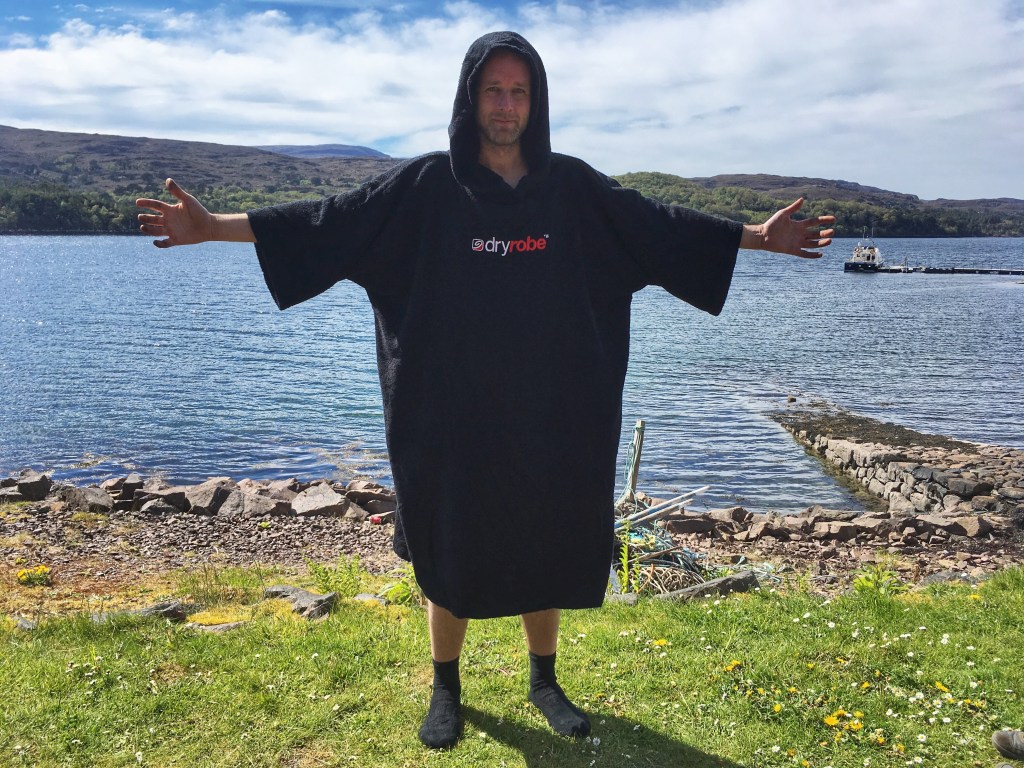
So, now, I recommend one way to get changed above all others. Buy a DryRobe and get changed under it.
A DryRobe is basically a large towel with a hood and two sleeves. It fits over your body and covers you from head to feet with enough material to host a marquee for 50 wedding guests. It’s as close as you can get to wearing a tent without actually wearing a tent.
I love it. And so do passing motorists who no longer have to avert their eyes.
So, if you’re looking for perfect gift for Christmas for the outdoor swimmer in your life (or, frankly, any relative who says they love dogging but doesn’t appear to own a pet) then you can buy them the perfect gift here: DryRobe
Boris’s Brexit: basically, when you think about it, Boris’s Brexit is all about the UK’s right to choose whether we want our kids to stitch footballs for peanuts in sweatshops in Kent.
While the EU want footballs made by trained adults – damn the EU and their regulations! – Boris believes small nimble fingers will build a better Britain.
And who’s to say he’s wrong?
(Everyone)
Maybe child labour is the future? You don’t have to pay anyone under 18 a minimum wage. Kids are cheap. So, we’ll all benefit from reduced costs. Also, kids don’t drive so we’ll have less cars on the road as more of the workforce use public transport. It would be an environmental disaster not to employ children. It’s the green choice. Extinction Rebellion would support it. No need to picket a runway to save the planet when you can support 10 year old children working the assembly line for a brand new Nissan Leaf electric car in Sunderland.
Now, some people may say that Boris has no intention of cornering the global market in furry yellow Mouldmasters footballs. He’s only cosying up to the Hard Brexiteers to get their votes until he’s secured a new five year term. But the haters only say that because they lack VISION – also a common problem of anyone who’s tried heading a rock hard Mouldmaster. However, Boris has proved the doubters wrong before, when everyone thought he would not get the EU to sign a new deal, and he can prove them wrong again! Back Boris!
But won’t parliament stop Boris if he tries to restore good old fashioned child slavery just like we had when Queen Victoria was on the throne? Won’t they talk about universal human rights and the need for children to have a childhood instead of a steady 9 to 9 job (with 30 minutes break for lunch, unpaid)?
Why, yes. Yes, they will, unless we all vote Tory. That’s why I’m suggesting that everyone across the entire country votes Tory so that there is not a single opposition MP in the House of Commons!
Give me Boris a free reign. No excuses. Let him do anything he wants for five years. And then let’s see how Great Britain will be!
(And, even better, we’ve all ready got a head start on restoring Britain’s competitive edge on the world stage as Boris has loads of kids)
So, choose Boris’s Brexit! Think of your children and the glorious future that awaits them! You know it makes sense! Back Boris bairns! Vote Tory and, just like Boris, bonk for Britain!
I was running through Cooper Park in Elgin this week when I passed the library and a bunch of teenagers hanging out on it’s steps. Which was good to see. Teenagers hanging out at the library. They must be the cool kids, I thought. Probably exchanging thoughts on whether the Blagh Book by Nigel Tomms really does challenge the stifling formality of language by writing a one million word long sentence where every second word has been replaced by the word “Blah” or whether it challenges anyone not to laugh at such pretentious twaddle as books are meant to, as a minimum, be, you know, read and understood.
And then one boy turned to the other and said: “Gonna give us a poond”.
“Wha fir?” said the other.
“It’s a poond an eccie and ahm gonna get wasted!”
Which made me think. How can an eccie, which I assume is an ecstasy tablet, not being up with the old drug lingo, be a pound? How can it be cheaper than a legal drug like alcohol or cigarette? Has the market fallen out of eccies. Is there a big warehouse with a secret stash of unsold tablets somewhere in the Moray countryside where the local drug dealer has no choice but to have a fire sale before the spring/summer eccies arrive?
Or was the kid being conned? Was someone selling Smarties and pretending they will get you high?
Or are drugs just really cheap?
They don’t tell you that in school.
“Don’t take drugs!” Says the teacher.
“Why not!” We say.
“They’re too cheap! Save up and get a proper drink like a Buckfast – like a real man!”
When I got back, I Googled “How much do drugs cost” and I was surprised to learn how cheap heroin is too. It’s only £10 for the average bag while cocaine is £30 – £40 per gram.
Based on those prices, I would be daft not to inject myself intravenously.
Then I Googled the price of new energy gels as I’d run out. And as I’ve written before – see here – I need a new supplier.
And, having checked the price of energy gels and energy bars and comparing them against the latest street prices I can confirm that I will be running Celtman on a nutrition plan of one ecstasy every hour and a shot of heroin at the end of each stage. It’s the economic choice. I’d be daft not to save money by buying my ‘nutrition’ on the black market. Triathlons can be expensive, but not if you shop around.
But, before I buy more drugs than Boots the Chemists, first I asked the Glasgow Triathlon Club Facebook forum this week for recommendations for a thick gel to replace my Zipvits and have been recommended gels by Torq. I’ve ordered a box of mixed gels – but if they don’t work out I may need to join the cool kid gang and visit the library…
There was no escaping one song this year – Lil Nas X’s ‘Old Town Road’. It sold 10 million copies in the US and it stayed in the top 40 in the UK for so long the Home Office threatened to deport it.
With its chorus of “take my horse to the old town road!” most folk assumed the song was inspired by country music. Which it was – but that country was England! I’ve discovered, by checking Google Maps, that Old Town Road is not in Utah but Stoke-on-Trent, just round the corner from Premier Electrical Wholesales and a ceramic tile pottery. It’s as authentically western as John Wayne’s name.
If you want proper country music there was only one place to take your horse – and that place was Nashville. And there was no better country song, and, in fact, no better song this year, than Luke Bryan’s ‘Knockin’ Boots’.
Most people would say it’s awful. That it makes ‘Achy Breaky Heart’ a contender for the Nobel Prize for Literature. But they would be wrong. It’s BRILLIANT.
Listen to that guitar solo, the way it’s a NUDGE NUDGE WINK WINK SAY NO MORE of the fretboard.
Listen to the lyrics. It’s not just a list of cliches that rhyme. It’s more complicated than that. It’s a list of cliches that rhyme that tells a story of a night: a night that begins with getting across town to meet someone; taking her out to get some drinks, then moving to the dance floor, followed by calling her a cab, then starting getting friendly in a backseat, before, eventually, she’s won over by Luke Bryan’s charming ways or suggestive guitar licks or, possibly, rhohypnol and they’re soon ‘knockin boots’! It’s a tale as old as time. If that time was before the #metoo movement rightly suggested getting her drunk was not the height of seduction. But that doesn’t stop this being my song of the year. Even if it doesn’t mention Stoke.
HONOURABLE MENTIONS
Miley Cyrus – Party Up The Street
For when you can’t afford the taxi to the party at Luke Bryan’s house.
Grimes – We Appreciate Power
Best lead single with the word ‘Power’ in the title since Kanye West’s Power. Hopefully this doesn’t mean that Grimes will follow Kanye into the light and become Sister Grimes the nun in 10 years time.
DC Fontaines – Big
One of my favourite albums of the year. I think they’re gonna be… big! (Did you see what I did there?)
The Slow Show – Eye to Eye
From my favourite album of the year.
Honeyblood – A Kiss From The Devil
Best Scottish album. I’m pretty sure there’s a hint of Gary Glitter’s Rock & Roll Part 1 to this one. You can definitely imagine the Joker dancing on the New York stairs to this song.
Foals – In Degrees
Would have been best album of the year if they’d released one ‘best of’ album instead of splitting it into two parts.
Fat White Family – Feet
A Spotify discovery, which is getting rarer as my wife shares my account and listens to One Direction and The Greatest Showman and my new discovery’s tend to be Louis Tomlinson singing Les Miserable.
Blake Shelton – God’s Country
Someone’s been listening very closely to Bon Jovi’s Young Guns 2 soundtrack.
Miley Cyrus – The Most
Final song on her album. Final song on this list. If you get the chance, watch her Glastonbury set. But not in front of your granny, unless your granny was a trooper and swears just like one.
I have slept in a living room, a cleaner’s cupboard and what felt like a supermarket skip. Racing around the country is expensive and one of the skills all triathletes need is the ability to find the cheapest and closest accommodation to the start line as possible.
On Skye we stayed in a hotel room whose window opened into a skip. Which was handy, as the room didn’t have a bin. Or much in the way of sheets, paint, any wifi or hope of better days. Every hour someone would throw a glass in the skip. Every hour. All night.
In Dunkeld, I thought I’d found a bargain before the Etape Caledonia. £35 a night for a double room. The room was new. Recently renovated and had a smell which could only be described as Eau Du Crime Scene Clean Up Crew. My eyes started watering as soon as we opened the door. The smell of bleach was so strong, my teeth turned white. The room was so new I’m sure it was still a cleaners cupboard that morning.
As for sleeping in a living room. That doesn’t sound too harsh until you read this – Norseman – and you spend three days with the equivalent of a torch shining in your face while you try and sleep.
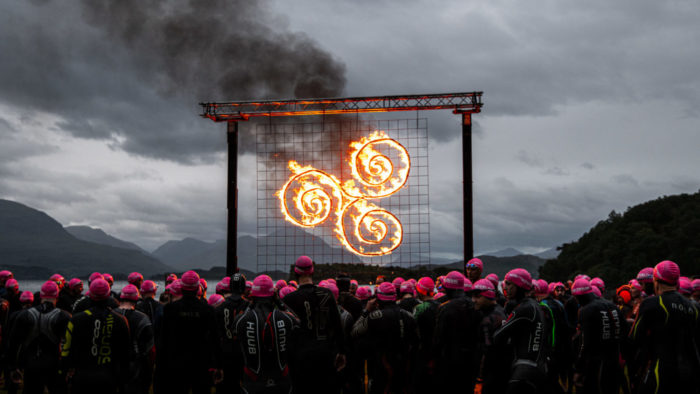
But not this time. This time we’re staying at the Torridon Inn, a luxury hotel only a few minutes from the finish line.
After years of slumming I want something to look forward to at the end of the race.
Not that there’s that much choice for Celtman. The Applecross penisula is isolated and there’s not a lot of accommodation. To make it harder, the penisula forms part of the North Coast 500 tourist trail so any accommodation is already hard to find with tourists booking for their own tour of the Highlands.
So, no sooner were places confirmed than Iain scoured AirBnB and hotel websites for places to stay because there’s no point having a place if you don’t actually have a place to stay too. And not, thankfully, anywhere that will involve a rubbish dump, the eternal sun or more chemicals than the Rolling Stones dressing room.
Goals for December:
Training will officially start in January. December will be about getting into a routine of doing ‘something’ most days of the week but without any pressure to do anything in particular. It’ll just be about getting used to a routine.
Work out training plan
See if I can try and be a bit more scientific and check stats like heart rate, functional training power, watts and a whole host of other words I don’t know the meaning of yet.
There are three starts to a race. The first start is when you start running. For most of us this will be a few metres before the start line as we don’t start at the start as we don’t want to mix it with the top club runners looking to win races. The second start is when you start your watch so you can keep track of how far you’ve run and how long you’ve been running. This second start will be as close as possible to the third start – the point we cross the start mat and hear the beep of timing chips.
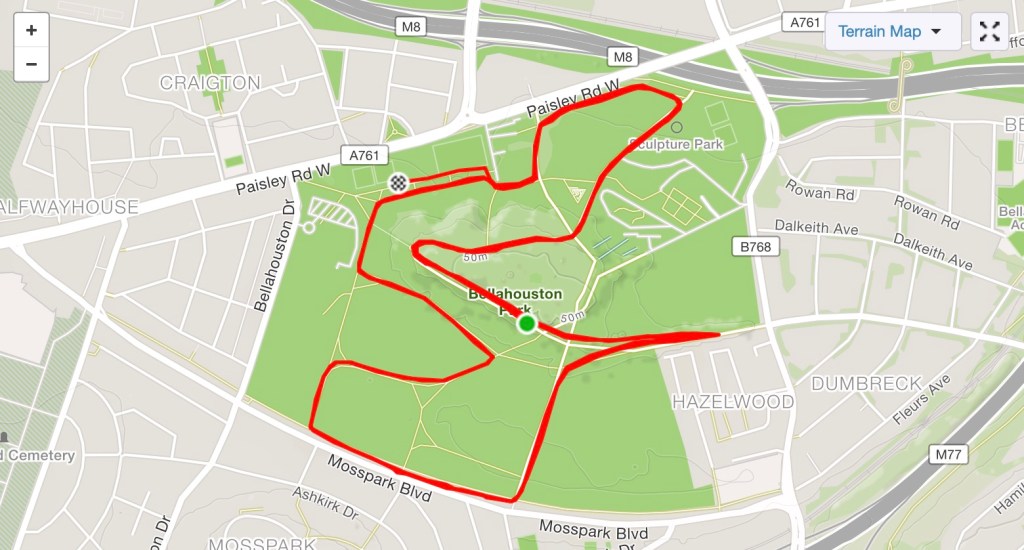
Three starts. Three times we control exactly when we start a race as we decide when to start running, when to press start, when to cross the mat, yet still I like to hear the sound of a starting gun, klaxon or just a loud whistle. There is something ‘official’ about having a starting signal that Garmins and beeps cannot replicate. Even better, the start should be marked with an official starter, and in most years, for the Jimmy Irvine 10K it’s been Jimmy Irvine himself. You can read about it here (including more about Jimmy Irvine). This year, he wasn’t here in person, but he was here in portrait as the finisher’s t-shirt had a picture of him and his wife on the start line at Bellahouston Park in Glasgow.
The race has taken a number of different routes around Bellahouston Park however, this year, it stayed the same as last, which I originally thought was great as it features two laps and three visits to the same downhill section. As the race starts on a hill you run downhill for most of the first kilometre. You then repeat it again at the end of the first lap and again at the end of the second. Two laps, three downhill sections.
However, when I say I “originally thought it was great”, I have now changed my mind. Last week, Iain and I ran around Edinburgh, taking in a number of hills including Blackford and Arthur’s Seats. After checking Strava, I notice something curious. The highest heart rate was recorded at the bottom of hills, and not the top. With the peak rate being recorded at the bottom of Arthur’s Seat after running down from the summit.
King of Edinburgh
I’d always thought that running uphill was harder. It certainly feels like it. But, the scientific evidence – and what is more scientific than a record on Strava! – shows that running downhill was much, much harder.
So, when I originally thought I was going to write about how the Jimmy Irvine 10K is a nice route as it’s more downhill, than up. I’m now here to warn you that the Jimmy Irivine 10K is a hard race because it’s mostly downhill! Avoid, do something easier like the Ben Nevis Hill Race or the Mt Everest Marathon. Anything except run downhill!
Saying that, I might just be annoyed because I missed out on breaking 45 minutes by 8 seconds. It was still the fastest I’ve run a 10k in a few years but, still, even with three starts, I couldn’t find one that would take my time below 45 minutes…
I blame Iain. He ran off to fast and I decided not to keep up as I wanted to warm up a bit first. Then, to make matters worse, he ran the rest of the race too fast as well! What a cheat! I bet he even ran the downhill sections. I didn’t. I walked them* – you can’t be too careful you know!
So, while there was three starts, there was only one way to finish: second place to Iain again.
*This might be a lie to avoid saying I couldn’t catch up with him even when I was trying to sprint.








 Twin brothers swimming, cycling and running in Scotland