When we used to work in offices it was easy to buy swim/bike/run gear without anyone knowing. A parcel would arrive, it could be opened before you got home, and no one would know that you’ve just bought another pair of trainers.
However, during the pandemic, we no longer get deliveries at work.
Or, to be more accurate, I still get deliveries from work but work has now become my home. And, instead of reception wondering why I get so many round boxes shaped like a tyre, I have my wife asking if I’m getting another delivery instead?
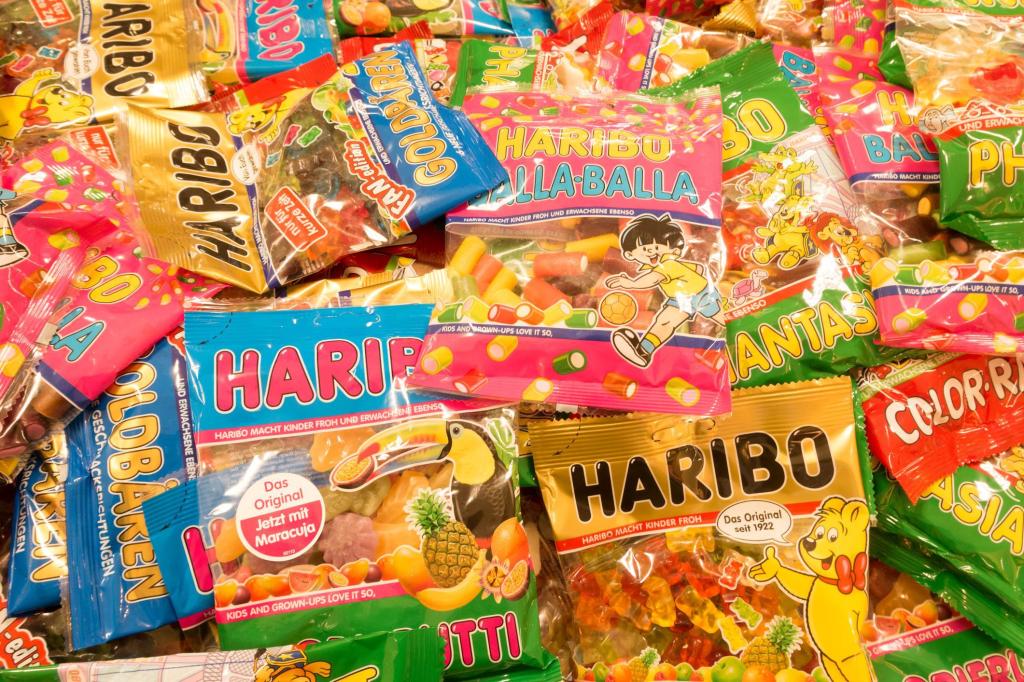
But she’s not complaining about the number of deliveries. She’s desperate for more. That’s because she’s discovered that when the online retailer, Wiggle, sends a parcel, it also includes a wee bag of Haribo sweets.
No sooner do I start to open a parcel before she’s ripping it out of my hands and tearing it open like a lion and a bag of Hula Hoops (assuming lions like Hoops).
“Where it is?” She says.
“What,” I ask.
“You know what,” she says, “the good stuff!”
I think she’s addicted and I think Wiggle know this and that’s why they send a bag of Haribo with each order. They might as well send crack cocaine, it would get the same reaction.
“Where’s my baggy?!”
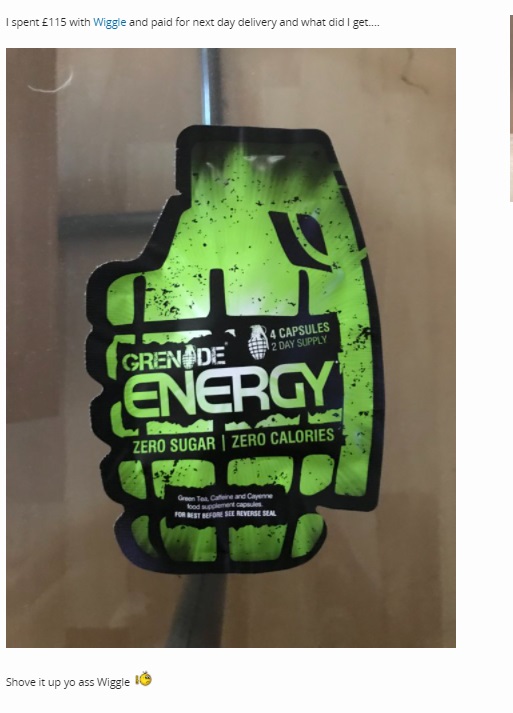
I tried to search online to see if there was an official reason for why Wiggle includes a bag of sweets but all I could find were complaints.
I’ve never had any problems with missing Haribo, however, having read the comments, I have bought a spare packet, just in case. I would hate to think what would happen if my wife didn’t find a Haribo the next time a parcel arrives.
There are many, many strange genres on YouTube. If you want to watch someone take new shoes out of a box then just search for “unboxing” and you’ll find a million videos of people taking their trainers out of a box. If you want to watch someone whisper into a microphone then welcome to the world of ASMR and a million videos of people being really, really quiet.
My favourite genre of YouTube video is a bit more specialist. I like the genre known as “Man Goes For A Walk And Then Takes A Photo”. In the UK, photographers like James Popsys and Nigel Danson are great at this – every week they release a video where they walk somewhere and then take a photo. It’s not a complicated plot to follow. Usually, they’ll explain why they’re taking the photo but most of the time, it’s just an excuse to see various mountains and woodlands around the UK.
If you want to get started in this exciting sub-genre of filming then I highly recommend this week’s video: Hiking The Length of Skye by Thomas Heaton. Heaton is a great presenter and filmmaker who, earlier this year, walked the length of Skye while taking photos. To say any more would be to spoil the surprise that… there is no more to it than that. He walks a bit. He takes a photo. He walks some more. But it’s a very enjoyable two part video that shows off Skye’s spectacular scenery.
No running this week. Instead a woman is asking: “Big man with the glasses?”
“Yes,” I say.
A big sigh and the woman, who has just taken our PCR COVID tests says, for what seems not the first time.
“You won’t get your results tonight, you’ll get them within 72 hours.”
We’re in a car park beside Toryglen football pitches. There’s a small tent and a couple of people walking around in yellow hi-viz and face masks. It’s not very clinical.
When we drove drive in. I put on a mask and rolled down the window.
“Please put it most of the way up,” says the volunteer at the entrance, making sure not to come near our now open window.
I do.
“Higher,” they say.
I leave an inch.
“Perfect,” they say before they try to pass through two test kits in plastic bags. The gap is so small and the bags so big that it’s like watching someone try and coax an elephant to limbo.
“If you pull the car up, read the instructions, follow them and then put on your hazard lights to let me know when you’re done.”
It sounds straightforward but in practice it feels like we’re dogging. Or setting up a illicit boxing fight. We’re not the only car in the car park. Nor the only one thinking we need to leave some space between us and the next car meaning that every car is circled, everyone is looking into every other car and every couple of minutes emergency lights flash until a man approaches the window.
“There is bound to be someone somewhere who’s made the mistake of starting to strip,” I say.
“NWAH, MAAW, NNAHFFFGGHH,” says Mrs TwinBikeRun, who has a cotton bud down her throat.
“That was disgusting,” she says when she takes it out.
“BAAAWWWWWKKKKK,” I say, retching after touching my tonsils with the bud.
“Now you have to stick up your nose too,” says Mrs E.
“The same end?”
“Yes.”
Now I do feel sick. But I stick my phlegm speckled throat swab up my nostril too and circle it 10 times. “I don’t know if I have COVID but I might get laryngitis of the nostrils,” I say.
“You might get a new friend if you keep those hazards on too,” says Mrs E as someone approaches. A large man with glasses.
“You’ll the results later tonight,” he says as he makes sure we close our plastic bags containing the samples correctly. “Just drop them off on your way out.”
Which we do only to find that we would have got better information if he’d actually been a dogger as the woman at the exit tells us the man with glasses doesn’t know what he’s talking about.
LATER
We don’t get our results but Mrs TwinBikeRun’s parents, who were also pinged and tested at the same time in a different location, receive confirmation that they tested negative.
I text Iain TwinBikeRun to tell him we’re still self-isolating until we hear more. He says: “That’s because it takes longer when you also test positive for syphilis.”
Every fortnight we cover the best and worst football songs from every club in the UK from our book ‘The Sound Of Football: Every Club, Every Song’. You can buy it here
AFC Wimbledon
Nickname: The Dons
Ground: The Cherry Red Records Stadium
Stadium Capacity: 5,339
Song: We Are Wimbledon
‘We Are Wimbledon’ is the perfect song for AFC Wimbledon as, despite being formed in 2002, the club is the proud winners of the 1988 FA Cup. To understand why a club formed in 2002 can claim a trophy from 1988 we need to understand how AFC Wimbledon was formed.
In 2002, the original Dons, Wimbledon FC, was in administration, living out of a rented ground, its stadium long sold, and watched by a handful of fans. The club directors argued the only salvation for the club lay in a fresh direction.
After trying and failing to find a new home in south London, the directors applied to the Football Association to relocate the club to a new stadium in Milton Keynes, 56 miles north. To its fan’s dismay, the FA sanctioned the move; and, in 2003, Wimbledon FC upped sticks to Milton Keynes, changing their name to the MK Dons.
Many Wimbledon fans refused to follow the club to Milton Keynes. Instead they established a new club: AFC Wimbledon.
AFC Wimbledon entered the ninth tier of English football and has steadily climbed through the divisions to reach the Football League. During their rise AFC Wimbledon went 78 matches without losing a game, an English record.
Yet, although formed in 2002, it’s AFC Wimbledon rather than MK Dons who has the right to claim Wimbledon most famous victory: the 1988 FA Cup – and with it the club’s cup final song.
In the 1980’s and 90’s Wimbledon was famous for playing direct football – a long ball, straight to an attacker as fast and as often as necessary to create more chances to score. It wasn’t pretty, neither were the players, but the Dons reputation for direct football meant teams would under-estimate them, believing the players had nothing to offer. Liverpool was one such team.
Liverpool was the dominant team of the 1980s and, in 1988, the club had just been crowned league champions. The FA Cup Final should have been no contest – Liverpool v Wimbledon. There should only have been one outcome. A victory for Liverpool.
Yet, Wimbledon scored first. Liverpool tried to battle back. Liverpool created lots of opportunities, even had a goal disallowed, but they just couldn’t score. It looked like a shock was on the cards until Liverpool was awarded a penalty. But even then, they couldn’t find the back of the net: Liverpool striker John Aldridge’s shot was saved by the Don’s goalkeeper Dave Beasant, making Dave the first keeper to save a penalty in a FA Cup final. Wimbledon went on to win the match and claim an epic upset.
Today, both the final and the song released to celebrate it are ‘owned’ by AFC Wimbledon after The Football Supporter’s Federation refused MK Don’s fan group permission to join the federation unless MK Dons acknowledged that AFC Wimbledon had the real rights to Wimbledon’s history.
‘We Are Wimbledon’ is the perfect song for the new club. Although, when the song was first recorded, fans and players thought it was cheesy, now when the fans belt it out now it becomes a genuine, lump in the throat anthem to power of working as a team. In 2012 it was re-recorded by the Big Blast Band, a band based in a local care centre for people with learning disabilities. The players teamed up with the band and recorded a new version for a local charity. Because that’s what fans of the Dons do – they see it through, determinedly, directly, together, at home, always and forever in South London.
I get up when I want Except on Wednesdays When I get rudely awakened by people looking through the window! (Vanlife!) I put my trousers on, have a cup of tea And I think about having to spend the next hour converting my bed back into a seat before I can drive to the shops (Vanlife!)
Not Parklife by Blur
If you search on social media for the hashtag vanlife you will find happy smiling people living out of campervans, classic VW campers and converted Ford Transits. You’ll even find some couples who have converted a full sized bus into a home. Yet, what none of these photos will show is the sheer unmitigating horror of living in a van.
First, in order to sleep at night you need to black out all windows. This can be as simple as a curtain but, if you’re anywhere warm, you’ll need thermal reflective pads to counteract the sun roasting you like a turkey in a metal oven. What they don’t tell you is that vans don’t come with air conditioning when the engine is switched off but the sun still rises in the morning and will turn every window into a magnifying glass with you as the poor hapless ant set on fire for it’s amusement.
But to stick up thermal pads you need to have the reflective screens as close to the window as possible, ideally stuck on them. This involve plastic suction caps that stick on the inner windows – but only if you lick them first to provide some liquid to act as a glue. Licking it stops air getting in and reducing the grip.
So, vanlife means you need to spend every night licking the suction caps to attach the reflective shields to every window and, if you don’t lick them they fall off, which means you wake up covered in sweat because the sun has got through your defensive shield, and your window is open to the world for everyone in the camping site to look in. You’re in your PJs, sweaty and bedheaded. Vanlife!
And then you have to pack away your bed and restore the seats so you can have breakfast and drive away. Which you think would be simple but WHY WILL THE BED/BACK SEAT NOT ROLL BACK LIKE IT SHOULD?!?!? And you have to elbow drop it like The Rock winning Wrestlemania to close it.
And at the end of that day you have to do exactly the same thing but in reverse to get from a seat to a bed and you realise you’ve spent two hours sumo wrestling a sofa bed. Every single day. Twice. Vanlife!
I hated vanlife. I drove round France for two and half weeks to follow the Tour de France. And every morning and every night I hated that van. So much so that by the end I was booking into hotels rather than spend any more time gargling a two litre bottle of water just to get ready to French kiss one hundred suction caps.
Vanlife? Avoid! More like banlife! If you want to live like a Blur song then I recommend Country House. He lives in a house, a VERY BIG house…!
Every fortnight we cover the best and worst football songs from every club in the UK from our book ‘The Sound Of Football: Every Club, Every Song’. You can buy it here
AFC Bournemouth
Nickname: The Cherries
Ground: Vitality Stadium
Stadium Capacity: 9,287
Song: Sweet Caroline by Neil Diamond
The club’s official name is AFC Bournemouth. It should appear at the front of any alphabetical list of English clubs. However, this order is often ignored, and clubs like Barnsley, Birmingham, Blackburn, Blackpool, and Bolton are listed first. We have chosen to list them by AFC so that it’s in front of Arsenal and Aston Villa – at least until those clubs, like a crafty tradesperson looking to get a higher listing, change their names to AAArsenal and AAAston Villa.
Musically, Bournemouth doesn’t deserve a high position on our list. The club doesn’t have a significant song to call its own – though not through lack of trying, most recently by looking for inspiration from across the Atlantic.
The baseball team, the Boston Red Sox, plays Neil Diamond’s classic ‘Sweet Caroline’ during every game at their stadium, Fenway Park. The sing-along song has become such a Fenway staple that the Red Sox mutes the sound for parts as fans know the lyrics off by heart.
Neil Diamond’s song was inspired by a photograph of Caroline Kennedy, daughter of US President John F Kennedy, that the singer saw in a magazine while staying at a hotel in Memphis*. Diamond wrote the song in an hour; it changed his life. He reignited his career and sold a million copies in the US.
Today, ‘Sweet Caroline’ is in every Boston bar, and it doesn’t matter if the Red Sox are winning, hurting, triumphant, or reeling when you’re down, and you sing it; it will lift you up. It’s Boston’s theme song. But not Bournemouth’s song, no matter how many times played it before kick-off.
This is not the first time a song has failed to connect with fans. Even a song written for the club couldn’t connect.
In the early 1970s, the club would play ‘Up The Cherries,’ an original song, when the team ran out at the start of matches. The song borrowed the club’s nickname – The Cherries – for its title. It was a nickname based on both the club’s cherry red striped shirts and the cherry orchards that once stood near its ground. However, surprise, surprise, it never caught on with supporters.
It is the same story for one of the Bournemouth’s cup final songs. In 2003, the song ‘Go South,’ a reworking of the Village People’s ‘Go West’, was released before the Division 3 play-off final against Lincoln City. The song predicted the Bournemouth would win – and it was right. Bournemouth was a comfortable winner, beating Lincoln 5 – 2 and setting a record for the highest number of goals scored in a play-off final. Yet, even then, despite soundtracking this big victory, the song didn’t catch on.
If you want to know Scotland’s most popular lay-by (excluding any featured in late night Channel 5 documentaries) then the lay-by next to Ben Cruachan in Argull must be among the leading contenders for the top stop.
Ben Cruachan is the highest mountain in Argyll. From the top, on a clear day you can see all the way from Northern Ireland in the west to Ben Nevis in the Highlands. Yet, for such a popular mountain, it only has a lay-by for around five cars at the start of the walk. If you want to climb then you normally have to park at Cruachan power station and visitor centre, around half a mile down the road.
When we got there in early September, we were lucky, we’d arrived early and got the last place. But if you really want to bag a space then you need to do what the car in front of us did. Put your backseat dow, convert your boot into a mattress and sleep the night in the back of your car.
If you want to know Scotland’s second busiest car park then you don’t need to go far to find it. Aproximately a mile down the road towards Tyndrum there is another lay-by with great access to Loch Awe. It has plenty of space but just be prepared for cars to pull in and out of it all day. In 30 minutes we saw four cars pull in, stop and then people getting out to admire the view of the loch, before getting back in and driving off.
So, if you love to swim with an audience then this spot is for you!
It’s said that after Roger Bannister broke the 4 minute mile it only took a few weeks for someone to beat it again. And, by a year later, three runners ran under four minutes in a single race. Once someone does something seemingly impossible for the first time, it redefines what we think is possible. And the impossible becomes normal.
Unless you watch this video.
I cannot believe there is anyone thinking, “you know what, I want to do this too! He might be the first, but I will be the second!”.
I don’t even know why anyone would even think to ski down K2. It’s like asking someone if they’d like to Hula Hoop in a shark tank or solve crossword puzzles while being fired out of a cannon. Why would you even think to do something where clearly you are going to almost certainly die?
Anyway, this guy did it. Good on him. But you won’t catch me skiing down K2 anytime soon – even if it does become ‘normal’.
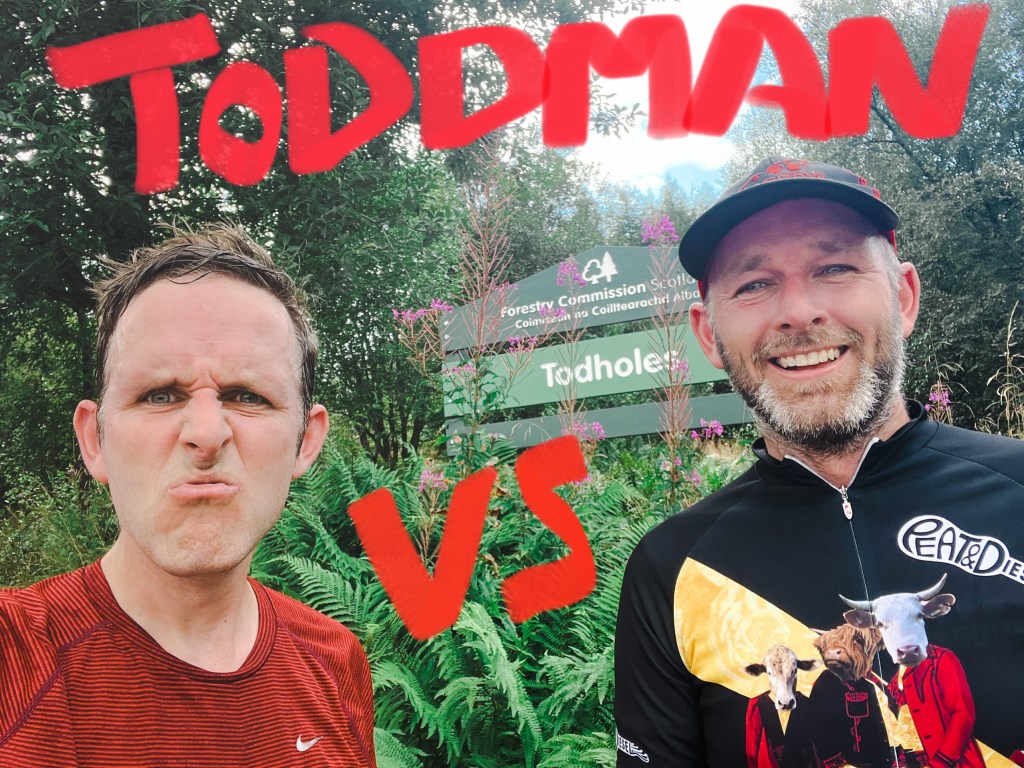
This year’s Toddman was won by a dirty, rotten, cheat. Even Lance Armstrong is saying “hey, that’s not fair!”.
Here’s what happened.
But before that: what is Toddman? I’m glad you asked. It is a triathlon race open to everyone with the surname Todd who is related to me or Iain TwinBikeRun. You can find more here and here.
This year’s race featured a new course as we changed the bike route to incorporate two iconic central Scotland climbs: Tak Me Down and the Crow Road aka Todd Me Down and the Todd Road. We also changed the run route by changing the start from Lennoxtown to Todholes aka Toddholes while keep the mid point as a climb to the summit of Mickel Bin before a downhill sprint back to Toddholes car park where the winner is the first to touch the green gate at the entrance – and, for which, they get to wear the now iconic black Peat & Diesel cycle jersey.
Last year, I won Toddman fair and square. This year, it was stolen from me!
SWIM
We both completed the swim at the same time, albeit I’d started swimming 10 minutes before him as he was trying to get some drone footage. But do I bring up the fact I was 10 minutes ahead of him and therefore finished 10 minutes earlier but had then swam an extra 10 minutes? No, because I’m a gentleman. I would never repeatedly mention that I was 10 minutes ahead of him as the end of the swim because I would expect that would be something he would acknowledge. 10 minutes is a HHHUUUUGGEEE gap. But do I mention it? No. Not me. Even though it was 10 minutes.
Anyway…
(10 minutes!)
I don’t mention it.
CYCLE
We complete the bike in the same time. I’m happy to call this a draw.
RUN
We start together. We reach the top of Mickel Bin together. We run back down together until, with a mile to go, I stop and tie my shoelace. I thought Iain would stop. I thought I could rely on him to recognise the unwritten rule that you don’t attack the leader when the leader has a mechanical.
I know this is a bike thing and not a triathlon thing but triathlons also use a bike so I’m borrowing this rule for Toddman.
And what did Iain TwinBikeRun do when I stopped to tie my shoelaces? He ran off, that’s what he did. He didn’t even hesitate. He just kept going and going until he reached the Toddholes gate and declared himself the winner.
But he’s not winner. He’s a CHEAT.
And while the general public doesn’t back me on this. A poll on the Glasgow Triathlon Club Facebook page showed 90% of members supported his claim for glory, it’s worth pointing out that people cheered when Lance Armstrong crossed the line too. But he was still a crook.
So, while Iain TwinBikeRun may think he wears ‘the Black’ and is proudly cycling round in the Toddman Jersey, I think history will be his true judge and the true winner of Toddman will be acknowledged as me!
(Also he only won by 5 mins and I was 10 minutes ahead of him after the swim, which I don’t like to mention. Even though it makes me the winner. 10 minutes!).




 Twin brothers swimming, cycling and running in Scotland