Like many kids, my first injury involved falling off my bike.
And like many kids, it also involved crashing into a car.
However, unlike any other kid, I crashed into a parked car. Even worse I crashed into a parked car while cycling uphill. I can’t even say I lost control, or my brakes failed, or any of the many other reasons an accident could happen. I cycled deliberately into a parked car that I could have easily involved if I’d just looked up.
It was raining. My head was down and I cycling uphill towards our house, which is near the top of a steep road. One minute I was cycling, the next I was face planting onto the rear window of a Ford Fiesta.
I can’t blame my bike, I can’t blame the conditions, I can only blame myself for not looking where I was going. A common cause of accidents as, this week, I managed to do exactly the same thing.
(Though not a Ford Fiesta, this time it was a tree).
There are many ways to have an accident while riding a mountain bike. You could crash while riding downhill through a particularly gnarly black run. You could fall off a cliff while attempting a dangerous Danny MacAskill ridge crossing. Or you could do what I did and ride up a path, get stuck in a rut, see a bush ahead and think, I can just cycle through that.
(Not stop and avoid the bush, oh no, I had to keep going.)
And that’s why Iain TwinBikeRun asked “Why did you ride into that tree, while going uphill, on a clear path, when you could have just stopped?”
And I didn’t have an answer because I was lying on the ground, nursing my elbow and wandering why 30 years after my fist accident I still wasn’t looking where I was going.
Every fortnight we cover the best and worst football songs from every club in the UK from our book ‘The Sound Of Football: Every Club, Every Song’. You can buy it here
Bolton Wanderers
Nickname: The Trotters
Ground: The Reebok Stadium
Stadium Capacity: 28,100
Song: Just Can’t Get Enough
In March 2011, Bolton Wanderers started blasting out ‘Just Can’t Get Enough’ by Depeche Mode over the speakers every time a goal was scored to try and improve the atmosphere around the stands of The Reebok Stadium.
The club had used a similar trick to improve atmosphere on the club’s return to the Premier League with James Brown’s ‘I Feel Good’.
Owen Coyle, then Bolton manager, explained that the decision was part of Bolton’s efforts to improve the match day experience for fans.
“The important thing is that we try and build an atmosphere, and that it gets better” he told The Bolton News, before he added: “It’s not my personal favourite but it might prove to be if we keep using it because it means we’ve scored goals.”
It’s fair to say that Owen Coyle never became a fan of Depeche Mode. He left the club in 2012 after Bolton was relegated from the Premiership after failing to score enough goals to stay up. Recent years have seen the club fall further and be threatened with winding up due to unpaid debts.
It’s surprising that Bolton’s Reebok Stadium lacks atmosphere, as, according to a survey by the British Association for the Advancement of Science, Boltonians are the friendliest people in Britain. This friendliness is not reflected in the stadium design. Rather than walk onto the pitch together, teams emerge from separate tunnels on either side of the halfway line. Also, the away fans are seated in the lower tiers not covered by the Reebok stadium’s roof. Visiting fans are advised to bring waterproofs if it looks like it might rain.
The club is proud of its history. In 1939 every member of the team volunteered to fight the Nazis. In front of a 23,000 strong crowd, the Bolton skipper gave a rousing speech before leading the entire team to sign up at a local Territorial Army hall.
For the next six years, the players faced some of the heaviest fighting of the war in France, North Africa and Italy, while also establishing themselves as a formidable regimental football team. They were even pulled off the front line to play King Farouk’s side in Cairo. Incredibly, after six years of fighting, all but one of the team survived the war.
Before moving to The Reebok Stadium in 1997, the club played for over 100 years at Burnden Park. Its most famous song relates to the older stadium and is sung to the tune of ‘The Blaydon Races’, a famous Geordie folk song (see Newcastle United).
The original is considered to be the unofficial anthem of Tyneside and is frequently sung by supporters of both Newcastle United and Newcastle Falcons rugby club. The song is used by a number of sides (Walsall, Blackburn, Berwick Rangers and Portadown) by changing the geographical references and dialect. The lyrics are changed to suit the club but the tune remains the same.
“Aw went to Blaydon Races, ’twas on the ninth of Joon,
Eiteen hundred an’ sixty-two, on a summer’s efternoon;
Aw tyuk the ‘bus frae Balmbra’s, an’ she wis heavy laden,
Away we went alang Collingwood Street, that’s on the road to Blaydon.“
The good thing about writing a weekly blog about running is that you can use the search box to find your old race reports.
If you’d asked me when was the last time I’d ran the Alloa Half Marathon I would have guessed 2018 or 19. In fact, it was five years ago, and you can find my report here.
I blame lockdown. After two years of the pandemic, my sense of time is screwy. I discount the two years spent at home and assume everything is two years shorter than it actually is, which is why I’m planning to celebrate my twenty first birthday this year…
I see from my report that I was complaining about the traffic. It’s also the one thing I remembered about the race as I phoned Iain TwinBikeRun to say we should try and get to Alloa for 7:45 (for a 9am start) but he disagreed. The start line had moved from near the town centre to a community campus on the edge of town. He didn’t think the traffic would be as bad as there was a lot more routes to get to the start, including buses from the town centre for those who wanted to park further away.
He was right. It was easy to drive in, find a bus and get to the start. The only queue this year was at the pre-start toilets. But there’s always a queue at the toilets before any race and it’s alway the case that no matter when you join that queue, whether one hour or five minutes before the start, and no matter how many people are in the queue, ten or a hundred, you’ll never reach the front until two mins before the race starts and you’ll come out to find everyone has already left. Alloa was no different.
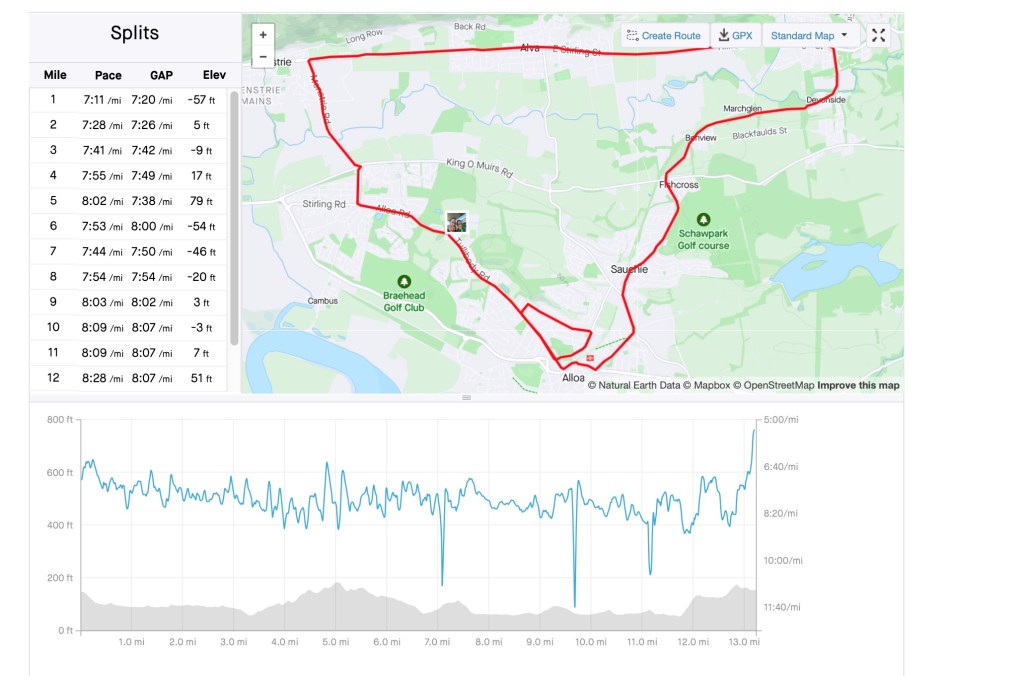
I also see from my report that I complained about the hills. The change to the start though has improved the route as there’s now a three mile gentle descent and flat before you climb the first hill. The warm up makes the hill feel easier, while there’s another long descent afterwards so you have time to recover before turning west toward Alva.
There’s another long hill around the 11 mile point as you come back to Alloa but while it’s long, it’s not that steep.
Overall, it was a cracking day for a race. Blue skies and no wind and the changes to the route has really improved the whole experience. I was pleased with a time of 1 hour 43 mins, which was faster than my previous time of 1 hours 48 mins and shows that while lockdown may have lost two years, I’ve also gained five minutes. Result.
For six years I worked at the Western Isles Hospital as a porter. I would provide cover whenever I was home from university and I’d generally work full time most weeks on either morning, evening or night shift.
Night shift was the best and worst. It was the best because I was paid time and half, and if it was the weekend I’d get another half for working a Saturday and another half again for working Sunday. (And if it was a public holiday like Christmas then it would double again – jackpot!).
But there was one night I hated working – the night the clocks went back an hour. At 2am, when the clocks changed, I’d walk round the hospital and move all the clock hands back by one hour to 1pm. And then I’d have to work that hour again… without pay.
That might sound harsh but, when the clocks jumped forward and 2am became 3am, I would work one hour less and still get paid for an eight hour shift. So, I would try really hard to be available to work at the end of March but to be away at the end of October.
For that reason, I’ve always like when the clocks go forward. It reminds me of getting paid for doing nothing.
This year, as I’ve worked more from the office than from home, it’s great to get the extra hour of light in the evening so I can run or cycle home without having to wear more lights than a Christmas tree. It’s good to feel the sun on my skin and to start to wear t-shirts rather than a running jacket, hat, gloves and, in Glasgow, oilskins for the days it’s really wet.
I do however miss the pleasures of night-time running – which mostly involve people leaving their curtains open and getting a good gawk in their living room. But also, the pleasure of running and not seeing where you are going. Night-time running reduces distances as you tend to focus on the light pool around you rather than looking to the end of a street in daylight and seeing everything before you clearly. (It’s for the same reason muggers hate the clocks going forward, people can now see them.)
The good thing about living in Glasgow though is that the clocks going forward is not a guarantee of daylight – in Scotland it can just as dark at 3pm as midnight when the rain clouds gather so while it’s good to see the change of the seasons, it’s also good to know that we don’t lose nighttime running even in June.
Every fortnight we cover the best and worst football songs from every club in the UK from our book ‘The Sound Of Football: Every Club, Every Song’. You can buy it here
Blackpool
Nickname: The Seasiders
Ground: Bloomfield Road
Stadium Capacity: 16,007
Song: Blackpool
When Blackpool celebrate scoring you’ll hear ‘Glad All Over’ by The Dave Clark Five. A home win will be soundtracked by ‘Rockin’ All Over the World’ by Status Quo. And, if the club has lost, fans can cheer themselves by singing its official anthem: ‘Blackpool’ by The Nolans.
The Nolan family had emigrated from Dublin to Blackpool in 1962. Parents Tommy & Maureen Nolan became a regular part of the variety show circuits that were a feature of Blackpool’s nightlife entertainment. They sang as The Singing Nolans and enlisted their family to help. Their children, Tommy Junior, Anne, Denise, Maureen, Brian, Linda, Bernadette & Coleen, would join them on stage.
In 1972, The Singing Nolans recorded a tribute to Blackpool, their favourite team.
Although the song was played over the tannoy at Bloomfield Road it would be another four years before fans warmed to it. In that time the daughters would become more famous as The Nolans, whose biggest hit was ‘I’m In The Mood For Dancing’. The Nolans would sell 25 million records worldwide – including 12 million in Japan, outselling The Beatles.
Yet the fans were still ambivalent towards ‘Blackpool’. And when you know more about Blackpool’s fans you’ll understand why.
In the 1950s and 60s the best-known supporter’s group was The Atomic Boys, famous for their wild pranks and colourful outfits.
Blackpool superfan Stan Bevers had formed The Atomic Boys in the 1940’s. Stan wanted a group that would really stand out on the terraces. He encouraged everyone to wear costumes. Using a contact at Madame Tussaud’s waxwork museum on Blackpool promenade he and fellow fans would dress up to take part in daring pranks.
Before the 1953 FA Cup final Stan, wearing a flowing tangerine cloak and a silver head dress, talked his way into 10 Downing Street to hand-deliver a seven-pound stick of Blackpool rock to Sir Winston Churchill.
The Atomic Boys even adopted a live duck as a mascot – it led the team out, and wandered up and down the touchline during matches.
The duck had been a gift from the actor Douglas Fairbanks Jr. The Atomic Boys had tried to attend the premiere of the star’s new film ‘Mr Drake’s Duck’. The tables were turned on them as the Hollywood star (or, more likely, his publicist) knew of The Atomic Boys’ reputation and, in view of the film’s title presented them with a duck.
With such colourful fans, it should not be a surprise that the family friendly, safe and, worst of all, bland Nolans had their work cut out to persuade the fans to adopt their song as an anthem
It was only after a match programme against Millwall on 11th September 1976 included a “Blackpool Supporters Song Sheet” that the fans started to warm to it. Although the song continues to divide supporters, it has found one fan: the Bloomfield Bear, who took over as mascot after The Atomic Boys’ duck retired. Today, he can often be seen dancing to it before kick-off.
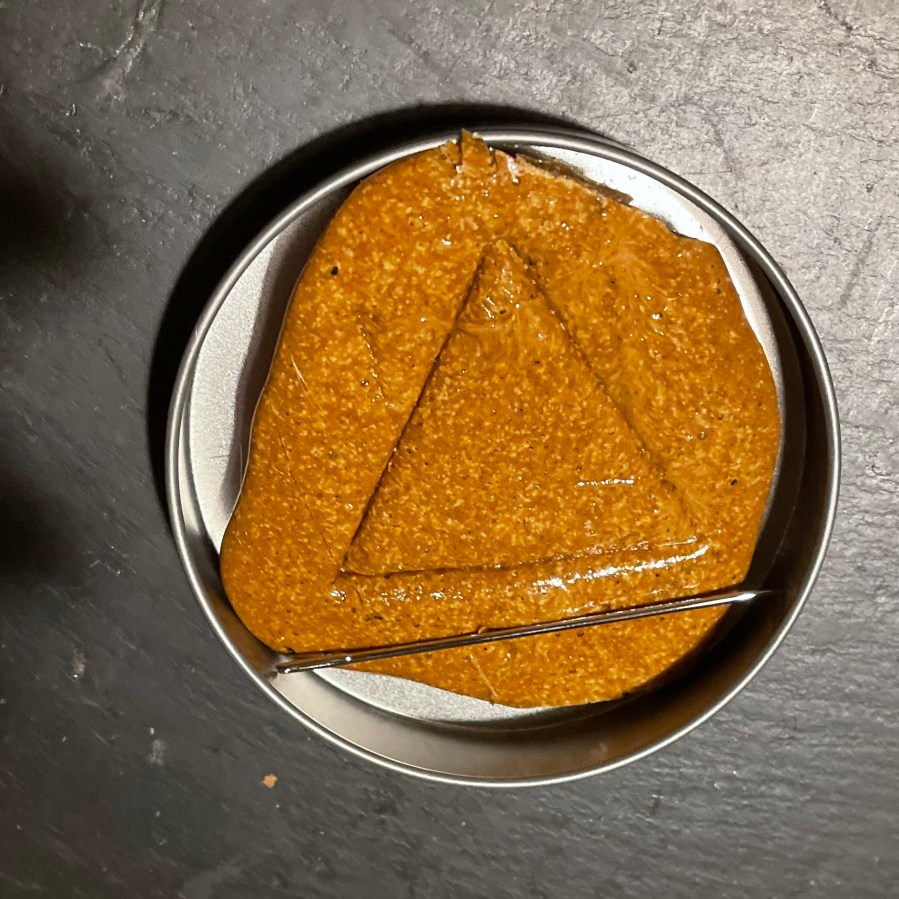
Either you will instantly recognise the image above and be glad you don’t have the umbrella, or it will mean nothing at all. The only difference is whether you’ve watched Squid Game on Netflix. If you have, then you know exactly what happens when you have 10 minutes to to carve out the triangle with nothing but a needle – a challenge known as Dalgona in South Korea.
The triangle itself if made from melted sugar and baking soda. You melt the two together in a frying pan and then pour the mixture into small discs. You then press a cookie cutter lightly into the surface to create the shape to be cut out by the player.
The player’s challenge is to then cut it out without snapping the shape.
However, if you want a real challenge, don’t just try and cut the shape out of the cookie – you need to eat it too.
WOOOOOAHH!!!!
Sugar RUSH!!!!
I have never taken class A narcotics but I can’t imagine that crack cocaine could be as good as pure sugar mixed with baking powder. A combination that requires a dentist on hand before you even take a bite.
BLIMEY!
It tasted good.
If you want to try it yourself then I found this video really helpful with tips on how to make it.
And if you want to recreate Squid Game then I’m afraid you’re going to have to find your own guard with a gun to stand over you – sorry, I can’t help you with that one!
Every fortnight we cover the best and worst football songs from every club in the UK from our book ‘The Sound Of Football: Every Club, Every Song’. You can buy it here
Blackburn Rovers
Nickname: Rovers
Ground: Ewood Park
Stadium Capacity: 31,154
Song: The Wild Rover (Trad)
Blackburn Rover’s anthem is, naturally, ‘The Wild Rover.’ It’s probably the most widely performed Irish song around the world:
“I’ve been a wild rover for many a year, and I’ve spent all my money on this seat right here.
So there’s no point in saving for a rainy day, ‘cos I’m a wild rover, and here I will stay.
AND IT’S NO NAY NEVER, NO NAY NEVER NO MORE!
‘COS I’LL STAY A WILD ROVER FOREVER AND MORE!“
(Source: trad.)
The song tells the story of a young man who has been away from his home for many years. Returning to his former alehouse, the landlady refuses him credit; until he presents the gold he gained while he was away. Finally, he sings that his days of roving are over, and he intends to return to his home and settle down.
To some, it’s a temperance song because it celebrates the end of his wild days. To others, it’s a drinking song, another drink before heading home. But, to Blackburn fans, it’s the perfect choice because Rovers fans were once known for their ‘wild adventures’ on the road – or, to give ‘adventure’ another name, hooliganism.
Today, football hooligans are more often found on satellite television shows presented by English actor and Eastenders’ landlord, Danny Dyer, than rioting in row D of the family stands of Premiership grounds. However, fans of Danny’s shows might not be aware that football hooliganism is not a modern phenomenon – it’s older than most clubs in the football league, and the first record of crowd trouble is linked to Blackburn Rovers.
Teams from the Home Counties surrounding London dominated footballs early years. The first team to break this southern monopoly was Blackburn after they won the FA Cup in 1884.
The Blackburn fans had a bad reputation. For one game in London, they terrified the locals by being “northern” (working class). A newspaper at the time, The Pall Mall Gazette, described them as:
“A northern horde of uncouth garb and strange oaths – like a tribe of Sudanese Arabs let loose.”
It was unfair to pick on Blackburn’s fans for being northern and working-class when its opponents that day weren’t just ‘northern’ – they were Scottish. Moreover, Blackburn was due to play Queens Park from Glasgow.
This wasn’t the only incident. In 1888, Preston refused to play a match against Blackburn because the club didn’t want to face Blackburn’s fans.
Preston and Blackburn have long been rivals, and there’s no love lost between the two sets of fans. Both groups of fans have an unusual tradition. When they are relegated, they bury a coffin decked out in the club’s colours. Once the side is promoted, they go back and ‘raise’ the coffin.
Unlike most teams, Blackburn Rovers has only ever had one design to its home kit. The distinctive blue and white halved jersey is widely acknowledged as the “town colour.” Although the design has remained the same, the side in which the colours fall has often changed. This is because blue resided on the wearers left since 1946. Before that, blue and white often switched over almost yearly.
In recent years there has been unrest between fans and the club due to unpopular decisions made by the club’s owners. The owners tried to get the fans back by consulting them over a choice of music for the team to run out. The options are the regular selections of stadium anthems, but they missed a trick by not including some of the more unusual Blackburn inspired songs.
First up is the metal band Frenzy with their simply named tune – Blackburn Rovers. A song about watching Blackburn play on TV. It’s not just metal bands who like Blackburn. The Norwegian band Seven released a song called ‘Blackburn (Always In My Heart)’. The true story of a former band member who lost his heart to Blackburn Rovers, and lost his girlfriend. And then, heartbroken, we can only assume he went to the pub and got very, very drunk while singing ‘The Wild Rover’.
Every year thousands of people cycle from John O’Groats to Lands End or the other way around. Riding from one side of Britain to the other is one of those cycling challenges that many people have on their bucket list. Yet, in Iceland, a smaller island, no one had ever crossed it from north to south before last year when an American cyclist, Payson McElveen, mades an attempt at being the first person to cross Iceland from coast-to-coast in one go.
I can remember swimming, but I can’t remember learning to swim. Instead I remember trunks and towels.
We would swim on holiday in the small Perthshire town of Aberfeldy. It has a sports centre with a 25 metre pool and every day on holiday we would go for a swim. We would get ready by grabbing our towel, folding it lengthwise in half and the rolling it up with our trunks inside. We’d then carry it under out arm up to the centre. We’d then unroll it, get changed and then repeat again on the way home – except this time our armpits would get wet because we’re carrying a soggy towel and trunks.
We never thought to use a bag. There was no need, once a towel was rolled up with your trunks then you didn’t need anything else. Not even goggles because for some reason our Dad didn’t believe in goggles. “You don’t need them”, he’d say, “If you duck your head under the water, it’ll sting for a minute but you’ll soon adjust.”
Which was okay for him to say as he only had one good eye. His other eye was damaged due to an operation in his thirties to cure an aneurysm. It was an operation that was so medically advanced he spent the rest of his life with doctors saying “I’ve never seen that before!”
He would start swimming without google and then say “you’ll get used it!”
We didn’t.
I could never put my head under the water. I still struggle now when water gets into my goggles. I need to stop and clear it.
But I never got goggles. It never occurred to me. I was learning from my Dad so I just did what he did. Even if he was medical miracle who thought he was Aquaman and I was a boy scared of getting his head wet.
Today, I always wear goggles but I still keep my trunks in a rolled up towel.