Film Friday is a weekly recommendation of one video to watch this weekend.
As I am an unfit middle aged man who tried to survive a Tour De France stage then this video resonated with me.

TwinBikeRun

Andrew and Iain Todd write about endurance sport, football and the everyday absurdity of life. Twin brothers, occasional triathletes, and authors of six books between them.

Film Friday is a weekly recommendation of one video to watch this weekend.
As I am an unfit middle aged man who tried to survive a Tour De France stage then this video resonated with me.
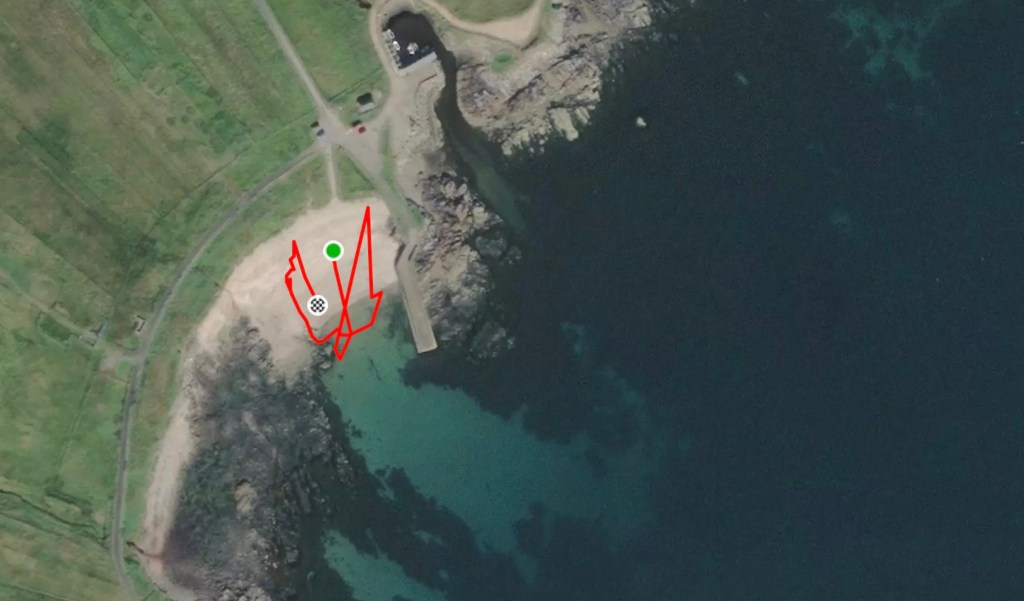
We’ve reviewed Bayble Beach before. You can find the reviews here and here so this review is more a warning than a review.
The beach is beside a working pier and when I arrived there was a tractor pulling a boat out into the surf. I waited a few minutes while the boat was floated and the fishermen (a grandfather, father and young son) left before I waded out into the water. The board quickly skirted the pier and left my sight. I thought I had the water to myself and started to swim only to find, a few minutes later, the boat came back.
“Well that was rubbish!” I heard the sound son say over the unmistakeable sound of something mechanical broken.
I stayed next to the pier while they grounded the boat and the father jumped out to get the tractor to pull it up to the beach.
And all I could think was “I should have worn a tow float!”
I’d started swimming in a spot I knew well, one that I knew was safe as it was near high tide on a calm day and I didn’t think to wear a two float. I was wrong. Even in the safest spots, something can change. An empty ocean can suddenly be filled by an anguished shout and next you see, a broken boat is bearing down on you.
So, for this review, I repeat everything Iain said about how great a location this is for a swim and I only add what should be an obvious plea: always wear a tow float when swimming outdoors!

Every fortnight we cover the best and worst football songs from every club in the UK from our book ‘The Sound Of Football: Every Club, Every Song’. You can buy it here
Brighton & Hove Albion
Nickname: The Seagulls
Ground: American Express Community Stadium
Stadium Capacity: 27,500
Song: Where Seagulls Fly
In 1983, Brighton met Manchester United in the final of the FA Cup. Both United and Brighton played in the First Division. However, while United finished third, Brighton had already been relegated when the teams met in the final.
With only a couple of minutes left to play, the score was 2 – 2. Brighton attacked. Its Scottish striker, Gordon Smith, found himself one on one with United’s keeper. Gordon took a touch to steady himself – and it seemed inevitable that he’d smash it home – but he scuffed his shot, and the keeper saved it.
Before Smith shot, the BBC commentator Peter Jones said the now immortal line: “…and Smith must score!”.
Which was unfair. It was late in the game, Gordon Smith was tired, and it wasn’t the easiest opportunity. Yet it proved to be Brighton’s final chance, and the game finished 2 – 2. The match was replayed, and United won 4 – 0.
The FA Cup final inspired local Brighton songwriter Johnny Wakelin to write ‘Where Seagulls Fly’.
Brighton got its nickname ‘The Seagulls’ after a match against its rivals Crystal Palace. The Crystal Palace supporters started chanting, ‘Eagles, Eagles’ (Crystal Palace’s nickname). A group of Brighton & Hove Albion fans responded with a chant of ‘Seagulls, Seagulls’. The name stuck, and, in 1977, the club crest was changed to a white seagull.
‘Where Seagulls Fly’ was not Wakelin’s first sporting song. He’d had a minor hit in the ’70s with a homage to boxer Muhammad Ali. His song ‘Black Superman (Muhammad Ali)’ reached number seven in the UK Singles Chart and spent six months in the U.S. Billboard Hot 100. Muhammed Ali, however, disapproved of the song and shunned it completely.
The B-Side to ‘Where Eagles Fly’ has an unusual honour: it was, we believe, the first football rap, five years before Liverpool, John Barnes and ‘The Anfield Rap’. It was ‘The Goldstone Rap’, and we recommend checking it out on YouTube. While it can’t in any way be called a good song, it can at least be described as a non-racist song, unlike the Anfield Rap.
If you go on a bus tour of Liverpool, you will visit the city’s modernist Catholic Cathedral. A tee-pee-shaped building also makes an excellent impression of Dumbledore’s hat. And if you listen to the recorded bus tour, just after you are informed that the four bells on the Cathedral are named John, Paul, George and Ringo, the tour guide will tell you that the Cathedral is known locally as ‘Paddy’s Wigwam’. But if you think that reference is racist, you can rest assured, it is not. If it were racist, would Liverpool FC use it in the lyrics of the Anfield Rap when they sing?
“Don’t forget us Paddies
And me the Great Dane
And I’m from London mate so watch your game“
(Source: Gainford, Johnston, Derek B and Byker)
But that’s not their only crime against race. Quite clearly, the songwriter had never met an Irishman. As the squad later sing:
“We’re Ireland lads
Och-aye the noo“
(Source: Gainford, Johnston, Derek B and Byker)
Och-aye the noo?! The only ‘Irishman’ to ever say “och-aye the noo” was former James Bond and Edinburgh born milkman Sean ‘I don’t do accents’ Connery in mawkish leprechaun fantasy Darby O’Gill & The Little People. Awful – except for John Barnes.
But if lyrics in football songs can be challenging, Brighton has a supporter who can help them. If Brighton ever reach the FA Cup final again, it could ask local supporter and superstar DJ Norman’ Fatboy Slim’ Cook to record a new song. Although Norman Cook has said he hates football records, he does mix football and music. In October 2004, the FA permitted him to change Brighton’s stadium’s name to Palookaville Stadium for one match only to publicise the release of his album Palookaville.
Buy the Sound of Football from Amazon.
Film Friday is a weekly recommendation of one video to watch this weekend.
I did an Artificial Intelligence course as part of my University degree.
One evening I was drinking in a pub opposite the AI building. Smoke came in through the door of the pub. I thought “That’s strange but not strange enough that it will make me want to leave my pint to find out where the smoke is coming from”
5 minutes later a policeman came into the pub and told us all to leave as the AI building was on fire. That explained the smoke!
I lost all my AI work in that fire. It was no loss to humanity. I got an F in the exam.


Film Friday is a weekly recommendation of one video to watch this weekend.
An interesting video about how to hack a computer using just an iPhone cable.

I don’t know much about Edinburgh. It was Iain TwinBikeRun’s city. I lived in Glasgow, he lived in Edinburgh. Together we divided up Scotland like a giant game of Monopoly.
So, when Iain asked if I wanted to try the Seven Hills of Edinburgh Challenge – a run to summit the seven hills that make up Edinburgh – I asked how long would it take. He said about two to two and half hours. I asked how many miles it would be. He said about 12. And I said, “hell yeah, let’s do it!”
(I might not have said “hell yeah” as I’m not American, but I was excited.)
There was only one problem. The run is no where near 12 miles. We had ran 16 miles and still not reached the sixth and toughest hill, Arthur’s Seat. We’d also been running for nearly three hours and still had another 45 minutes to go. I had no choice but to say “see ya, sucker!” and run back to the start.
So, instead of the Seven Hills of Edinburgh Challenge, I ran the Seven Hills of Edinburgh Minus Arthur’s Seat Challenge and I learned an important lesson: never trust Iain TwinBikeRun’s directions. I should have known better, I should have read this, where he admits to running eight hills because he got the route wrong. In future, I should always check the route I’m running before I run it.

I previosuly wrote about North third here https://twinbikerun.com/2019/07/19/outdoor-swim-review-north-third-reservoir-iain/ and here https://twinbikerun.com/2021/05/18/rugged-run-north-third-reservoir/
In recent years there hasn’t been as much water in North Third as there was when I wrote my intial review. I decided to pop by (May 2022) to see what the water level was like this year but it was still very low.
Which is disappointing as my usual swim would actually be mostly walking. The water was that low.
I suspect it will be like that for the rest of the summer. Ill keep an eye on it and hope it improves but I don’t think I’ll get any swimming here.
REVIEW (when the water was full)

Ease of Access: There’s a small car park beside a gate next to the path that leads down to the reservoir. If the spaces there are taken then there’s spots nearby to park.
Water quality: A bit murky and a little bit shallow in places. There was much less water in the reservoir than when I was last here in March. The water temperature was 18.5C.
Swim Quality: Excellent – There’s a nice loop around the islands. The water was calm.
Other People: There’s usually folk fishing at the side of the loch and I’ve occasionally bumped into other folk either heading in or leaving after swimming themselves.
Would I go back: Yes. Its one of my favorite places to swim.
Every fortnight we cover the best and worst football songs from every club in the UK from our book ‘The Sound Of Football: Every Club, Every Song’. You can buy it here
Brentford
Nickname: The Bees
Ground: Griffin Park
Stadium Capacity: 12,763
Song: Hey Jude
Did Rod Stewart play for Brentford? We know that his first love was football, closely followed by blondes and platform shoes. On his hit song, ‘You’re In My Heart (The Final Acclaim),’ he compared one of his conquests with the best team he’d ever seen. Better even than Manchester United or his beloved Celtic. Was Rod talking about Brentford?
For years, the press would write that Rod had played for The Bees as a young man. But, in 1995, he finally confessed he’d never played at Griffin Park. He’d only had a trial as a schoolboy. We think we can now assume that Brentford was not the best team he’d ever seen.
One man believes Brentford was the best team he’s ever seen, and that’s ex-player Lloyd Owusu.
Owusu joined Brentford from non-league Slough in 1998 and immediately made an impact, helping the team to promotion. He finished top scorer with an impressive 22 goals. Over the next few years, he continued to feature prominently and became a fan’s favourite due to his ‘raise the roof` goal celebrations
Although Owusu left the club briefly, he returned in 2005 for a second spell. The fans welcomed his return, and one in particular – Status Quo bassist John ‘Rhino` Edwards – even created a tribute song, ‘Owusu The One And Only, in his honour.
Brentford’s club song is ‘Hey Jude’ by the Beatles, played at every home game. For the chorus, the fans sing:
“Laaa Laaa Laaa La-la-la Laaa
La-la-la Laaa Brentford
Laaa Laaa Laaa La-la-la Laaa
La-la-la Laaa Brentford“
(Source: fan chant)
There are two theories why the fans sing Hey Jude. The first is that a woman named Jude in the 1960s dumped a Brentford player, and the club played the song to remind him of her. The second theory is more straightforward – and more plausible – it was simply started by supporters who spotted that the chants of “Hey Jude” could be easily swapped with “Brent-ford“.
‘Hey Jude’ is one of The Beatles’ greatest songs, but drummer Ringo Starr almost didn’t play on it. The band was ready to record the track, but Ringo went to the toilet before they started. The rest of the band didn’t notice he had gone. He heard Paul McCartney singing and ran back in time to hit his drums right on cue.
John Lennon may have once said that Ringo wasn’t “even the best drummer in The Beatles“, but Ringo knew, like all great drummers, that timing is everything.
Buy the Sound of Football from Amazon.
Film Friday is a weekly recommendation of one video to watch this weekend.
Would you spend 30+ hours on a train travelling from Kolkata to Bangalore? I’ve done that trip….by plane. And after watching this I’m glad I choose to fly.

