





Every fortnight we cover the best and worst football songs from every club in the UK from our book ‘The Sound Of Football: Every Club, Every Song’. You can buy it here
East Fife
Nickname: The Fife
Ground: New Bayview Stadium
Stadium Capacity: 1,980
Song: The Cowden Family
When Rangers beat Hibernian 7 – 0 in December 1995, Gordon’ Jukebox’ Durie scored four times. You might expect a man who scored four goals to make every paper’s back page, but not this time. Gordon played with Paul ‘Gazza’ Gascoigne, and everyone remembers what Gazza did instead of Gordon’s goals.
Midway through the match, referee Douglas Smith dropped his yellow card. Gazza picked it up and tried to give it back, but not before, with a flourish, he pretended to book the referee.
Douglas Smith was not amused, though all the fans were laughing, and Smith grabbed the card back, turned the tables on the Georgie joker, and booked him for dissent.
When questioned by Hibs player Joe Tortolano about why he had booked Gazza, Douglas is reported to have told Joe: “He might be able to take the piss out of you, but he’s not taking the piss out of me!”
In 2012, Gordon’ Jukebox’ Durie was appointed manager of East Fife, the club where he began his career, but, due to illness, he only lasted a few months before he had to step down.
With his local knowledge, Gordon will know East Fife’s finest musical achievement. In 1996, East Fife fans made national news when they appeared on the BBC comedy programme ‘They Think It’s All Over’ to sing their version of the Addams Family theme-tune: The Cowden Family, directed at their rivals Cowdenbeath.
“They come fae near Lochgelly
They hivnae goat a telly
Their dirty and their smelly
The Cowden Family“
(Source: terrace chant)
Buy the Sound of Football from Amazon.
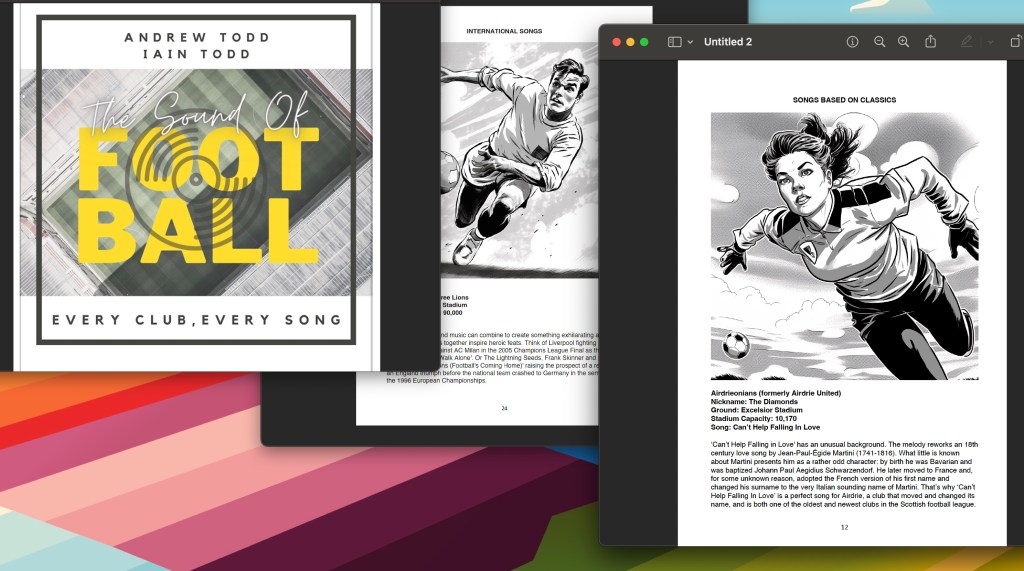
Our book ‘The Sound of Football: Every Club, Every Song’ has been updated for the new season with songs from clubs like the newly promoted Wrexham, and with a new format (as I’ve learned how to create a proper index). Songs are now divided into categories so you can quickly see which clubs have used the same ideas see by category which clubs share similar songs.
You can buy the new edition here: Amazon.
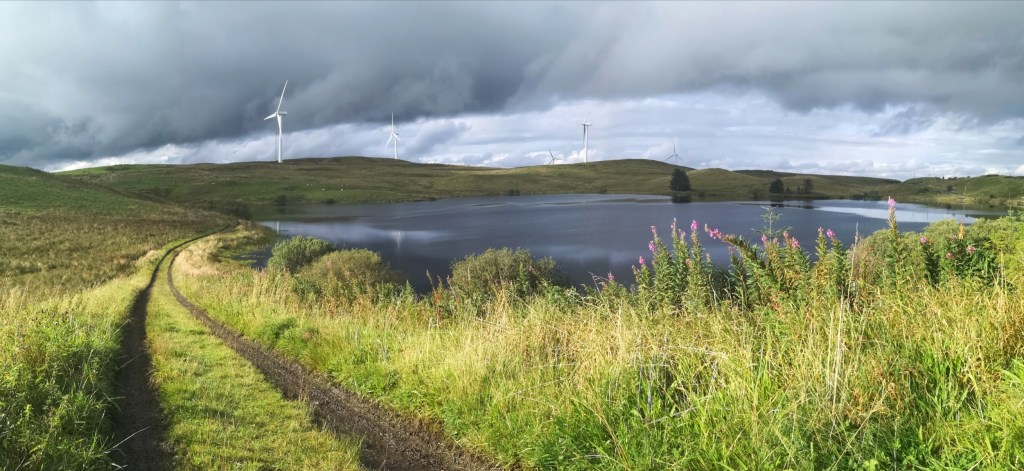
I’ve covered the White Loch before – see here – and for parking see this previous review. In 2022, I mentioned that you should check which route you plan to use to drive to the White Loch. That’s still the case this year, with upgrade work taking place to the A77 at the edge of Newton Mearns. And for that I have to say “sorry” as I think the company I work for might be partially responsible for it! Sorry! It’ll be great when it’s done though!.
Water Quality
In previous years, I’ve mentioned that you might feel a slight sliminess after you swim. This is due to peat and nothing to be alarmed about even if you might feel like the Creature of the White Loch Lagoon when you come out of the water. Currently, the water is clear and I felt clean when I came out of the water.
Two years ago the loch was ‘closed’ due to a blue-green algae infestation. This can occur after a long period of warm weather. Luckily, or unluckily, depending on your view of this summer’s weather, that’s not been much of an issue this year. Check out the Southside Swimmers Facebook group for the latest updates to confirm if the loch is safe to swim.
Swim Quality
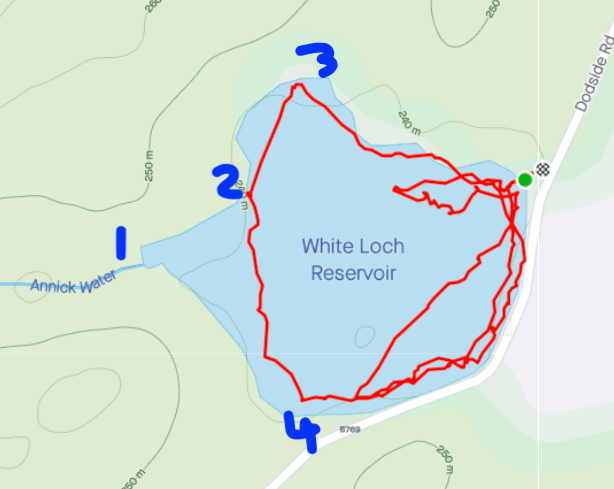
Excellent location for different lenghts of swims. If you just want a dip then a paddle round the entrance is nice and shallow. If you want to complete a full lap then it will be around 1000 – 1200 metres. You can aim for the opposite bank at 4, then a bright and obvious life buoy post at 2 then a wind turbine at 3 before coming back to the start.
I’m told that some people experience a slight pull in the water around the dam at 1 so keep away from it.
Other people
At least one person every time I’ve been. If it’s been sunny then I’ve seen 10 people here, including swimmers, paddle boarders, a canoe – and one dog swimming laps after it’s owner. It’s a busy place.
Overall
A great spot for a swim – but also a very well known one so expect to see other people particularly at weekends, evenings and if the weather is warm and sunny.
Every fortnight we cover the best and worst football songs from every club in the UK from our book ‘The Sound Of Football: Every Club, Every Song’. You can buy it here
Dunfermline Athletic
Nickname: The Pars
Ground: East End Park
Stadium Capacity: 11,480
Song: Into The Valley
Dunfermline Athletic run out at East End Park to The Skids song ‘Into The Valley’, Which has also been used by Charlton Athletic and, for a brief time, Bradford City when it was in the Premier League.
The Skids were formed in 1977 in Dunfermline. The band’s (now sadly passed on) Stuart Adamson went on to form Big Country, while another founding member, Richard Jobson, went on to become a noted TV presenter, producer, and filmmaker. Into The Valley was their biggest hit – and what a hit it was. Fast, thrilling, exciting, no wonder Dunfermline fans adopted it – it was the exact opposite of a Saturday afternoon at East End Park.
The song does have a local connection. While Richard Jobson has said that the song was about a friend killed on a tour of duty in Northern Ireland and the recruitment of Scottish youths by the army, Dunfermline fans believe that the song refers to High Valleyfield, an area near Dunfermline known locally as ‘The Valley’.
The club is nicknamed the Pars, and one theory about why it has this name is that it was short for ‘paralytic’. The players were meant to be renowned for their drinking, so they were called the Paralytics, shortened to Pars.
In recent years, fans have needed a strong drink. Financial problems led to relegation from the top-flight, while subsequent administration and another relegation to the second division followed, after the team was docked points. In July 2013, a fan-led consortium rescued the club after it looked like it might have been the next club to go out of business.
Since the 1950s, fans have left Eastend Park after the game to the sound of Jimmy Shand and his band’s ‘The Bluebell Polka’. The track was Jimmy Shand’s biggest hit, getting into the Top 20, becoming the first (and only) Scottish traditional dance band to have a top 40 hit. It was produced by George Martin, who produced all The Beatles’ albums.
Jimmy Shand had an eventful life. He was born near Dunfermline, in East Wemyss in Fife. He was a miner who got blacklisted from working in the mines due to playing benefit gigs for striking miners. As a musician in the fifties, he’d release a record a month and was the first person to do proper tours up and down the UK, laying down the blueprint for the rock bands of the 60s. As far as we can tell, the club adopted the song following its chart success and, just like Crystal Palace and Liverpool, chart success has led to terrace longevity.
Buy the Sound of Football from Amazon.
Film Friday is a weekly recommendation of one video to watch this weekend.
No one has completed the Barkley marathon in the last five years. It’s one of the world’s hardest races, and every time someone completes it, they make it even harder the following year. Does anyone complete it, this year? This documentary is a good video of one first timers attempt at the marathon.

I had two goals this year: Celtman Solo in June and the Devil of the Highlands ultra race in August. Until April, I thought my training was going well for DOTH, but then I injured my foot – more here – before I also got a chest infection just as I was getting ready to start running again. Between illness and injury I managed to run only six times between Easter and taking part in Celtman Solo in June. And six runs do not make a good training programme for an ultra marathon. So, I have had to pull out of this year’s race.
I’m not disappointed, just realistic. Like admitting I’m not going to play for Scotland. Or stand on the moon. Or tie my shoelaces properly. You know things that I could feasibly do but I’ve not shown any likelihood of doing so far.
I need to run 42 miles. I can currently run 10 miles, at a push. And ,unless the other 32 miles are downhill…
[Checks map, shakes head]
… which they’re not.
Then pulling out was the only option.
“He doesn’t use a saddle,” she said, pointing at her husband riding a stallion in a field, “he controls the stallion with his bum – and the saddle would only get in the way.”
“He controls the horse with his bum?!?” I asked skeptically.
“I don’t get it myself,” she said, “but he’s the greatest rider I’ve ever known and he says his bum can tell him what the horse will do, before the horse even thinks to do it.”
The woman I was talking to was a horse trainer and I was taking a horse riding lesson. She had over 60 horses so I assumed she knew what she was doing – but clearly not as well as her husband, the Bum Ranger.
While she didn’t teach me how to control a horse with my posterior, I can confirm that, for me, riding a horse was less about telling the horse what to do and more about holding on and accepting that it will go in the direction it wants to go in.
I wasn’t a good rider, though Mrs TwinBikeRun has kept up the lessons and has become decent, even though she uses an old-fashioned saddle and reigns and not a buttock.
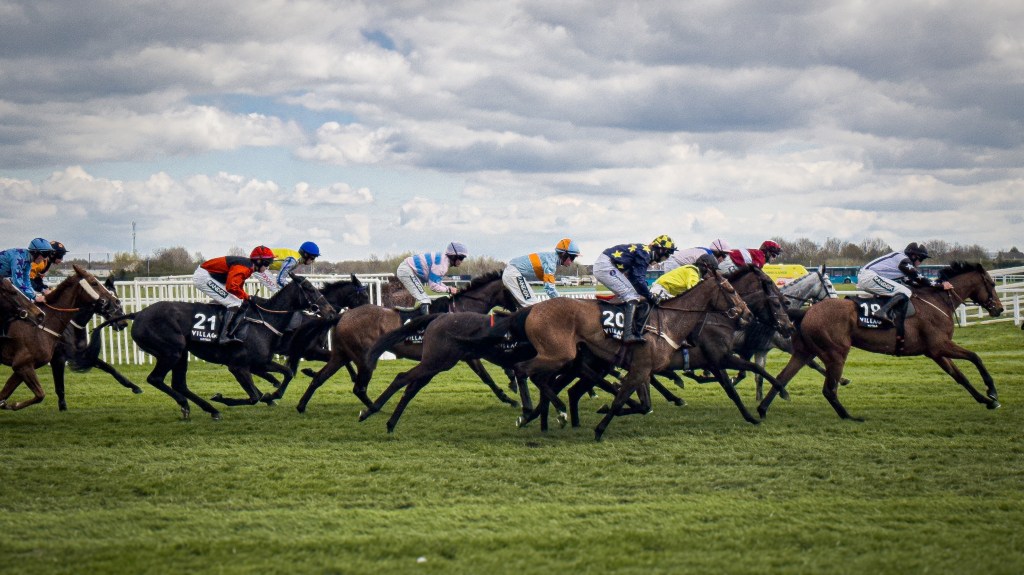
As she loves horse riding, we decided to visit the Grand National, to see ‘real’ horse riding in action. Neither of us had been to horse racing before so I thought it was worth sharing a guide to how to get there and what to do while you’re there.
(And while this year’s race was notable for the animal rights protests, I’ll keep away from the politics of jump horse racing here. This is purely a practical guide to getting around.)
What is the Grand National?
I know the Grand National more as that thing that race that always causes someone to start a sweepstake in the office. It’s nicknamed the People’s Race but it should really be called the Office Sweepstake Race as, for most people, that’s all it is: a sweepstake to win £50 and beat Kevin from Accounting.
In-person, the race is not just one race but a series of races over three days culminating in the Grand National race itself on Saturday evening.
Where is it held?
Aintree, near Liverpool.
How do you get tickets?
Ticket sales start almost as soon as the race finishes. There are different categories. We bought tickets for West Tip, which is a covered stand. On the day, we didn’t need to use the tickets as it was a nice day and we could find good places to stand next to the race barriers but it was good to know that if it had rained, we would have been able to sit in the stand and remain dry.
How did you get there?
We struggled to get accommodation in Liverpool and stayed in Manchester instead. From there, it’s around 45 minutes by train to Liverpool Lime Street station and then only a few minutes walk to Liverpool Central station to change train for Aintree.
Where there long queues?
Not really. Everything is slick and we were on the train within 10 minutes of arriving at the station and, on the way back, we were heading away from Aintree within 20 minutes of joining the queue. Trains run every 7 minutes during the race and for a few hours after it.
What did you do at the racecourse?
First, we binned all our drugs. 😊
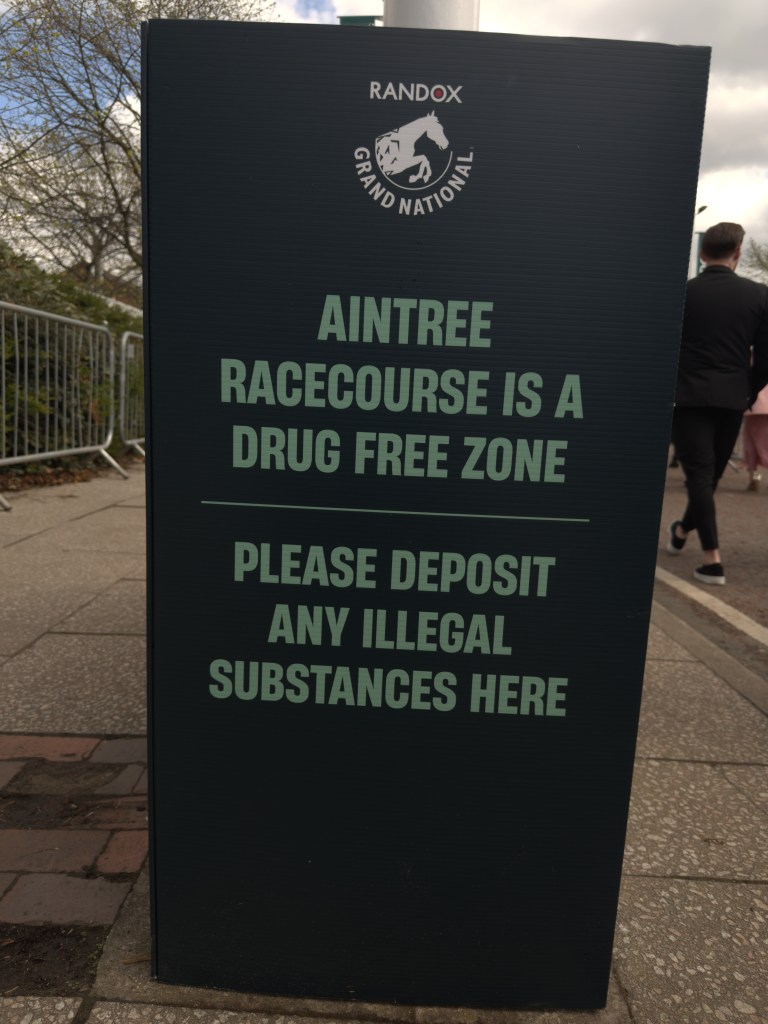
Then we alternated watching the races with checking out the parade ground and placing bets. Due to the number of people at the race course, it’s slow going to move around so leave plenty of time to see everything.
There were a number of good places to watch the race, with options to stand at the barrier near to the jumps. There are also screens for watching the parts of the race you can’t see from the pavilions.
Do you have to dress up?
There’s no dress code so you can wear what you want. I wore jeans and a jumper and looked like a hardcore gambler because there’s eight main types of people at Aintree.
Since I had jeans and a jacket I was a newspaper away from being a hardcore gambler.
What was the food and drink like?
Lots of food vans, loads of bars and prices were not extortiate (though not cheap either). We didn’t buy as we arrived at 1:30 and left at 6 so had already had lunch so I don’t know about quality.
How easy is it to place a bet?
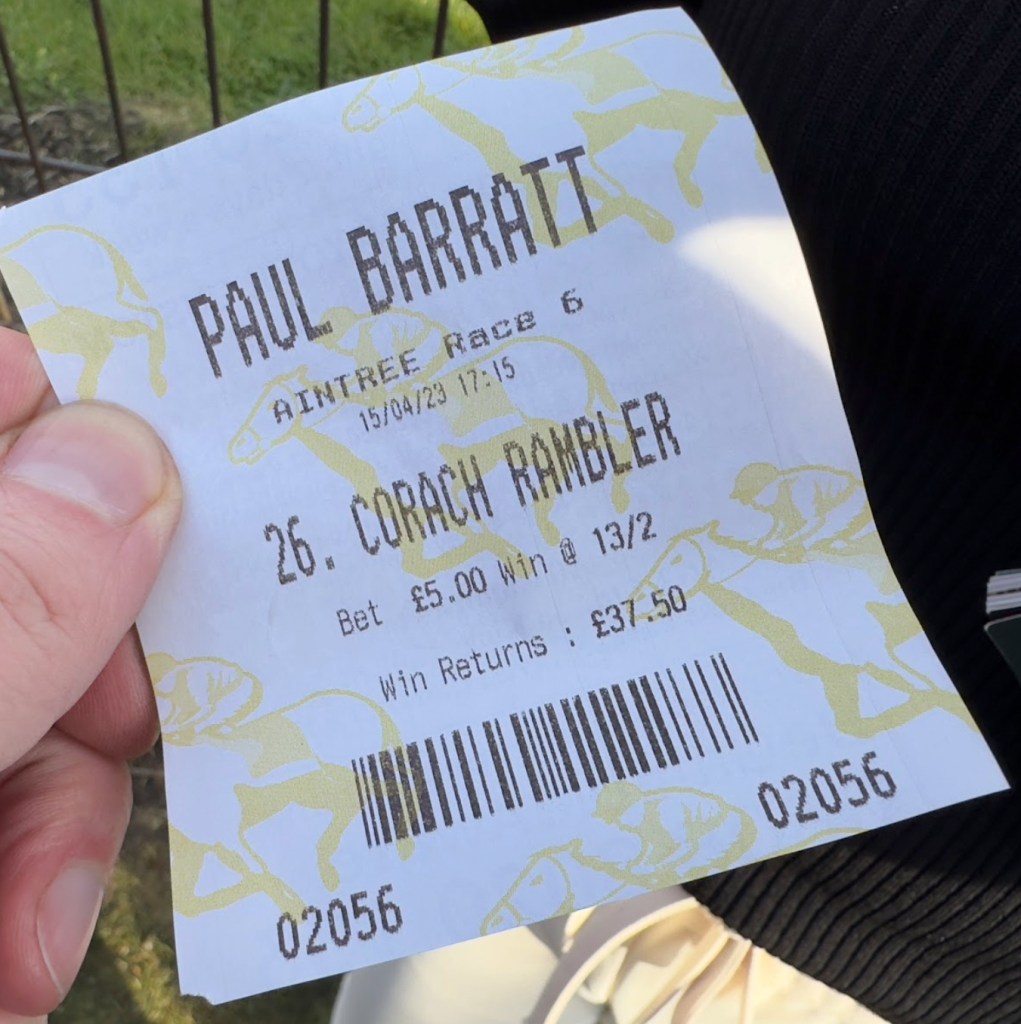
Very. There’s loads of bookies lining the racetrack. If you know what you’re doing, I’m sure there’s loads of options, but for us, we just placed £2.50 on X to win. You got a slip and, if you win, you take the slip back and they paid you in cash straight away.
And did you win?
Yep!
Overall
Politics aside, if you’re thinking of going, then go. It’s good fun, plenty to do, and it’ll give you plenty of chances to see whether a top jockey can also control a thoroughbred with his bahookie.
Every fortnight we cover the best and worst football songs from every club in the UK from our book ‘The Sound Of Football: Every Club, Every Song’. You can buy it here
Dundee United
Nickname: The Terrors (and not The Arabs (see below))
Ground: Tannadice Park
Stadium Capacity: 14,229
Song: Love Is In The Air
For the 2014 Scottish Cup final, then Dundee United player, Ryan Gauld, was treated to a special version on an old classic. ‘Gauld’, sung to the tune of ‘Gold’ by Spandau Ballet, was designed to inspire the Tangerines — and their midfielder — for the cup final against St Johnstone. Sadly, it didn’t work. St Johnstone won, and Gauld left Tannadice soon after in a move to Sporting Lisbon.
It’s sad that the song didn’t catch on as it was another cup final anthem – ‘Love Is In The Air’ that came to define United.
‘Love is in the Air’ has been sung at Tannadice for nearly 20 years. It’s commonly thought to have been adopted by fans during the Scandinavian invasion of the 90s when the club acquired a clutch of players from Norway and Sweden. Back then, in honour of Swedish striker Kjell Olofsson, it was sung as ‘Olof’s in the Air’.
The song achieved tipping point and unofficial anthem status after Dundee United’s famous 1 – 0 victory in the Scottish cup final over Rangers in 1994 – Dundee United’s first ever Scottish cup triumph. And fans – known as Arabs – have been singing it ever since.
Arabs is a strange nickname as the club was originally set up for Irish immigrants. In 1909, a group of immigrants, led by bicycle dealer Pat Reilly, decided to form a new club – then called Dundee Hibernian – as a focus for the local Irish community. It chose an area of Dundee at Clepington Park as a ground for the new club. Pat had one problem. Clepington Park was already used by local side Dundee Wanderers. Undeterred, Pat had a quick word with the landlord and, after agreeing a higher rent, Wanderers was told to live up to its name, and find a new home.
Wanderers was livid. It had been based at Clepinton Park for 19 years only to be evicted by a club with no history, no place in any league and, at this point, no manager. Though Pat Reilly sorted that out too by appointing… Pat Reilly.
In a final act of (understandable) spite, before Wanderers left Clepington Park it dismantled a grandstand and wooden changing rooms along with the fencing which enclosed the ground. Wanderers even removed the goalposts so that all that was left was a grass field. In return, Pat Reilly, changed the name of the ground/field to Tannadice Park (named after the nearest street and entrance to the ground) so that no trace of Wanderers remained.
Today, there are few traces of Dundee United’s Irish origin. The name was changed from Hibernian to United in 1923 and the original green colours were changed first to black and white and then to its current tangerine orange.
While no one knows exactly how the fans got their nickname as the Arabs, the most common reason given is that in the 1960s, after a particularly icy spell, United hired a tar burner to melt the ice on the pitch. However, tar doesn’t just melt ice, it also burnt all the grass beneath.
Undaunted by a lack of a playing surface, United ordered several lorry-loads of sand, spread it around, painted some lines on it, and played several games before the grass grew back. When the team started winning on this unconventional surface it was described as having taken to it like Arabs.
The name stuck and even after the grass returned, Dundee United’s fans started to dress up for big games and cup final appearances. Hence the fans are now ‘the Arabs’ and not the team – and why in Scotland you’ll find Arabs singing a Nordic inspired song.
Buy the Sound of Football from Amazon.


 Twin brothers swimming, cycling and running in Scotland