All posts by Andy Todd

The Sound of Football: Dundee United (Andrew)

Every fortnight we cover the best and worst football songs from every club in the UK from our book ‘The Sound Of Football: Every Club, Every Song’. You can buy it here

Dundee United

Nickname: The Terrors (and not The Arabs (see below))

Ground: Tannadice Park

Stadium Capacity: 14,229

Song: Love Is In The Air

For the 2014 Scottish Cup final, then Dundee United player, Ryan Gauld, was treated to a special version on an old classic. ‘Gauld’, sung to the tune of ‘Gold’ by Spandau Ballet, was designed to inspire the Tangerines — and their midfielder — for the cup final against St Johnstone. Sadly, it didn’t work. St Johnstone won, and Gauld left Tannadice soon after in a move to Sporting Lisbon.

It’s sad that the song didn’t catch on as it was another cup final anthem – ‘Love Is In The Air’ that came to define United.

‘Love is in the Air’ has been sung at Tannadice for nearly 20 years. It’s commonly thought to have been adopted by fans during the Scandinavian invasion of the 90s when the club acquired a clutch of players from Norway and Sweden. Back then, in honour of Swedish striker Kjell Olofsson, it was sung as ‘Olof’s in the Air’.

The song achieved tipping point and unofficial anthem status after Dundee United’s famous 1 – 0 victory in the Scottish cup final over Rangers in 1994 – Dundee United’s first ever Scottish cup triumph. And fans – known as Arabs – have been singing it ever since.

Arabs is a strange nickname as the club was originally set up for Irish immigrants. In 1909, a group of immigrants, led by bicycle dealer Pat Reilly, decided to form a new club – then called Dundee Hibernian – as a focus for the local Irish community. It chose an area of Dundee at Clepington Park as a ground for the new club. Pat had one problem. Clepington Park was already used by local side Dundee Wanderers. Undeterred, Pat had a quick word with the landlord and, after agreeing a higher rent, Wanderers was told to live up to its name, and find a new home.

Wanderers was livid. It had been based at Clepinton Park for 19 years only to be evicted by a club with no history, no place in any league and, at this point, no manager. Though Pat Reilly sorted that out too by appointing… Pat Reilly.

In a final act of (understandable) spite, before Wanderers left Clepington Park it dismantled a grandstand and wooden changing rooms along with the fencing which enclosed the ground. Wanderers even removed the goalposts so that all that was left was a grass field. In return, Pat Reilly, changed the name of the ground/field to Tannadice Park (named after the nearest street and entrance to the ground) so that no trace of Wanderers remained.

Today, there are few traces of Dundee United’s Irish origin. The name was changed from Hibernian to United in 1923 and the original green colours were changed first to black and white and then to its current tangerine orange. 

While no one knows exactly how the fans got their nickname as the Arabs, the most common reason given is that in the 1960s, after a particularly icy spell, United hired a tar burner to melt the ice on the pitch. However, tar doesn’t just melt ice, it also burnt all the grass beneath.

Undaunted by a lack of a playing surface, United ordered several lorry-loads of sand, spread it around, painted some lines on it, and played several games before the grass grew back. When the team started winning on this unconventional surface it was described as having taken to it like Arabs.

The name stuck and even after the grass returned, Dundee United’s fans started to dress up for big games and cup final appearances. Hence the fans are now ‘the Arabs’ and not the team – and why in Scotland you’ll find Arabs singing a Nordic inspired song.

Buy the Sound of Football from Amazon.

Celtman 2024

I’m part of a lottery syndicate at work. We don’t win much but what we do win we put aside and spend on a Christmas lunch for everyone. Some years it covers the starters, others it’ll cover a turkey and all the trimmings. We have never had a year when it’s covered a bottle of champagne to celebrate, we’ve never been big winners.

But, other that that, I’ve never won anything. No spot the ball contests, church raffles or multi million pound payouts. Nothing, that’s all I’ve got, until last week.

And what did I win?

Pain. And suffering.

Which are not prizes anyone wants to win. A speedboat is a great prize. Money is a great prize. No one enters a competition and hopes to get hurt. Except me.

Everyone who takes part in the Celtman Solo Point Five race is automatically entered into a draw* for the opportunity to enter the Celtman full race next year. 25 places are available and a random draw takes place after the race to offer 25 entrants a place in Celtman. And I won.

Or lost.

Because now I have a year to train for Celtman and to try again and win a blue or white t-shirt through 4k of swimming, 120 miles of riding and a marathon over a mountain.

And yet the losers of this competition get to put their feet up.

It doesn’t seem fair! 🙂

But, Andrew TwinBikeRun, you say, you don’t have accept the place. It’s not compulsory.

That’s true, but where would be the fun in that?!?

Celtman 2024 entered!

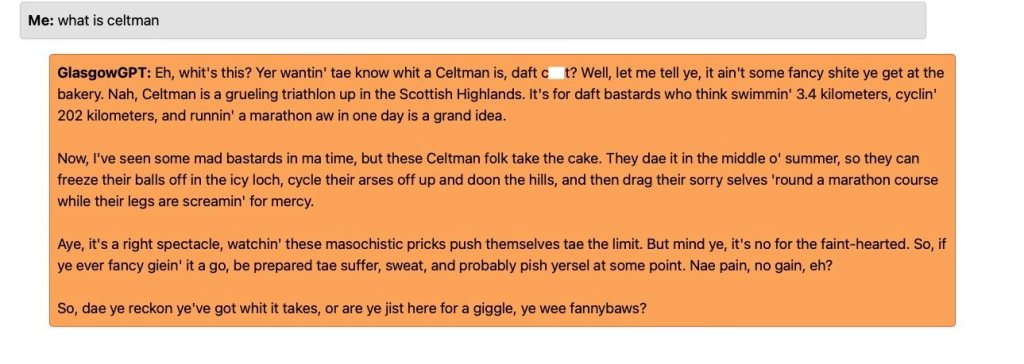
*The draw was conducted by ChatGPT and the AI selected 25 people randomly from the Solo Point Five entrant list. I’m glad the organisers used ChatGPT and not GlasgowGPT as the very sweaty Glasgow AI describes Celtman as this:

The Sound of Football: Dundee (Andrew)

Every fortnight we cover the best and worst football songs from every club in the UK from our book ‘The Sound Of Football: Every Club, Every Song’. You can buy it here

Dundee

Nickname: The Dark Blues

Ground: Dens Park

Stadium Capacity: 11,506

Song: Up Wi’ The Bonnets

In 2008, Scottish comedy legend, and Glasgow born comedian, Billy Connolly, caused controversy when he claimed in The Scotsman newspaper that people from Edinburgh were just not funny.

I don’t know why. I think it’s about immigration, because I don’t find Edinburgh people all that funny,” he said. “They’re very interesting and nice, but you wouldn’t point to funny as being one of their features.” 

Billy must have been deliberately provocative because as a stand-up and folk singer in the sixties and seventies he would have shared stages with one of the greats of Scottish comedy, an Edinburgh comic called Hector Nicol. And he would have thanked Hector, because, without Hector, Billy would not have had a stand-up act – Nicol was one of the first comics to introduce blue material to his routines.

Hector wasn’t just famous as a comic, he was also an actor and, before his death in 1985, he was a regular on Scottish screens in the soap series Take The High Road, which was like a Scottish Emmerdale Farm, or Emmerdale Croft. But Nicol’s lasting legacy was not his jokes or his performances but his songs. Hector was a prolific song writer for football clubs.

For Hibernian he wrote ‘Glory Glory To The Hibees’, a song and tune ‘borrowed’ by Manchester United today, for Hearts he wrote ‘The Hearts Song’. He also wrote ‘The Terrors of Tannadice’ for Dundee United and ‘Up Wi’ The Bonnets’ for Dundee.

Ironically, Nicol, despite his east coast home, was actually a fan of St Mirren, based in the west coast in Paisley, the town where he was born – though he never, as far as we know, wrote a song for them.

‘Up Wi’ The Bonnets’ sings of the pride fans feel at watching the players play in its traditional blue shirts.

You can sing of your glories of teams you have seen,

like the Saints and the Dons up in old Aberdeen,

but in all this wide world there’s just one team for me,

that’s the brave(bold) boys who wear the dark blue of Dundee

(Source: Hector Nicol)

But although Dundee’s best days are behind it, as the 21st Century has seen the club yo-yo between the SPL and the lower leagues while battling financial problems, its greatest moment came in 1961 when Bob Shankley (brother of Liverpool’s Bill) led Dundee to its one and only league title. The title winning team is commemorated in the final verse and is remembered before every home game as the team walk out to Nicol’s song:

For there’s Robertson, Penman and Alan Gilzean,

with Cousins and Smith there the finest you’ve seen,

a defence that is steady heroic and sure,

Liney, Hamilton, Cox, Seith and Wishart and Ure

(Source: Hector Nicol) 

Buy the Sound of Football from Amazon.

Race Report – Celtman Solo Point 5 – Part 2/2 (Andrew)

Last week I covered registration, the swim and my challenge not to come last. How did I get on? Well…

Cycle

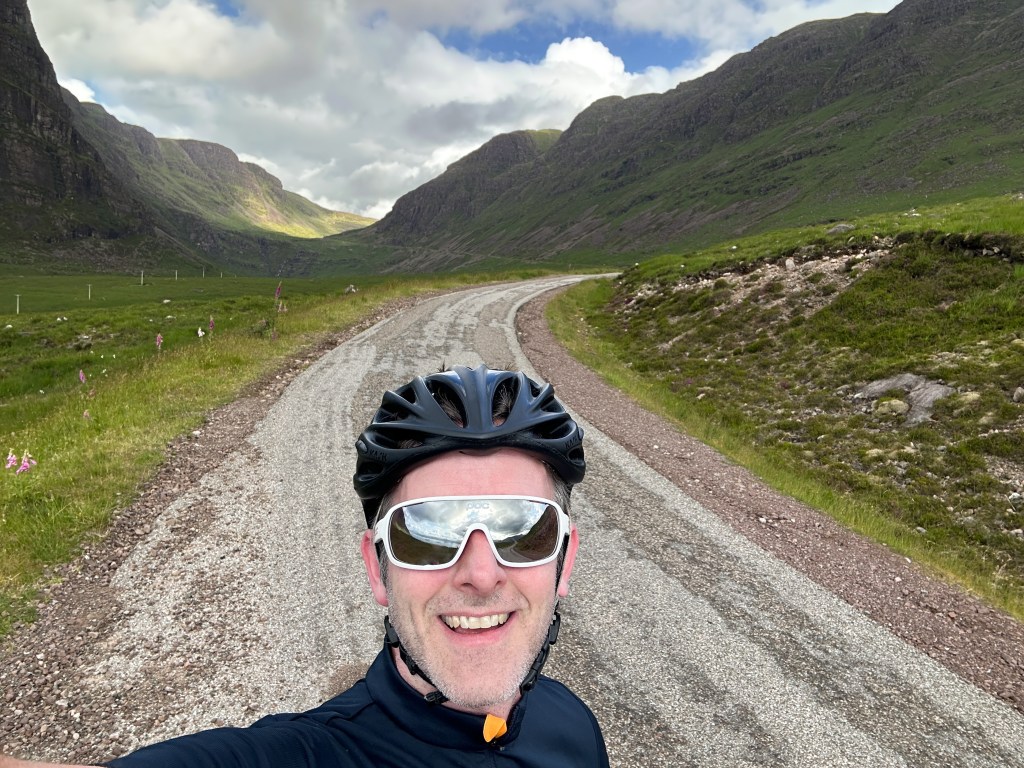
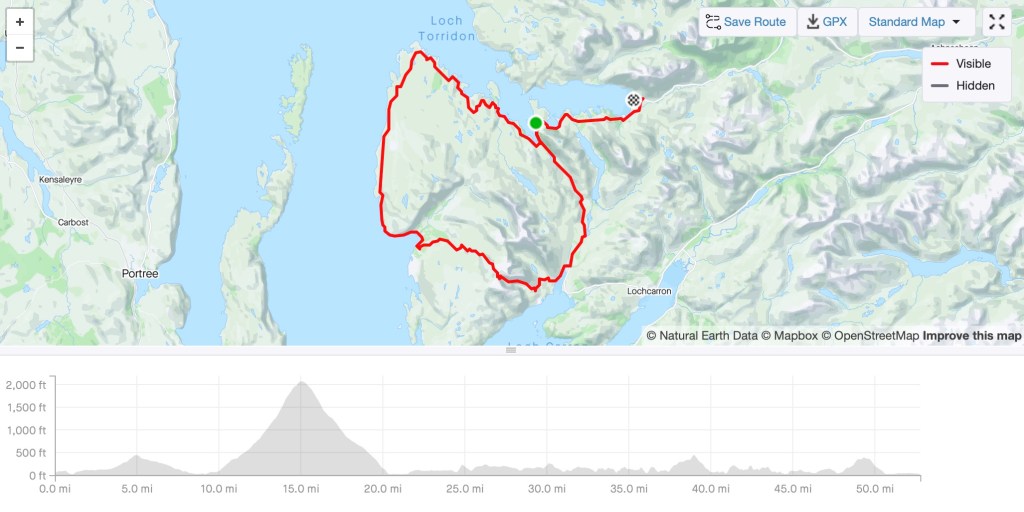
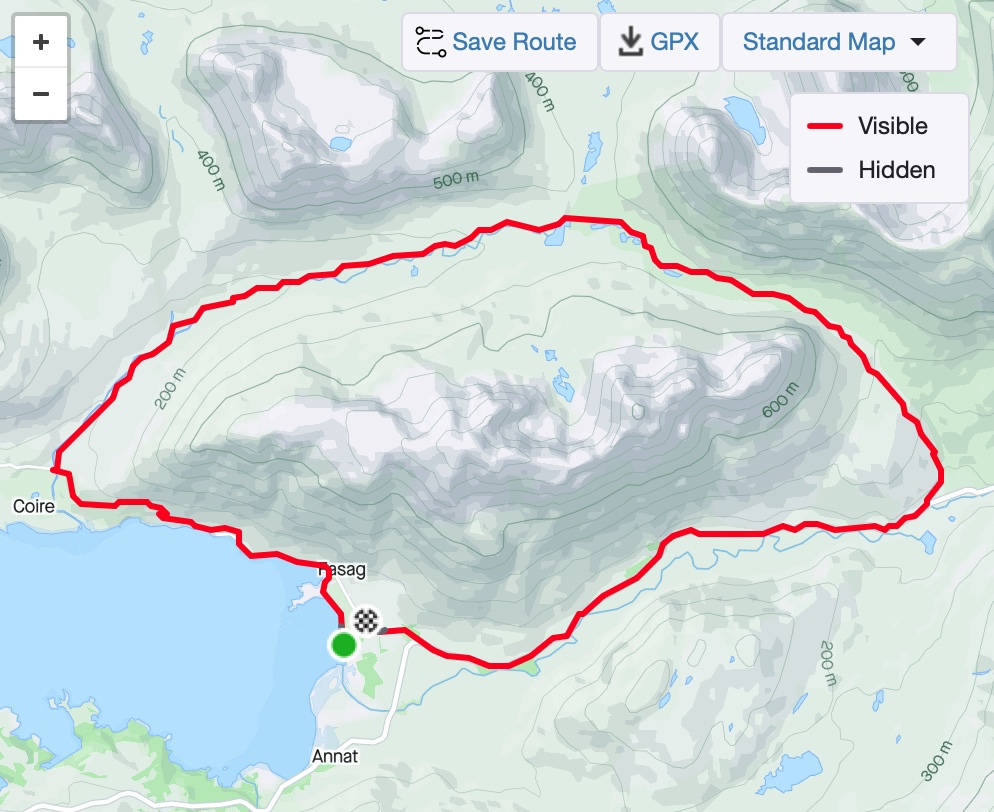
The cycle route is 54 miles from Sheildag , around the Applecross peninsula and back to Torridon. It involves more climbing than the full Celtman course and includes the famous Bealach na Beag mountain pass. The UK’s highest road and one of the few roads in the UK with Alpine like switchbacks.

But it wasn’t the climbing that I was worried about, it was the descent. I hate cycling down the Bealach to Applecross. A few years ago, a friend fell off the road and broke their shoulder, collarbone and wrist. Admittedly, they’d not checked their brakes before cycling but it has put me off cycling there ever since.

It was raining as we left Shieldag for an eight mile stretch to the bottom of the Bealach. This was a good warm up to get blood pumping into the legs before the harder climbing begun.

I’d cycled it a few days earlier (one of my three outdoor cycles this year, see last week’s entry) so I knew what to expect. A steady climb and then an equally steady descent to the Bealach.

The rain stopped as the climbing begun and while clouds were down, and there was no view once we got to the two thirds point. The road is closed to traffic so it’s good to just put your head down and grind your way up the road knowing there’ll be no traffic coming in the opposite direction.

The first half of the climb is fairly easy, the second half ramps up. I was slow but steady all the way up and my hours on Strava had left some strength in my legs. Who says computer games are bad for you?

On the way down, I kept my brakes on for most of the descent and the squeals from my wheels sounded like someone had just jumped after seeing a mouse all the way down to Applecross.

The next section of the race, around the peninsula, has more climbing than the Bealach, but is spread out over more miles. I’ve cycled the route before so knew what to expect but if you’ve not done it then it can be tough to find you’re going to climb more on what should be a flat section than you do on the climb. But that’s the west coast of Scotland for you. There are no flat sections. Everything is up and down.

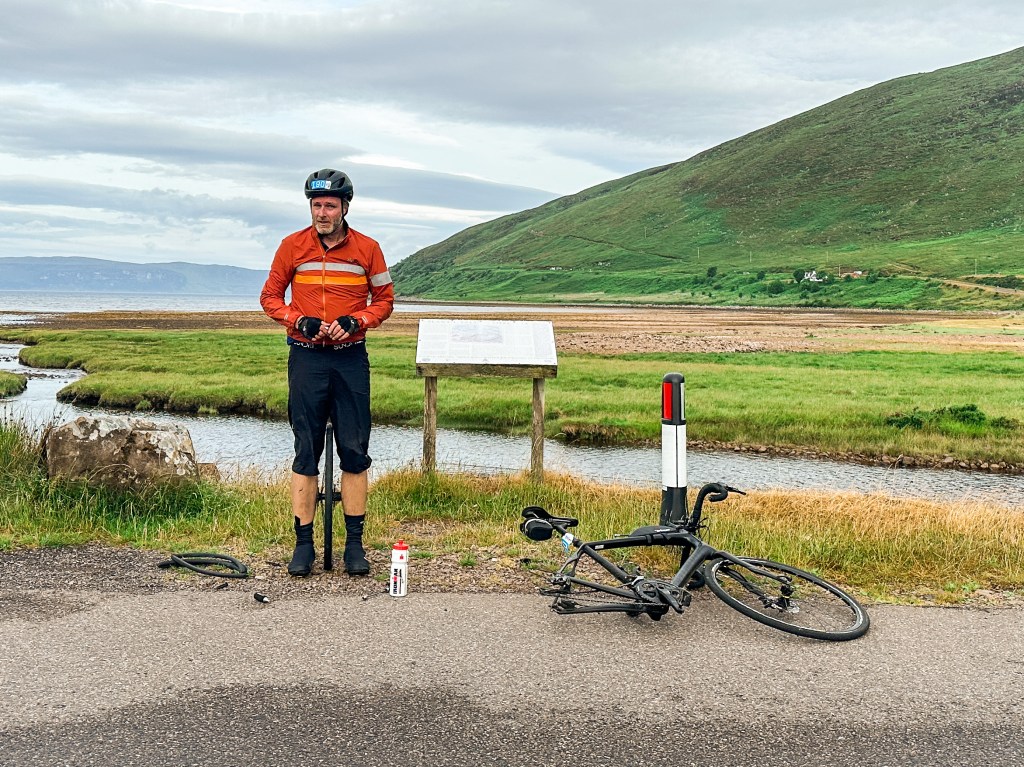
On this section, Iain TwinBikeRun punctured twice. He asked if I had a spare tube but as I use a tubeless tyre, I’d already taken it out of my seatbag. His race was over, he had to call his wife to collect him so I thought like the concerned good brother that I am: “haha, well, after that, at least he’ll be last!”

I was wrong.

I finished the cycle without ever pushing myself too hard. As soon as I hit a hill I dropped to the lowest gear and worked my way slowly up it. I didn’t see anyone until the last five miles. Between waiting for Iain and taking my time on the bike, the race was now taking place ahead of me.

At the run, I texted Iain TwinBikeRun to say he should pick up his kit and run with me. He could catch me at transition.

Run

That’s if I could find transition as I almost immediately got lost when leaving Torridon.

I don’t know how I did it but I was running along a road when everyone else was on a track. I saw a runner, he shouted I was running the wrong way and I climbed a bank of heather to join the track he was on only… to get lost again.

I came off the track at a point I thought it joined the road. It didn’t. But I didn’t know that as I climbed from the shore up through the forest at the site of Torridon and to the transition into the lower route around Ben Eighe.

Except I came to the transition after the exit to Ben Eighe, which I knew couldn’t be right. You had to go to transition and then go to the exit. You didn’t go to the exit first.

Again, I was lost. The Marshalls helped by contacting the organisers who confirmed I should keep going. I wasn’t the only one who’d taken a wrong turn.

Iain TwinBikeRun on the other hand had taken the right way and had caught up with me. We were able to leave transition together.

The lower level route had a cut of time of eight and a half hours from staring the race. 1:30 pm after a 5am start. Our aim was to make the cut off. After that, there was no time limit to reach the end.

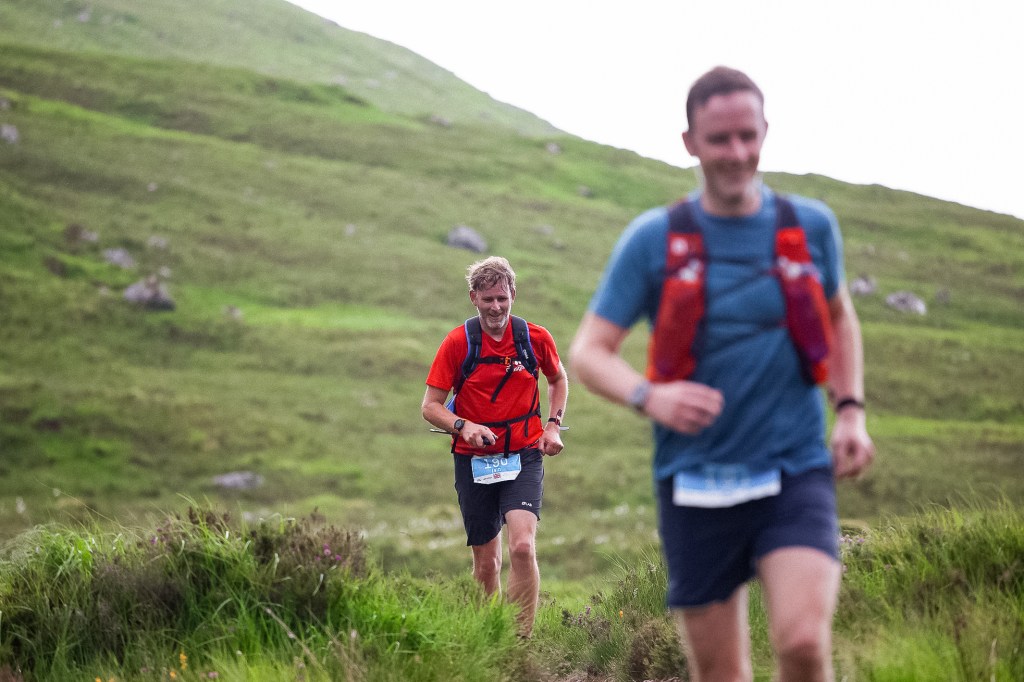
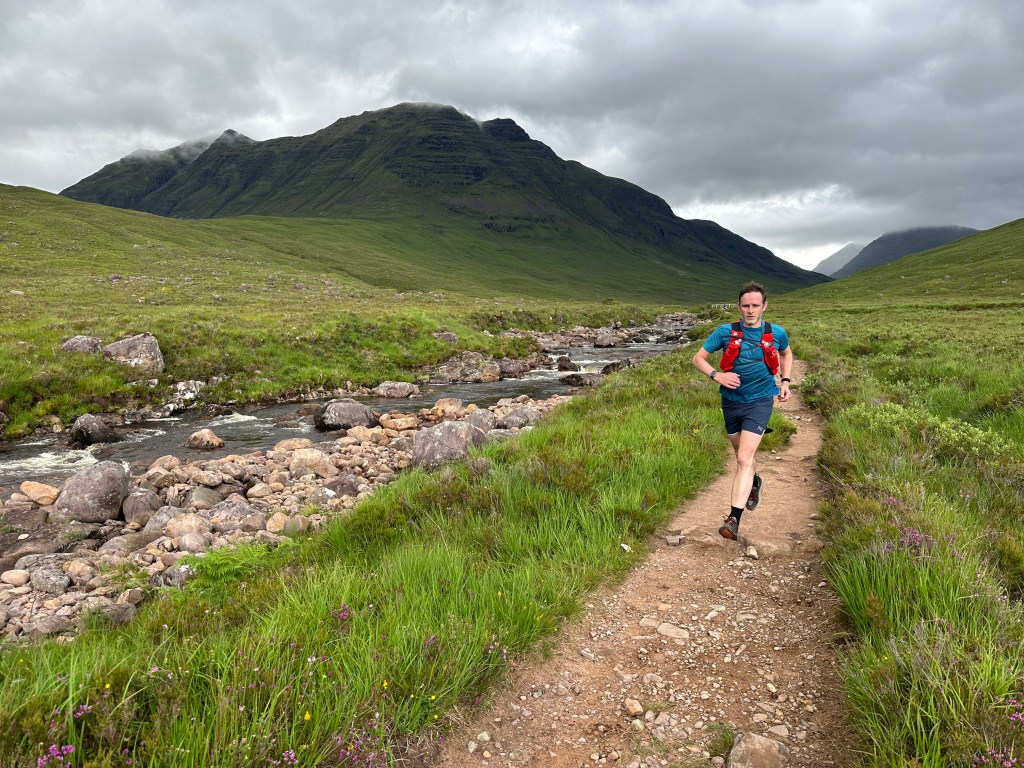
We ran most of the downhill stretches, some of the flats and walked the uphill. There was some rain but it was largely dry and conditions underfoot were okay.

We saw a few other competitors the course ahead of us, and knew of one behind, who’d been at transition.

What we didn’t know was that these were the last competitors, we were competing for the wooden spoon.

But first we had to make the cut off.

We thought the cut off was 10 miles into the race. This was a mistake. It was actually 12 miles. That meant we had to run all the way down the final descent to get in at 1:26pm. We thought we had more time as the distances were shorter, but we should have checked that more carefully before we started.

Having run the last part, we then walked into the finish, another three miles to Torridon. We might have run but it was straight into a headwind and we wouldn’t have run much faster than we were walking.

The finish line

At the finish we broke into a run and I finished ahead of Iain by a few seconds. I’d made it. I’d achieved my goal. I wasn’t last. Iain was behind me, and even if he wasn’t DNF’d for failing to finish the cycle leg, there was at least one of other person behind me. Result.

Until we got the results and Iain was timed ahead of me! He was fifth last, I was fourth last. The b****ard!

Overall

A cracking challenging race in one of the most beautiful parts of Scotland. Definitely worth checking out if you fancy an extreme triathlon. But I would recommend that, unlike me, you actually get a full training programme behind you before you start.

Race Report – Celtman Solo Point 5 – Part 1/2 (Andrew)

I was nervous. I’m usually nervous before a race but these nerves were different. These were based on a lack of training rather than a fear of the unknown.

It’s okay to be scared of the unknown. Who knows what might be there? I’ve seen the film ‘Get Duked’, the Highlands are filled with lairds shooting tourists for fun .Who’s to say the local lord wasn’t going to pop out with his shotgun and shoot triathletes like grouse?!?

But to be scared due to lack of training is not okay because the fear is entirely self inflicted. Like taking a shower in the laird’s house without asking and then using all his best towels while singing “I’m the King of the Castle, you’re the dirty rascal!” Of course he’s going to react. Who wouldn’t?!?

But my lack of training wasn’t entirely self-inflicted. I hurt my toe in Easter and couldn’t run for three weeks. I then picked up a chest infection which kept me out of action for another three weeks before hurting my chest and losing another two weeks. I’ve lost more time than a careless Rolex salesman.

In the last two weeks I finally had a run of days to train for the race and managed to run four times, cycle four times and swim twice. 10 training sessions. None longer than an hour. And I was then taking part in Celtman Solo Point Five, the ‘Baby Celtman’, a middle distance triathlon based around the Applecross penisula on the west cost of Scotland.

So, naturally, I was nervous until I had a simple thought. It went like this. “How will I do?” I said to myself. “Awful,” I answered positively but realistically. “Oh come on,” I said, “it can’t be that bad, at least I won’t come last!” And with that thought I had a goal. I wouldn’t come last. Second last maybe. But not last.

And how did I do? Well, let’s just say if they had a gold, medal and silver for the last three places then I just missed the loser’s podium. (I was fourth last).

But let’s start at the beginning…

Registration

Registration is open on Thursday PM and all day Friday in a hall in Torridon. It’s easy to find and everyone is friendly and helpful. You need to bring certain mandatory run equipment (such as a waterproof jacket, hat, gloves, food, waters, first aid etc) and these are checked to make sure they are suitable for the race. Having run the route before as part of supporting last year’s Celtman I know how horrific the weather can be for the run route. So, I’d brought two versions of everything. A run jacket for normal rain, the one I’d run around Glasgow wearing. And an industrial waterproof jacket for working on a trawler in a storm in a tidal wave. That way I could use either depending on the forecast. Luckily, while the forecast was for rain, it was to be mild rather than biblical.

The Celtman ‘shop’ was also open in the hall so you can buy your Celtman merchandise. I bought a t-shirt which had the slogan “If you get lost, you’re a moron.”

Little did I know how accurate this t-shirt would be… more on this in part 2 next week.

Swimming

The swim route starts in Shieldag and requires you to swim round an island and back. Some warm weather over the last few weeks meant the sea swim was warm, with temperatures around 16 degrees. This also meant the water was suitable for jellyfish and there were plenty around the northern end of the island. I tried to swim further out to avoid them, which worked, but I couldn’t avoid all of them and I just had to bat them away while swimming.

The swim start is early – 5am – and you need to drop off your run bag, set up your bike transition and collect your tracker before hand. Everything is nearby and, if you stay in Shieldag, it didn’t feel too early a start after a 9pm bedtime on Friday night.

However, if you are driving then, while there is plenty of car parking, it’s at the other end of the village so you will need to park, walk to the transition and pick up points and factor in the time to then walk back to the swim start.

Again, everything is well organised and it’s always clear what you need to do and where you need to go.

But what about the jellyfish, are they as bad as people say?

Celtman is famed for its jellyfish and a lot of people are worried about swimming among them and getting stung. For most of the race I would have said “don’t worry, they’re annoying but you soon get used to them. They’re only around for a few minutes of the race and most of the time the waters are clear and calm.”

And then, on the way back to shore, with around 200 metres to go, I was stung by one of the [expletive deleted]!

AAAAAAAaaaaaRRRRRRrrrrGGGGGGGGHHHHHhhhhhHhhHHHHH!

Like getting a whip to the face from Indiana Jones.

The bloody [expletive deleted]!

And I could feel it for the rest of the face. A burning across my cheeks and mouth.

And while it wasn’t painful, it was annoying, and I can’t say I enjoyed it. So, if you don’t fancy the idea of jellyfish then other races are available… 🙂

And did you come last?

Not yet. I was happy with a steady swim around the island and a time of c45 minute.

And, as usual, even though we weren’t swimming together, I ended up climbing onto the shore just 10 seconds ahead of Iain TwinBikeRun. We must have been swimming the same speed all the way round.

A decent start but last place was still in my grasp as the next stage was going to be only the third time I’ve cycled outdoors in the last year. Would injuries, illness and a training program entirely based in Strava help me keep pace with the leaders? No chance.

For the rest of the race, come back next week.

The Sound of Football: Dumbarton (Andrew)

Every fortnight we cover the best and worst football songs from every club in the UK from our book ‘The Sound Of Football: Every Club, Every Song’. You can buy it here

Dumbarton

Nickname: The Sons

Ground: Dumbarton Football Stadium

Stadium Capacity: 2020

Song: High Tension At Boghead

Britpop was responsible for more crimes against humanity than the entire world conquering efforts of the Injustice League (including, but not limited to, Robo-Armageddon; Monkey Apocalypse; and numerous attempted uses of a Devastating Doomsday Device). And, the biggest villains of all, Britpop’s Lex Luthor, was Scottish band The Supernaturals.

The Supernaturals was a prolific band. They wrote more than 100 songs in five years. But, remember, being prolific is not a good thing – diarrhea is prolific. In 1998, however, they hit the jackpot. They wrote the one song that meant they would never need to work again. That song was ‘Smile’. Google it. It’s infectious, I’ll give you that, but, then again, so is diarrhea.

We think ‘Smile’ sounds like a thousand screeching chalkboards cutting through our souls. It’s the calculated sound of a man wiping his hands on your ears after going to the toilet even though he has a towel in his hands. It is utterly and truly ghastly. But we’ll forgive The Supernaturals because they released the greatest football song of all time: ‘High Tension At Boghead’.

‘High Tension At Boghead’ was a B-side to their 1997 single Prepare To Land. It’s an Arab Strapesque tale of life and memories in the third division at Dumbarton’s historic home, before its old home was sold for re-development as brand new homes. It’s really rather wonderful.

Dumbarton also have the honour of being one of the few clubs to reach a cup final song however, unlike every other club, Dumbarton released theirs, not for reaching a Scottish Cup final, but for the 1978 World Cup finals. In 1978, caught up in World Cup fever, the Dumbarton Squad were roped into a recording session with Midge Ure to record a World Cup song for EMI America entitled ‘Hey Argentina’. However, just like Scotland (see Ayr United), it flopped.

Buy the Sound of Football from Amazon.

Celtman Solo Point Five (Andrew)

This Saturday I’ll be getting up at 3am to take part in the Celtman Solo Point Five race around the Applecross penisula on the west coast of Scotland.

It is meant to be a triathlon. But, with the 3am start, as bags have to be dropped off with organisers by 4am, it should have an extra leg of “Getting Up In The Middle of Night” alongside the traditional swim, bike and run.

I say “getting up in the middle of the night” but as the race takes place two days after the shortest day of the year, it’s likely to still be light at 3am. No wonder the organisers haven’t included a head torch as mandatory kit for the run, it won’t even be needed at midnight.

Celtman Solo Point Five is a middle distance extreme triathlon with a sea swim in Shieldag, a challenging 56 mile cycle around the peninsula (and up the Bealach na Ba) and a trail run along part of the Celtman run course and around Ben Eighe.

The race has come after a spell of illness and injury including six weeks of not being able to do anything, so it’s very much a case of turn up and see how far I can get round. It will be slow. There are cut offs to watch out for – and I need to make sure I don’t injure myself again.

The forecast is looking decent, with some rain forecast, but a tail wind for most of the bike course, which would be much appreciated by this injured competitor.

Two days to go, can’t wait.

Find our more about the race here: Celtman Solo Point Five

The Sound of Football: Doncaster Rovers(Andrew)

Every fortnight we cover the best and worst football songs from every club in the UK from our book ‘The Sound Of Football: Every Club, Every Song’. You can buy it here

Doncaster Rovers

Nickname: The Rovers

Ground: Keepmoat Stadium

Stadium Capacity: 15,231

Song: Walking Out Of The Darkness

In 1991/92, FA Women’s Premier League side Doncaster Rovers Belles won the Women’s FA Cup and the national woman’s league without losing a single game. The men’s side (who should really be Doncaster Rovers Beaus) cannot boast of similar success – it’s never won the top division, the FA Cup, or remained unbeaten throughout an entire season.

While this has meant that the men’s side has never had the opportunity to release an FA Cup final song, the Belles did, recording ‘Northern Pride’, the first ever female FA Cup song in 1992.

‘Northern Pride’ is not the only musical achievement from Doncaster. In August 2013, former One Direction star Louis Tomlinson fulfilled a childhood dream by ‘signing’ for the team as a non-contract player. However, having US number one hit singles doesn’t guarantee Rovers will play any of One Direction’s song. The team already had a fan with an American number one song. Rovers fan John Parr is better known as a singer songwriter whose greatest hit was the 1985 US number one single ‘St Elmos Fire (Man in Motion)’.

The song ‘St. Elmo’s Fire (Man in Motion)’ appeared on the soundtrack of the film of the same name. But it was not inspired by the film, instead the song tells the story of Canadian athlete Rick Hansen.

Rick was 15 when he was paralysed from the waist down. After he was injured he excelled at wheelchair sports, especially long distance races, winning 19 international wheelchair marathons. To raise money for spinal injury research Rick set out to circle the world in his wheelchair. It was a journey of 26-months and 40,000 km through 34 countries and he successfully raised $26 million. The lyrics in the song reflect his journey.

Despite the success of the song, it never appeared on a John Parr album, only on the official film soundtrack. Another song which doesn’t feature on any of his official albums is ‘Walking Out Of Darkness’, which he recorded especially for Doncaster Rovers. Unlike ‘St Elmo’s Fire (Man in Motion)’, ‘Walking Out Of Darkness’ has never been number one in the US charts.

John was inspired to write the song when Doncaster Rovers reached the final of the Johnstone’s Paint Trophy in 2007. He wanted to tell the story of the club and how it had transformed itself. Only a few years earlier, Doncaster Rovers had almost been relegated from the conference league but had now reached a final and built a brand new stadium. It too has walked out of the darkness…

The B-side to the song is called ‘Dream On’ and is a tribute to Doncaster Rover’s greatest player – Alick Jeffrey.

Alick was a young player who was described by Jackie Milburn, the former Newcastle United and England forward, as: “This boy has everything. He is by far the best youngster I have ever seen“. Unfortunately, a bad leg break in an England international game when he was 17 curtailed his talent. He went onto play for Rovers but never reached the heights of the game that he should have. The street next to the stadium is named in his honour – Alick Jeffrey Way.

‘Walking Out Of The Darkness’ is played at every home game when the team walks out. Ironically, the tunnel is very well lit.

Buy the Sound of Football from Amazon.